Ever noticed a groaning or whining sound when you turn the steering wheel, especially when parking? That’s often the first tell-tale sign from your power steering pump, indicating its fluid level is running low. Don't ignore it.
Topping up the fluid is one of the simpler maintenance tasks you can perform, and it’s absolutely vital for the health and longevity of your steering components. A few minutes spent under the bonnet now can save you from a seriously expensive power steering pump replacement down the line.
Why Power Steering Fluid Is Your Steering System's Lifeline

Think of power steering fluid as the hydraulic muscle doing the heavy lifting for you. This specialised fluid operates within a sealed, high-pressure system, transferring force from the steering wheel to the steering rack, which in turn moves the car’s front wheels. Without this hydraulic assistance, every turn would feel like a workout.
When the fluid level drops, you're not just losing convenience—you're compromising the health of the entire system. The fluid acts as both a lubricant for all moving parts and a coolant for the hard-working power steering pump. Running it low introduces friction and excessive heat, two things that will quickly destroy the delicate internal components of the pump and rack.
The Real Cost of Neglect
Ignoring that warning whine isn't a minor oversight; it has real consequences. Here in the UK, where there are over 32 million cars on the road, you might be surprised to learn how often steering issues crop up during an MOT.
Believe it or not, power steering problems are a top 10 reason for MOT failures, tripping up roughly 4.5% of vehicles tested each year. That translates to over 1.4 million cars failing their annual test due to steering faults—many of which started as a simple case of low or old fluid.
This really hammers home how important a quick check can be. Learning how to top up power steering fluid could easily save you between £150 and £300 on what a garage might charge to replace a burnt-out power steering pump. For a closer look at the market, you can find more in-depth data on the UK lubricants industry.
Ultimately, knowing how to maintain your power steering fluid is about more than just silencing a noise. It’s smart, preventative maintenance that keeps your car's steering system safer, more reliable, and cheaper to run. A small task with a huge payoff.
Choosing the Right Fluid and Gathering Your Tools
Before you even pop the bonnet, a little preparation is essential. Selecting the correct components is the key to protecting your steering system from some seriously expensive damage.
Luckily, you only need a few simple items for the job: a clean, lint-free cloth, a funnel to avoid messy spills, and a pair of protective gloves. But the most crucial item on your list, without a doubt, is the correct power steering fluid. Using the wrong type is one of the most common—and costly—mistakes a DIY mechanic can make.
Why the Right Fluid Matters
Modern cars are incredibly particular about their hydraulic fluids. A power steering system is a high-pressure circuit, filled with delicate seals, O-rings, and precision-engineered valves. Pouring an incompatible fluid in there—say, a mineral-based fluid into a system designed for a synthetic one—can quickly cause the seals to swell or degrade. This leads to internal and external leaks, and eventually, a failed power steering pump or steering rack.
The colour of the fluid can sometimes offer a clue. You might see red fluid (often an Automatic Transmission Fluid or ATF) or others that are clear or amber. However, this is not a foolproof method. Never, ever guess based on colour alone.
The only way to be certain is to find the exact fluid specification recommended for your vehicle. Your owner’s manual is the definitive source of this information. An even quicker method is to use a number plate lookup tool online. This instantly matches your specific make and model to the right product, giving you complete peace of mind. You can explore a wide range of quality power steering fluids that meet all the necessary manufacturer specifications.
By gathering these few items—and most importantly, the correct fluid—you'll ensure the job gets done right the first time. It’s a small step that safeguards your car’s steering components for thousands of miles to come.
A Practical Guide to Topping Up Your Power Steering Fluid
Right, let's get to the practical part. Learning how to top up power steering fluid is a straightforward job, and there’s genuine satisfaction in understanding how to service your own car. Don’t worry about confusing jargon; I’ll walk you through it with simple, clear guidance.
First things first, park your car on a completely level surface. This is a must for an accurate fluid reading, as any slope will cause the fluid in the reservoir to sit at an angle, giving you a false reading on the dipstick. As for whether the engine should be hot or cold, that depends on the manufacturer, so a quick flick through your owner's manual is the best place to start.
Next, you’ll need to pop the bonnet and locate the power steering reservoir. This is a small, often translucent plastic container with a cap that has a steering wheel icon or the words "Power Steering Fluid" on it. Before opening it, grab a clean, lint-free cloth and give the cap and the surrounding area a good wipe. This tiny step is crucial—it stops any dirt or grit from falling into the reservoir and contaminating the entire hydraulic system.
Checking and Adding Fluid the Right Way
Once the area is clean, unscrew the cap. Most caps have a dipstick attached. Pull it out, wipe it clean with your cloth, then re-insert it fully and remove it again. This gives you a proper, accurate reading.
You’ll see markings on the dipstick, usually with ‘HOT’ and ‘COLD’ lines. The fluid level should correspond to the engine's temperature at the time of checking.
This image shows the essential kit you'll need to get the job done cleanly and safely.
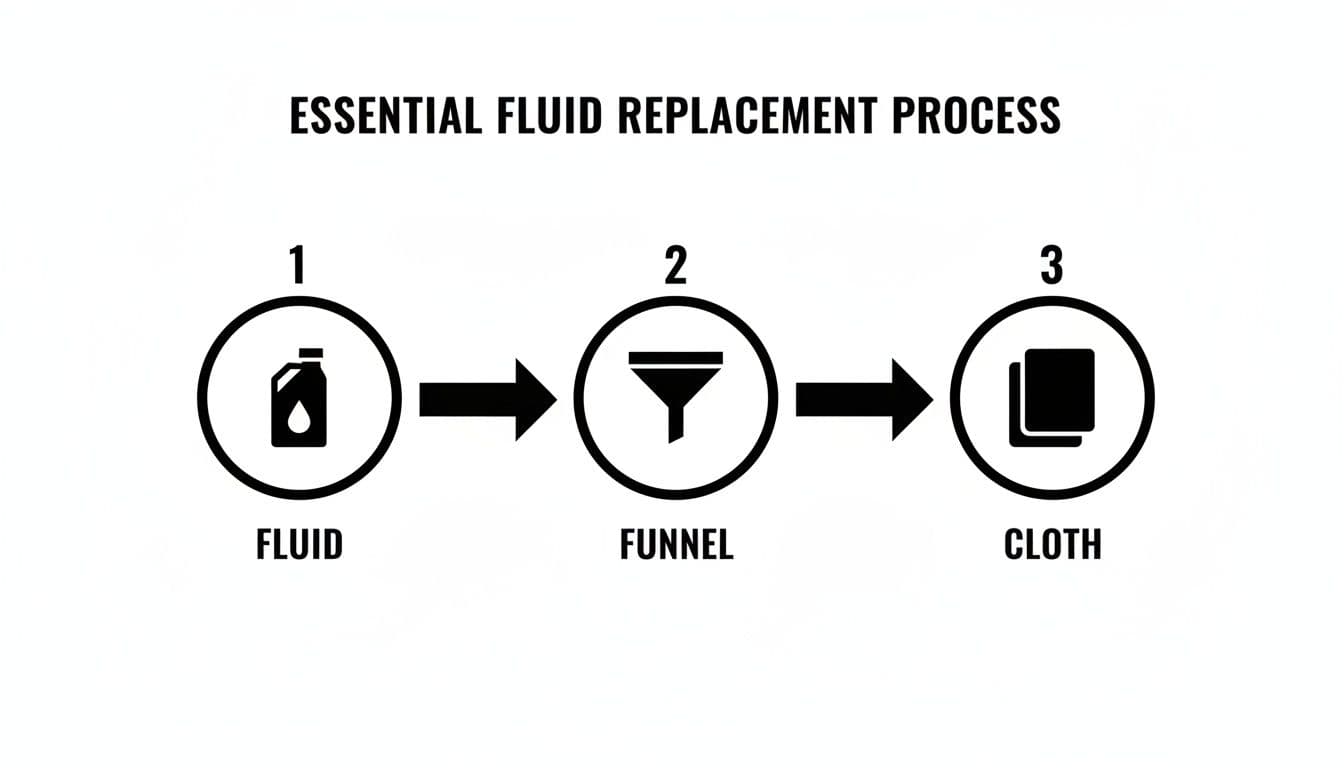
Having the right fluid, a good funnel, and a clean cloth ready makes the whole process much smoother and helps you avoid common mistakes.
If the level is low, it’s time to top it up. This is where a lot of simple DIY jobs can go wrong. In fact, mishandling lubricants contributes to 12% of warranty claims at trade garages, which is a seriously costly statistic. To avoid spills and contamination, always use a funnel. If you need one, you can find a whole range of funnels and other useful gear in our selection of fluid transfer tools.
Pro Tip: Pour the new fluid in very small amounts. It's far easier to add a little more than it is to try and remove any excess fluid. Add a small amount, re-check the dipstick, and repeat until you hit the correct fill line.
Overfilling is a classic mistake. Excess fluid has nowhere to go when it heats up and expands. This can increase system pressure, cause the fluid to foam (aeration), and potentially damage seals, leading to new leaks. By going slowly and checking as you go, you’ll nail the perfect top-up every time.
What to Do After You Top Up The Fluid

Simply adding fluid isn't the end of the job. To finish properly, you need to circulate the new fluid and purge any trapped air from the system. This process, known as 'bleeding', ensures your steering feels smooth and responsive right away, not spongy or noisy.
It’s an easy last step. With the reservoir cap still off, start the engine and let it idle. Now, slowly turn the steering wheel all the way to the left until it stops, then all the way to the right. Do this a few times, from lock to lock.
You might hear a slight whining or groaning sound at first – don’t panic! This is perfectly normal. It’s just the sound of air pockets being worked out of the hydraulic lines and through the pump. As you turn the wheel, the noise should quieten down and eventually disappear completely.
Become a Leak Detective
With the fluid now circulated, this is the perfect time to investigate for leaks. Remember, low fluid is almost always a symptom of a hidden issue—a failing seal, a cracked hose, or a loose connection. Finding it now is the difference between a simple top-up and an expensive future breakdown.
According to AA breakdown data, a huge number of steering faults are fluid-related, with repair bills averaging £250. To avoid becoming a statistic, let the engine idle and have a friend turn the wheel lock-to-lock again while you watch the reservoir. If the fluid level drops or becomes frothy, you have a leak. Top up carefully, but plan for a professional inspection. You can read more about the UK active power steering trends and what they mean for drivers like you.
Key Takeaway: The classic sign of a leak is a small, reddish or clear puddle appearing under the front of your car after it’s been parked. For a closer look, grab a torch and inspect the power steering pump, the steering rack, and all connecting hoses for any signs of wetness or fresh grime.
Finding a leak might feel like bad news, but you’ve just diagnosed a problem before it led to a roadside failure. It means you can get a professional repair booked in before a minor drip turns into a major system failure.
Safety Tips and Responsible Fluid Disposal
Working on your own car is incredibly rewarding, but safety should always be your number one priority. Before you start work, ensure the engine has cooled down completely. Components like the exhaust manifold and radiator can stay scorching hot for a long time and will cause a nasty burn.
Always wear the right protective gear. A good pair of gloves will keep harsh automotive fluids off your skin, and safety glasses are a non-negotiable must-have to shield your eyes from any unexpected drips or splashes. You also need to be constantly aware of moving parts like serpentine belts and cooling fans, especially if the engine needs to be running.
So, you’ve finished the job. What do you do with that leftover or old power steering fluid? It’s important to know that this stuff is classified as hazardous waste.
Never, ever pour it down the drain or into your household bin. It's highly toxic to the environment and illegal. The only correct way to handle it is to seal it securely in its original container or another clearly labelled, leak-proof bottle.
From there, you’ll need to take it to your local council recycling centre or find a garage that accepts used automotive fluids. Many workshops will happily take it off your hands for you.
Proper disposal is a crucial part of being a responsible DIY mechanic. Using the right equipment, like professional drain pans, makes collecting old fluids much safer and keeps your workspace clean.
Got Questions About Power Steering Fluid?
Right, so we’ve covered the how-to, but a few common questions always pop up. Understanding the specifics of these components is about more than just trivia—it’s about protecting your car. Using the wrong fluid or ignoring a warning sign can quickly turn a simple top-up into a costly trip to the garage.
Let's clear up a few things so you can tackle this job with total confidence.
How Often Should I Check the Fluid?
As a rule of thumb, it’s a good idea to inspect your power steering fluid level at least twice a year. A great time to do this is during every oil change, as it helps you build a solid maintenance routine for all your car's essential fluids.
However, if you ever hear that classic whining noise when turning the wheel or feel the steering getting heavy, check it immediately. These are your car’s early warning signs that the fluid is low, which could mean a leak in a hose, the pump, or the steering rack that needs your attention.
Can I Mix Different Fluids?
This is a critical point: never mix different types of power steering fluid. Seriously, don't do it. Adding a modern synthetic fluid to a system designed for a mineral-based one, for example, can cause a chemical reaction that ruins the seals, leading to leaks and pump failure. The additives in different fluid types are not compatible.
While mixing different brands of the same type of fluid (like two different brands of Dexron III ATF) is generally okay in a pinch, best practice is always to stick to one brand and the exact fluid your owner’s manual specifies.
Red vs. Clear Power Steering Fluid
The colour can be a clue to the fluid’s base chemistry, but you must not rely on it alone for identification.
Red Fluid:
This is usually an Automatic Transmission Fluid (ATF), such as Dexron or Mercon. Many vehicle manufacturers, especially older ones, designed their power steering systems to use ATF.
Clear/Amber Fluid:
These are typically dedicated hydraulic fluids formulated specifically for power steering systems. Some are mineral-based, while others are synthetic.
Always, always rely on your owner’s manual or a part-finding tool to confirm the exact specification your car requires. Using colour as your only guide is a gamble that could damage your steering components.
Is It Safe to Drive with Low Fluid?
Even for short distances, driving with low power steering fluid is a bad idea. For one, it makes steering heavy and unpredictable, which is a major safety risk, especially in an emergency.
More importantly, it starves the power steering pump of the lubrication and cooling it needs to survive. The pump can run dry and burn out in a very short amount of time, leading to rapid, expensive damage that far outweighs the cost of a bottle of fluid.
For all the quality parts, tools, and fluids you need to keep your car in top condition, look no further than GSF Car Parts. With our handy number plate tool, you can instantly find the exact power steering fluid your car needs, with free UK delivery on orders over £25 and Click & Collect in as little as 30 minutes. Visit us at https://www.gsfcarparts.com to get started.