


You've probably had that moment on a wet Monday morning, bonnet shut, engine running, and the car just doesn't feel as eager as it used to. Maybe it's a longer-than-usual commute into town, or a dusty run down a rural lane after roadworks, and the car seems a bit flatter, a bit less willing. A lot of drivers start thinking about fuel, injectors, sensors, or even bigger faults, when the simplest answer is often the engine air filter.
This small part sits in the intake path and decides how clean the air is before it reaches the engine. That matters because the engine doesn't run on fuel alone, it needs the right amount of clean air as well. In UK driving, with stop-start traffic, motorway cruising, and plenty of roadside muck, a neglected filter can become more than a service item, it can become a real restriction on how the car feels and how much it costs to run.
If you're checking a replacement part, the basic product range is easy to browse through on GSF Car Parts air filters, but the part itself only makes sense once you understand what it's protecting and why a dirty one can affect everyday driving.
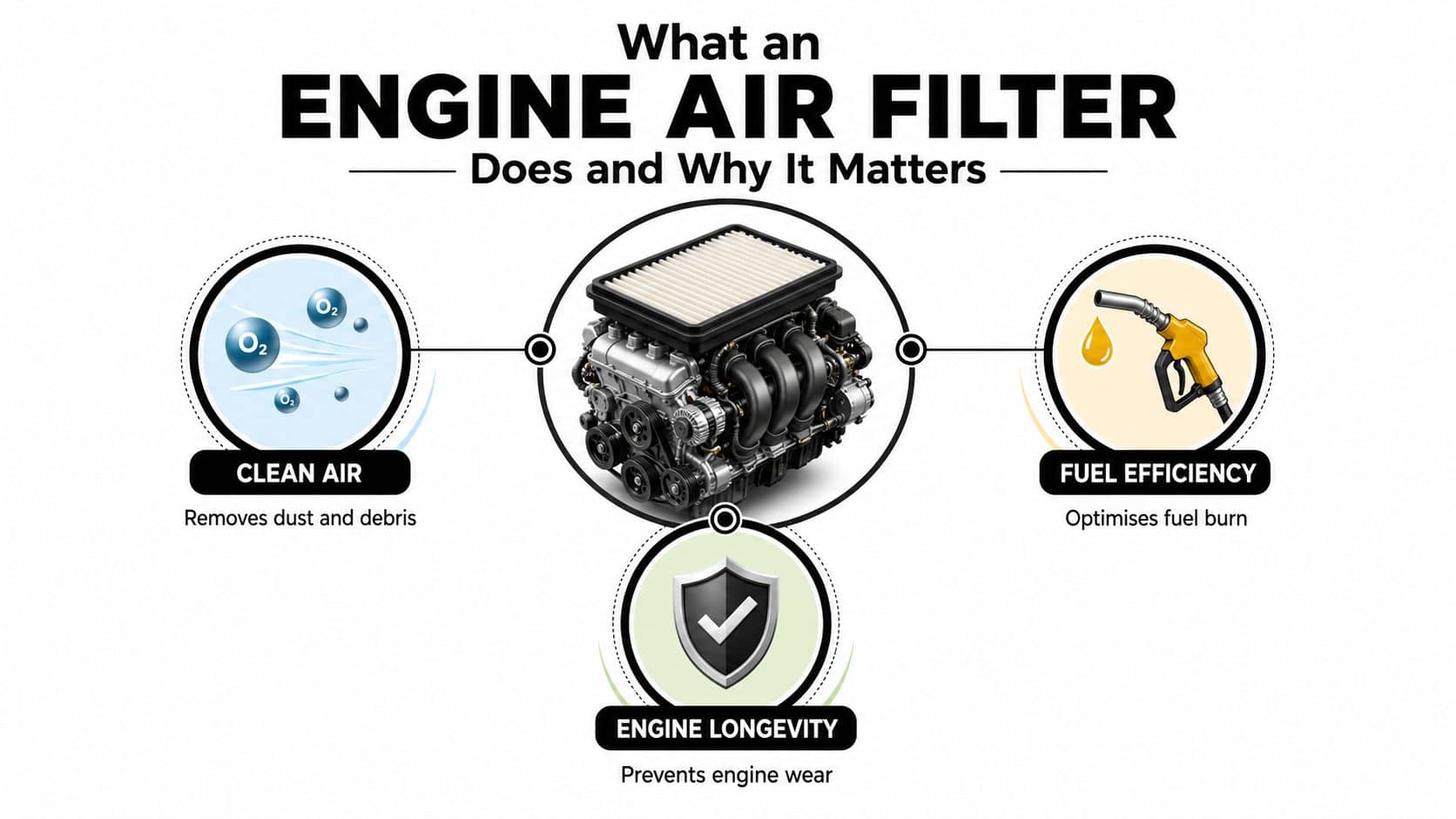
What an Engine Air Filter Does and Why It Matters
Open the airbox on a car that has been used through winter slush, roadside dust, or a stretch of stop-start commuting, and the engine air filter is usually the first line you want to inspect. Its job is straightforward, it keeps dust, grit, pollen, and road debris out of the intake so those particles do not travel on to parts that need clean airflow and very little abrasion. That is why this part is about more than tidy servicing, it helps protect the engine from avoidable wear while keeping air moving the way it should.
A simple way to judge it is by condition, not just mileage. The filter can look lightly coloured and still be restricting flow if it is loaded with fine dust, sitting badly in the housing, or no longer sealing tightly around the edge. A combustion-engine study found that when filter resistance increased, engine filling degree fell by 12%, useful power dropped by almost 10%, specific fuel consumption rose by almost 5%, and exhaust gas temperature rose by up to 30°C empirical study.
Why UK driving makes it matter more
UK driving puts that seal and condition check under a bit more pressure. City traffic, damp winter roads, traffic spray, and seasonal dust all work the filter in different ways, so a part that still looks serviceable on a calm country run can be working much harder in a commuter car or small van. The same study also found no significant effect on NOx or HC emissions, so the immediate issue was mainly lost efficiency and power rather than a sharp change in those pollutants.
A blocked filter is a bit like trying to breathe through a scarf that keeps getting thicker with dust. The engine can still run, but it has to pull harder for the same amount of air, and that extra effort shows up in the way the car feels on the road.
Practical rule: if the car feels flatter under load, start with the filter before assuming the fault is expensive. A restricted air filter is one of the simplest intake checks to make first.
That matters for fleets too. When a small, repeating part starts adding drag to fuel use and drivability, it stops being a box-ticking service item and becomes a maintenance check worth taking seriously. The point is not that every dirty filter causes an obvious fault, it is that a clean, well-seated one helps the engine breathe as designed, and a poor seal can let unfiltered air past even when the element itself does not look terrible.
How an Engine Air Filter Actually Works
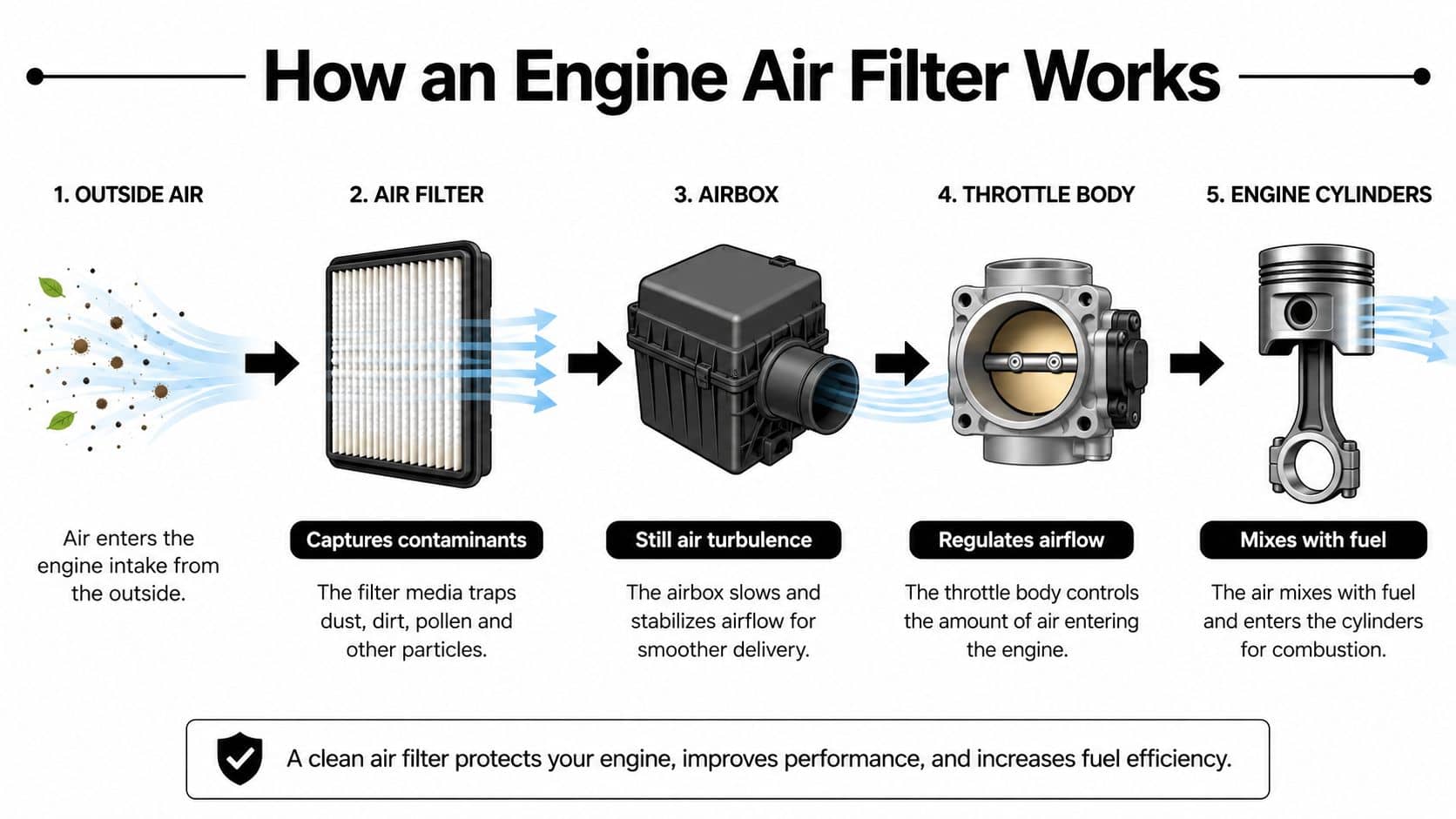
Think of the intake system as a breathing route. Air comes in from outside, passes through the airbox, then through the filter media, and continues towards the mass airflow sensor, throttle body, and combustion chambers. The filter is doing the same job as a nose and mouth combined, it catches the rubbish before the rest of the system has to deal with it.
Inside the element, the pleats matter because they create surface area. More surface area means the filter can trap more particles before restriction becomes a problem, as long as the media is built properly and sealed properly in the housing. That's why a clean-looking filter still isn't the whole story, a damaged edge, poor seating, or a warped airbox can let unfiltered air sneak past the element.
The parts in the path
Here's the mental picture that helps most owners:
Outside air enters the intake opening. That air can carry dust, sand, pollen, insects, and fine road debris.
Air filter media traps those contaminants while still letting air move through.
Airbox keeps the element in place and helps control the airflow path.
Throttle body regulates how much air the engine gets.
Cylinders receive the cleaned air, which mixes with fuel for combustion.
The filter doesn't just “stop dirt”. It has to stop dirt while not choking the engine, and that balance is the whole game.
That's why published test data matter. ISO 5011 is used for full-performance testing of efficiency, initial restriction, terminal restriction, and dust-holding capacity at rated airflow, while ISO 11155-1/-2 covers particle efficiency and adsorption performance technical standards overview. If a filter page gives you real test data tied to those standards, you can compare parts on something more useful than packaging claims.
A good way to think about the mass airflow sensor link is simple. The cleaner and more stable the incoming air supply, the easier it is for the engine management system to do its job. When the intake path gets messed about, whether by restriction or a poor seal, the rest of the system starts working around a problem that shouldn't be there.
The TRUTH About Engine Air Filters (You’re Changing It Wrong)
If you're checking intake parts, GSF Car Parts MAF sensor listings sit right alongside the filter side of the job, because the sensor and filter are part of the same breathing system.
Main Filter Types and Their Real-World Trade-Offs
A filter choice makes more sense once you match it to the way the car is used. A commuter that spends its life in town, a weekend car that sees lighter mileage, and a work van that sits in traffic all ask different things from the same part. A filter is a bit like a door mat, it has to catch what comes in without becoming the problem itself.
Comparing the common options
Filter type | Typical use | Filtration strength | Maintenance | Relative cost |
Paper or cellulose | Everyday road use | Strong for normal filtration | Replace when serviced | Usually lowest |
High-capacity pleated paper | Daily driving with longer service needs | Strong, with more dust-holding capacity | Replace when dirty or restricted | Moderate |
Foam | Motorcycles and some off-road use | Can be effective in the right application | Clean and service carefully | Varies |
Oiled cotton gauze | Performance or enthusiast setups | Depends on correct maintenance and fitment | Wash, dry, re-oil correctly | Usually higher |
Paper elements are the straightforward choice for most road cars. They are simple, effective, and do not ask much from the owner, which is why they suit everyday UK driving so well. High-capacity pleated paper gives you more room for dust before restriction builds up, so it can suit drivers who want a little longer between changes without moving into the upkeep that comes with performance-style filters. Foam and oiled cotton gauze can work well, but only if they are fitted correctly and looked after with more care than a standard service part.
The key question is not which label sounds best. It is whether the filter still seals properly, still flows air as intended, and still matches the car's duty cycle.
What matters more than the marketing label
The filter market is steady rather than flashy, and the numbers mostly reflect routine replacement demand. One market overview places the global engine air filter market at USD 3.8 billion in 2025, projected to grow at a 1.26% CAGR through 2030. The same source also gives a wider industry estimate of USD 5.8 billion in 2025, rising to USD 7.9 billion by 2034 at 4.2% CAGR, with aftermarket demand at 56.3%. Those figures are global rather than UK-specific, but they show how ordinary this part is in the aftermarket.
A performance range such as GSF Car Parts performance air filters can suit the right owner, but only if the car is used and maintained for that type of part. For most UK daily drivers, the better question is whether the filter still has a clean sealing edge and enough flow left in it, not whether it looks dusty. A standard paper element usually remains the most practical fit when ownership needs to stay simple and servicing needs to stay predictable.
Symptoms of a Blocked or Failing Filter
A clogged filter doesn't always shout at you. Sometimes it just makes the car feel heavier, a little more reluctant to pull, and slightly less efficient. That's why people miss it and chase more expensive faults first.
The clearest sign is usually a change in how the car responds. Sluggish acceleration, a rougher idle, or a general drop in fuel economy can all point back to intake restriction. In one controlled study, moving from a new air filter to a clogged one reduced fuel economy by 2.5% in the HFET test, with an overall economy decrease of 2.1% reported in the study ORNL study.
What it can feel like on the road
A restricted filter doesn't behave the same way in every situation. On a steady motorway run, the loss can feel subtle. In town, where the engine is constantly speeding up, slowing down, and pulling away, the same restriction can feel more annoying because the car needs airflow quickly and repeatedly.
Common signs include:
Sluggish acceleration, especially when joining a dual carriageway or climbing a hill.
Higher fuel consumption, which can be gradual enough that many drivers blame traffic first.
Rough idle, where the engine sounds or feels less settled at a standstill.
Black smoke, which is more likely to be noticed on harder acceleration in some vehicles.
Check engine light, though that can have many causes and shouldn't be assumed to mean only the filter.
A useful warning sign many owners miss is dirt around the housing itself. If the airbox is filthy or you can see debris around the seal, the problem might not be the filter media alone. It may be a seating issue, a damaged clip, or a housing that didn't close properly after service.
Do the cheap check first. If the intake path looks dirty, inspect the filter and the housing before paying for more involved diagnostics.
A conference paper on intake restriction found air intake system restriction ranging from 1.45 kPa to 3.8 kPa at maximum-flow test conditions, with filter-only restrictions in the 0.125 to 0.750 kPa range conference paper. That's a good reminder that the pressure drop is measurable even when the part looks small and ordinary.
Replacement Intervals and How to Check Yours
Mileage gives you a starting point, but it does not tell the whole story. UK guidance commonly places replacement in the 12,000 to 15,000 mile range, with many schedules stretching to around 30,000 to 45,000 miles in normal use and shortening where there is heavy traffic, dust, or unpaved-road driving maintenance guidance. Another UK-focused source says many manufacturers suggest inspecting the filter at 15,000 miles and replacing it at 30,000 miles, while some experts advise checking it at every oil change, usually every 3 to 6 months inspection guidance.
A better habit than waiting for a mileage number
The better habit is to treat the air filter like brake pads, something you look at regularly rather than waiting until it is obviously worn out. A filter can be serviceable on paper and still be loaded with dust, especially if the car spends its time in town traffic, on short trips, or behind other vehicles on gritty roads.
Condition matters more than the number alone. If the pleats are packed with debris and the paper looks dark enough to block light, the filter is telling you it has done its job and is getting near the point where airflow starts to suffer.
A simple check is to hold the filter up to a bright light. If very little light passes through, or the surface looks caked rather than evenly dusted, it is time to replace it. That same kind of visual inspection is used by technicians to judge whether a filter still has enough open area to breathe properly inspection guidance.
Don't stop at the element
The airbox matters just as much as the element. A fresh filter will not do its job properly if the housing is cracked, the clips are loose, or the seal does not sit flat all the way round. That is the part many drivers miss, because the key question is not only “how old is the filter?”, it is also “did the intake go back together tightly enough to keep unfiltered air out?”
A dusty housing after fitting is a warning sign. If you open the box and the inside still looks dirty, the issue may be the seal, the seating, or the cover itself rather than the filter media alone.
For UK motorists, the sensible rhythm is straightforward. Check the filter at oil changes, inspect it again after dusty driving, and replace it based on condition as well as mileage. That approach is more useful than treating the service sheet as the only rule, because a filter that looks tidy can still be sealing badly, and a filter that looks dark may still have usable life if the airflow path is clean and the housing is sound.
Choosing the Right Filter for Your Vehicle
Fitment comes first. A filter that's slightly wrong in size, shape, or sealing profile isn't a bargain, it's a problem waiting to happen. The safest approach is to match the car by registration or check the old filter against the new one before fitting, because the housing has to close properly and the element has to sit square.
The other thing to look at is the specification, not just the brand name. A good listing should tell you the filter type, media construction, and, where available, test data tied to recognised standards. Initial restriction, dust-holding capacity, and efficiency matter more than claims like “better breathing” on their own.
What sensible buyers compare
Fitment accuracy: The filter must match the engine and airbox, not just the vehicle badge.
Published test data: ISO-linked performance figures are more useful than a glossy product description.
Service pattern: If you do lots of short trips or dusty routes, a higher-capacity element may suit you better.
Maintenance confidence: If you don't want cleaning and re-oiling, stick to a conventional replacement part.
OEM-style filters remain the easy option for most owners because they're designed around the factory intake system. Aftermarket filters can be perfectly suitable if they're made to the right spec and fitted properly. The wrong assumption is that expensive automatically means better, because the winner is the part that matches the engine's airflow needs and your maintenance habits.
A UK buyer can also use the retailer side of the equation sensibly. GSF Car Parts, for example, stocks OE-matching ranges such as DR!VE+ Filters, which includes air filters, so the buying decision becomes one of fitment and specification rather than guessing from a warehouse photo. That's the sort of detail that helps when you're standing in front of a laptop trying to keep a car off the road for as little time as possible.
Costs, Warranty, Disposal and Common Questions
The price of an engine air filter is usually modest beside the parts people often blame when a car feels flat. Standard replacement filters are the everyday choice, while performance filters usually cost more because of the materials involved and the upkeep they expect. Fitment and brand affect the price, so the sensible comparison is between like-for-like parts, not the cheapest box on the screen.
Warranty matters too, even on a consumable. A good retailer warranty gives confidence that the part is genuine and suitable for the job, while the return policy tells you what happens if the box arrives wrong or the fit is off. GSF's broader service model includes a minimum 12-month warranty, 60-day returns, and Click & Collect in as little as 30 minutes from more than 190 stores across the UK and Ireland, which helps if you need the part quickly and do not want the car stuck on the drive waiting for a replacement. Those are retailer service terms, not claims about how the filter performs in use, but they still matter when you are buying under pressure.
A few quick questions owners ask
Can a dirty filter trigger the engine management light? It can contribute to running issues, but the light can mean many things, so the filter should be checked as part of the wider fault search rather than treated as the only likely cause.
Can you clean a paper filter? Usually, no. A conventional paper element is normally replaced, not washed and reused, because washing can damage the fibres and reduce how well it traps dirt.
Is it worth checking the airbox after fitting? Yes. A new element with a poor seal leaves the engine exposed in the same way a closed door with a gap still lets draughts through. The filter needs to sit properly in the housing, with the seal all the way around.
What should I do with the old filter? Dispose of it responsibly, especially if it is full of grit and road debris. Keep the contamination out of the boot and away from the workshop bay so it does not spread back into the clean side of the intake.
A clean engine air filter is cheap insurance against lost airflow, wasted fuel, and avoidable intake wear. If you need the right part quickly, check the fitment, compare the specification properly, and use the publisher details so you can get the car back to breathing normally without guessing at the part number.





