


You notice it first on a cold morning. The engine catches, then a brief metallic rattle flutters from under the bonnet, and for a second you wonder if it's nothing or the start of something expensive. That moment is exactly why a timing chain for car matters, because it's the hidden part that keeps the engine's valves and pistons working in step.
A timing chain sits inside the engine and links the crankshaft to the camshafts, so the valves open and close at the right moment relative to piston movement (CARFAX explanation of timing chains). It's metal, it runs in engine oil, and when it's healthy you never think about it. When it's worn, stretched, or poorly lubricated, the engine can start sounding wrong long before it stops running properly.
What a Timing Chain Does Inside Your Engine
A cold start often gives the first clue. You turn the key, the engine catches, and a brief rattle comes from the front of the motor, like a bicycle chain brushing a loose guard. That sound suggests the timing system may not be holding tension as firmly as it should.
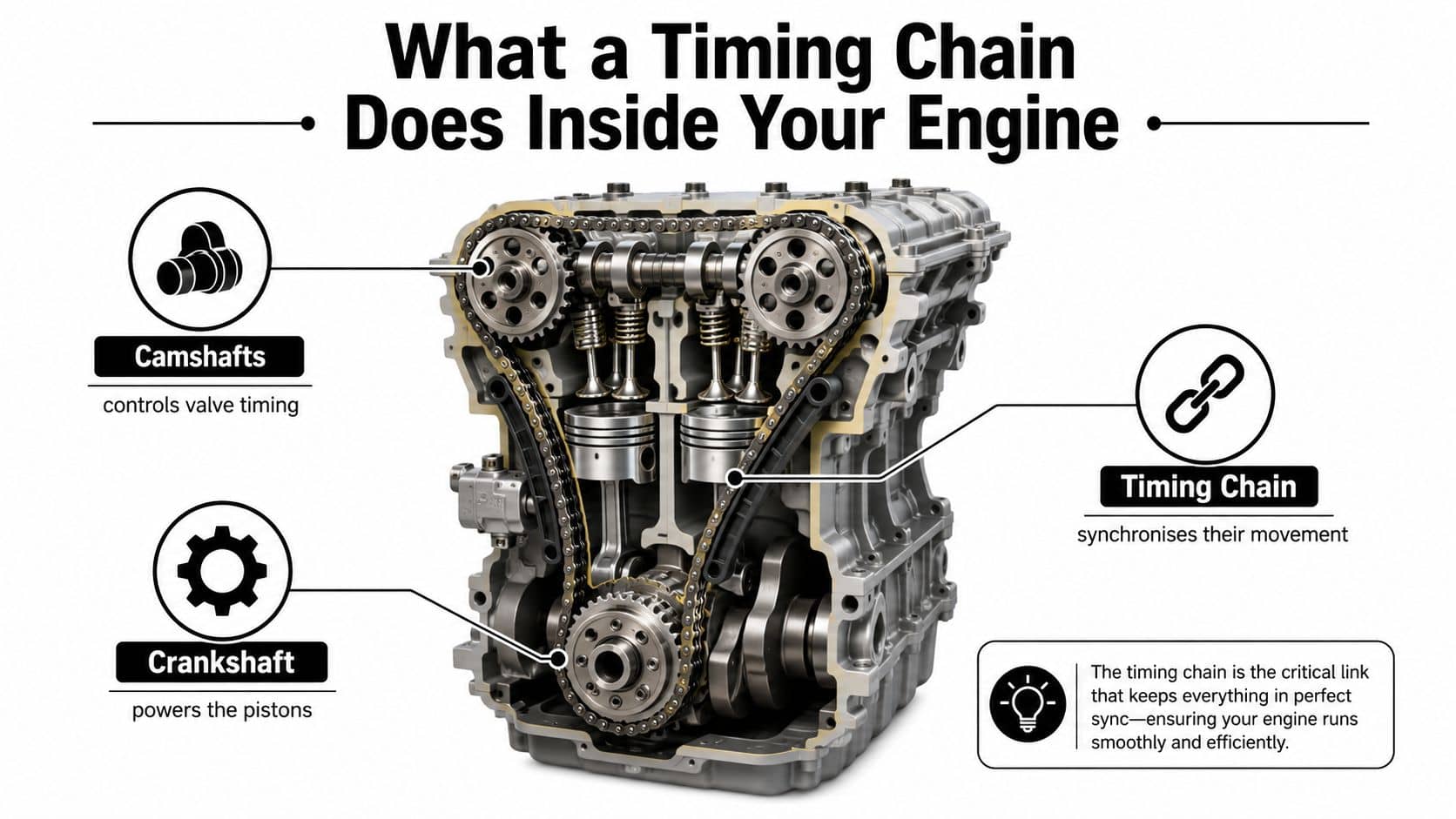
The chain keeps the engine in step
The timing chain links the crankshaft at the bottom of the engine to the camshafts at the top. The crankshaft turns as the pistons move, while the camshafts control when the valves open and close. If those movements fall out of step, combustion happens at the wrong moment, and the engine can run badly or suffer serious damage.
A bicycle chain connecting two gears is a good comparison here. When the chain is tight and the sprockets match, both ends move together. If the chain stretches, the fit changes, and the timing becomes less precise.
Practical rule: if the engine sounds normal once it is warm but rattles for a few seconds at cold start, treat that as an early warning, not background noise.
Why oil matters so much
Unlike a belt, the chain sits inside the engine and depends on engine oil for lubrication. Clean oil helps the chain, guides, and tensioner work together, while dirty or low oil can make the system noisier and less stable.
That is why the decision point for a UK owner is often not mileage alone, but how the engine behaves. A chain-driven engine with poor oil changes, a cold-start rattle, or a warning light needs attention sooner than one that runs smoothly and has proper service history. A timing chain usually gives warning before it fails completely, and that warning is the moment to diagnose it rather than wait for a louder fault.
When you are checking the top end of the engine, the camshaft area is where the timing system starts to make sense as a whole, not as separate parts. The camshaft parts range helps show how the timing components fit together around the same assembly.
Timing Chain vs Timing Belt Explained
A lot of UK drivers use “chain” and “belt” as if they mean the same thing. They don't. Both parts synchronise the crankshaft and camshafts, but they're built differently and they age differently, which changes what you need to watch for.
Side by side differences
Feature | Timing Chain | Timing Belt |
Material | Metal links
inside the engine | Reinforced rubber type material |
Lubrication | Runs in engine oil | Runs dry in a covered external path |
Noise | Usually noisier when worn | Usually quieter in operation |
Maintenance | Often treated as long-life, but not maintenance-free | Regular replacement is expected |
Failure pattern | Can stretch, rattle, or jump timing | Can crack, fray, or snap |
Owner responsibility | Pay attention to oil quality and symptoms | Follow the replacement schedule closely |
Chains are often chosen because they're seen as the tougher option, but that doesn't mean they're immune to wear. Belts wear in a more obvious, scheduled way, while chains often let you know through noise, rough running, or timing faults.
What that means for a UK owner
If your car has a belt, you usually plan around a service interval. If it has a chain, you need to think more about condition, service history, and engine family. That's why many owners only learn there's a problem after a warning light or a cold-start rattle appears.
The timing belt range is the useful reference point if you're trying to compare the two systems on the same car. A belt is a scheduled wear item. A chain is more of a health item, watched through symptoms, oil condition, and diagnosis rather than a simple date on the calendar.
Warning Signs Your Timing Chain Needs Attention
A noisy start doesn't always mean the chain is finished, but it does mean the timing system deserves a proper look. The trick is not to blame the chain first and ask questions later, because the tensioner, phasers, oil supply, or a blocked screen can create similar symptoms.
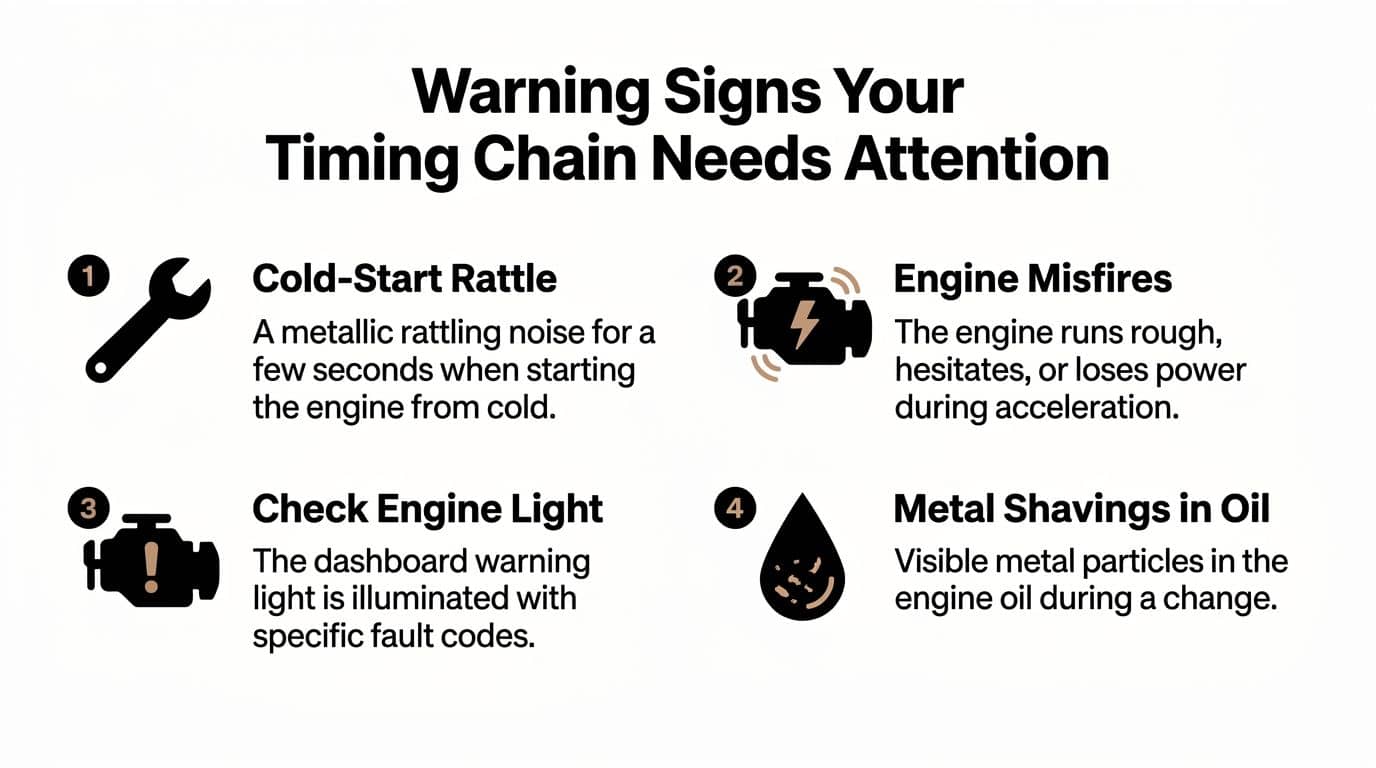
What the car is trying to tell you
The most obvious sign is a cold-start rattle, especially if it disappears after a few seconds. That can point to chain wear, but it can also come from a tensioner that hasn't built pressure yet. If the noise becomes more frequent, louder, or starts happening when hot, the risk level rises.
Misfires, rough running, hesitation, and weak acceleration can also show up when the timing is drifting. So can a check engine light with crank-to-cam correlation faults. Those codes matter because they tell you the engine isn't seeing the camshaft and crankshaft in the relationship it expects.
Don't guess at a timing chain job from sound alone. Check oil level, scan data, and oil-control valve screens before you condemn the chain itself.
What to check before ordering parts
A simple diagnostic order saves money and time:
Scan the fault codes first: correlation or timing-related codes give you a starting point.
Check the oil level: a low sump can affect tensioner operation and phaser control.
Inspect oil-control valve screens: blocked screens can mimic chain trouble.
Listen at cold start and after a hot restart: the pattern matters more than one noisy morning.
The YouTube diagnostic walkthrough from a technician-led timing-chain discussion backs up that approach, because the visible symptom often isn't the root cause.
Metal shavings in the oil are a stronger warning sign than a brief rattle, because they suggest real wear inside the timing system. If you're seeing that, the car needs proper inspection, not hopeful driving.
9 Symptoms of a Bad Timing Belt or Timing Chain | How To Tell
How Long a Timing Chain Lasts and What It Costs to Replace
A timing chain is usually treated as a long-life component in the UK, not a fixed-service part. That still does not mean you can ignore it forever. UK-focused motoring guidance says many chain-driven engines often last 150,000 to 200,000 miles or more, while replacement is still often discussed in the 80,000 to 120,000-mile risk window when wear, noise, or service history points to trouble. A chain is a bit like the engine's internal drive belt made of steel links, it should keep working for a long time, but once it starts stretching or the guides wear, the warning signs matter more than the number on the odometer. The same guidance also links typical repair work to cost ranges that vary by engine size and how far the problem has gone, so early checking is usually cheaper than waiting for a failure (UK timing chain lifespan and cost guidance).
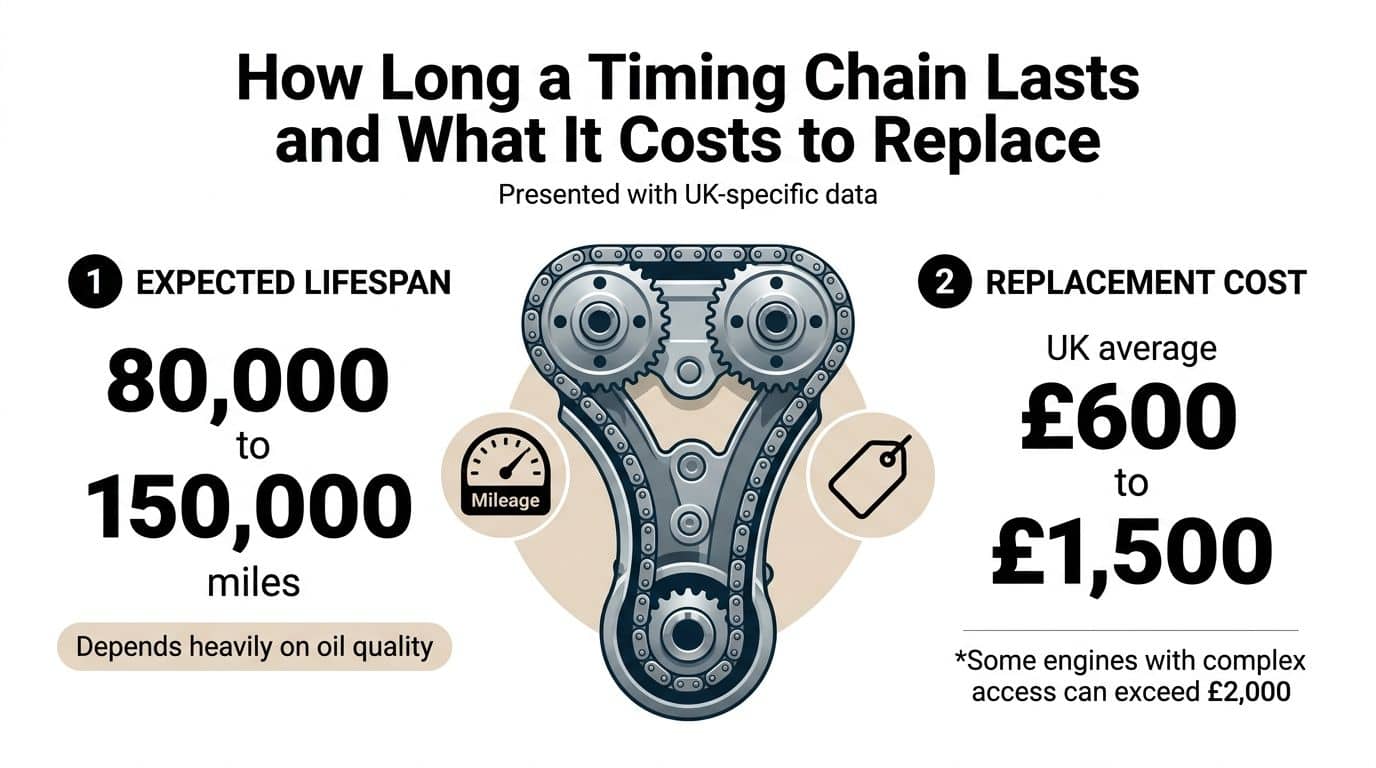
Why mileage alone doesn't settle the decision
Mileage only tells part of the story. A chain that has had clean oil and regular servicing can stay quiet for a long time, while a neglected engine can start making noise much earlier. That is why the owner decision point is usually symptom-led, not mileage-led.
The practical question is whether the engine is showing the kind of symptoms that point to timing wear, or whether the noise is coming from somewhere else in the timing system. A cold-start rattle, especially if it settles quickly, does not automatically mean the chain is finished. A persistent rattle, rough starting, or repeated timing faults carries more weight than a single noisy morning. That is the point where a proper inspection, not guesswork, starts to save money.
The same UK guidance puts typical chain-and-guides work at £650 to £950 for a 3-cylinder engine, £1,000 to £1,600 for a 4-cylinder turbo full rebuild, and £2,500 to £5,000 if chain failure leads to engine rebuild work (UK timing chain lifespan and cost guidance). Those are the sorts of figures that make early diagnosis worth it, because once the chain damage spreads, the repair cost climbs fast.
Known problem families and earlier failures
UK-used-car reliability data shows the issue is real for some engine families. A UK breakdown dataset places several BMW and Mercedes models among the worst offenders, with average failure mileages around 70,000 to 80,000 miles for the BMW 3 Series E90, BMW X1 E84, BMW X3 F25, BMW 1 Series F20, Audi A6 C7, and Mercedes-Benz E-Class W212 (UK timing chain problems by brand).
In that same dataset, some BMW N47-chain cases are shown at about £3,000 to £4,000 in worst-case repair exposure, while other models sit around £2,200 to £3,500.That is why owners of high-mileage diesel and turbo-petrol cars should take a noisy start seriously. A worn chain, tired guide, or weak tensioner can show up well before the mileage many drivers still assume is safe. If you are buying parts, a timing chain kit from GSF Car Parts is usually the more sensible route than a single chain, because the chain, guides, and tensioner need to work together.
Choosing the Right Timing Chain Kit for Your Car
A timing chain job is not just “buy chain, fit chain”. The chain, guides, tensioner, and sprockets all work as a set, and if one part is wrong the whole repair can be compromised. That's why the kit matters more than the single chain on its own.
Match the exact specification
Supplier catalogues show timing chains vary in pitch, width, link count, and design type. Elgin's technical catalogue lists common automotive chains with designs such as inverted-tooth and roller, pitches including 0.250 in, 0.310 in, 0.315 in, and 0.375 in, widths from about 0.384 in to 0.560 in, and link counts from 44 to 254 depending on the application (Elgin timing chain technical data).
That matters because the chain has to mesh with the sprockets correctly. If the pitch or width is off, the chain can load the teeth unevenly, run noisily, and create timing scatter.
Workshop rule: engine family is not enough. Match the OE chain spec, link count, and kit contents before you order anything.
Why the kit is the safer buy
Independent technical literature notes that even current simplex chains are specified at 9.525 mm pitch with distinct link counts such as 70 links and 74 links for closely related applications (febi technical article). That small difference can affect how the tensioner sits in its operating range, especially as the chain wears and the engine heats up.
That's why I'd always look for a complete kit rather than trying to reuse tired guides or an old tensioner. The chain is made from hardened steel, but the whole system still depends on correct preload and stable oil control. If you're shopping for a replacement kit, the timing chain kit range is the sort of category that helps you compare the full assembly, not just one link loop in isolation.
Maintenance Habits That Extend Timing Chain Life
Most chain problems don't start with a dramatic failure. They start with small decisions, like stretching oil changes or ignoring a low-oil warning because the car still drives. A chain-driven engine is less forgiving of that kind of neglect than many owners realise.
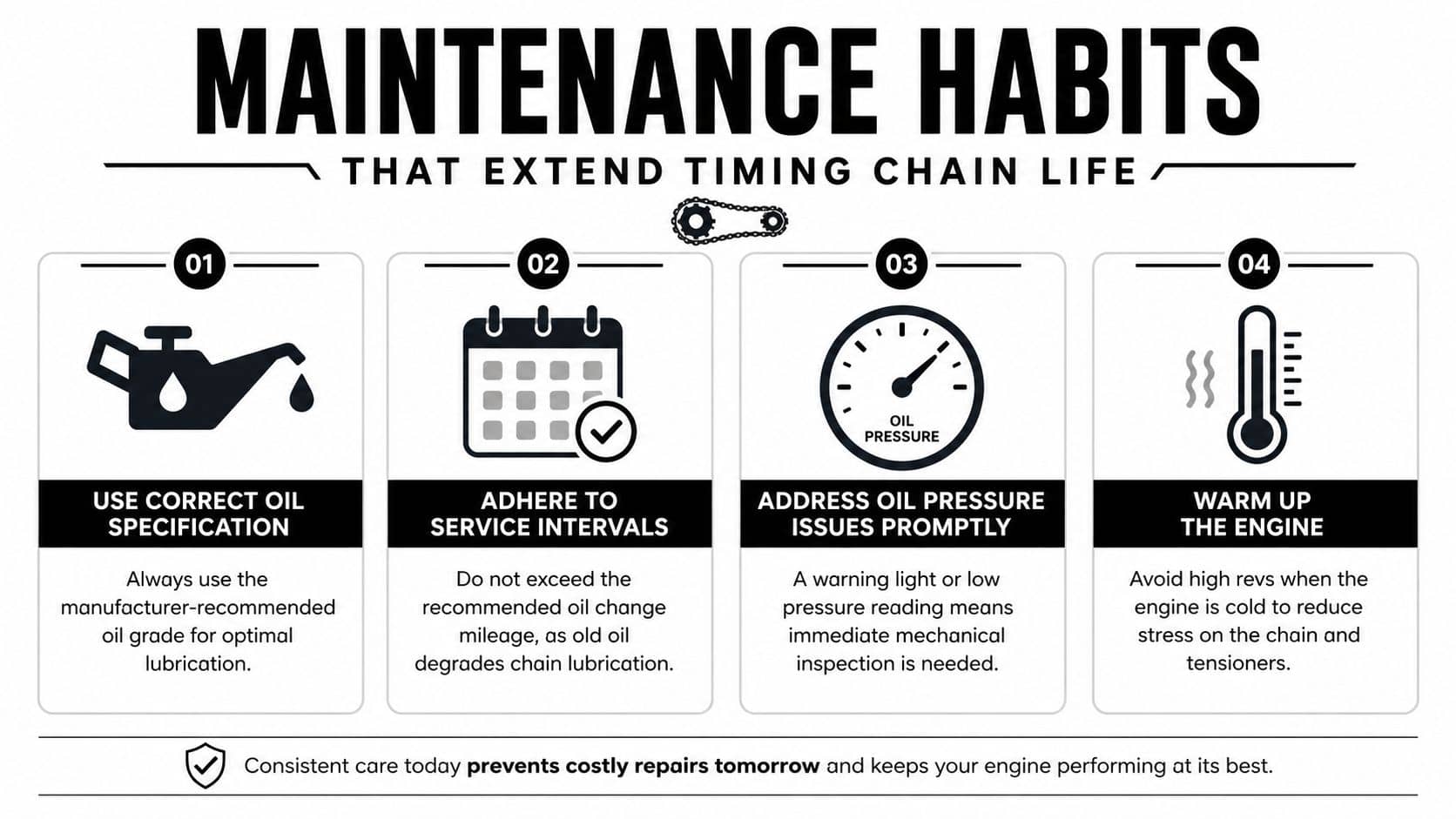
The habits that actually help
Use the correct oil specification.The chain, tensioner, and phasers depend on the oil grade the manufacturer intended, not just any bottle that fits the filler cap.
Stick to service intervals.Fresh oil keeps lubrication and hydraulic control healthier for longer, which matters on timing-chain engines.
Deal with oil pressure issues quickly. A warning lamp or low-pressure reading means the engine needs inspection, not another week of commuting.
Warm the engine before hard revs. Cold oil doesn't support the chain system as well, so give it time to settle.
Those are simple habits, but they're the difference between a chain that stays quiet and one that starts rattling earlier than expected.
When proactive action makes sense
If your car has a known problem engine, a patchy service record, or repeated low-oil events, waiting for louder symptoms can be a false economy. A chain can last a long time, but once it starts to wear, the supporting parts often need attention at the same time.
A clean service history gives you more confidence to wait and monitor. A neglected history tells a different story.
Finding and Ordering the Right Parts for Your Vehicle
Once you've got a sensible diagnosis, the next job is making sure the parts match the engine exactly. That's where registration lookup, engine code checking, and supplier support save you from buying the wrong kit and opening the job twice.
Use the lookup, then confirm the details
GSF Car Parts has a number plate parts finder that helps you identify the right timing components for the vehicle in front of you. That's useful, because timing chain kits are rarely universal, and small differences in engine variant can change the correct part set.
If you're choosing between brands, look for trusted names, check what's included in the kit, and confirm whether guides and tensioner parts are part of the box. The safest route is still the one that matches the OE specification, then verifies it against the vehicle record before you order.
What the buying process looks like
The practical advantages matter when the car is down and the clock is ticking. Orders over £25 qualify for free UK mainland delivery, and free Click & Collect is available from more than 190 stores across the UK and Ireland, often in as little as 30 minutes. Purchases are backed by a 12-month warranty, 60-day returns, and Klarna Pay in 30 Days.
For anyone trying to keep a repair moving without guesswork, those options reduce friction. If you're dealing with a noisy engine and you've already ruled out the obvious oil-related causes, the next step is to identify the exact kit, order once, and fit once.If your engine is starting to rattle, misfire, or throw timing-related faults, don't keep guessing. Check the right kit, confirm the specification, and use GSF Car Parts to find the timing chain parts that match your vehicle so you can move from diagnosis to repair with less risk and less wasted labour.





