


A clutch kit and flywheel are foundational components of any manual transmission vehicle. They form the crucial link that transfers power from a constantly running engine to the wheels, allowing the driver to control that power flow. Think of them as the mechanical mediators of your engine's force, enabling you to engage or disengage it from the gearbox for smooth gear changes and controlled starts. Without this system, a manual car would be undrivable.
How Your Clutch and Flywheel Work Together
To understand the drivetrain, it's essential to know how these two parts function as a team. It’s not just a matter of two metal discs interacting; it's a precisely engineered mechanical system that manages incredible rotational forces. One component simply cannot perform its function without the other.
First, let's explore the flywheel. This is a heavy, precisely balanced disc bolted directly to the engine's crankshaft. As the engine runs, the flywheel spins, storing rotational energy (kinetic energy). This stored momentum smooths out the pulsating power delivery from the engine's combustion cycles, preventing lurching and maintaining a steady idle speed.
The Clutch Engagement Process
Positioned between the engine's flywheel and the gearbox's input shaft is the clutch assembly. This typically consists of the clutch disc, a pressure plate, and a release bearing.
When your foot is off the clutch pedal, powerful diaphragm springs within the pressure plate clamp the clutch disc firmly against the flywheel's surface. This creates a solid, direct connection, forcing the flywheel and the gearbox input shaft to spin at the same speed. In this state, 100% of the engine’s power is transmitted to the wheels.
When you press the clutch pedal, you activate the release bearing. This component pushes against the pressure plate's springs, releasing the clamping force. The clutch disc is now free, breaking the mechanical link between the engine and the gearbox. This interruption of power flow is what allows you to shift gears smoothly without grinding.
This elegant process occurs every time you change gear. The clutch disc, with its high-friction lining (similar to brake pad material), is designed to grip the flywheel's smooth face. The flywheel, in turn, provides the ideal, stable surface for this engagement while storing the kinetic energy needed for a seamless transition.
To make sense of it all, here's a quick look at the main components and what they do.
Key Components and Their Functions
This table breaks down the core parts of a standard clutch and flywheel system.
Component | Primary Function |
Clutch Disc | The friction disc that connects (or disconnects) the engine's power from the gearbox. |
Pressure Plate | The spring-loaded cover that applies clamping force to the clutch disc, pressing it against the flywheel. |
Release Bearing | The part activated by the clutch pedal that engages the pressure plate to release the clutch disc. |
Flywheel | A heavy disc that stores rotational energy from the engine and provides a machined surface for the clutch to engage with. |
Understanding this partnership is the first step to diagnosing problems, choosing the right replacement parts, and appreciating the engineering that makes manual transmission vehicles rewarding to drive. The condition of your clutch kit and flywheel directly dictates how your car performs and feels.
Single Mass vs Dual Mass Flywheel Differences
When exploring options for a clutch kit and flywheel, you'll encounter a fundamental choice: a single mass or dual mass design. This isn't just a technical detail; the decision has a significant impact on your vehicle's driving characteristics, performance, and long-term maintenance costs.
A single mass flywheel (SMF) is the traditional design. It is a single, solid piece of precision-balanced metal, a robust and simple concept trusted for decades. Because it’s a single unit, it creates a direct, unfiltered connection between the engine and gearbox. This is why it's often favoured in performance and motorsport applications, where drivers seek instantaneous throttle response and a raw, connected feel.
A key benefit of an SMF is its durability and lower cost. With no internal moving parts to fail, it is exceptionally reliable. Furthermore, it can often be resurfaced by a machine shop during a clutch change, saving the cost of a full replacement.
Its rugged, straightforward design makes the SMF a go-to for high-performance vehicles, heavy-duty work trucks, or as a popular "solid flywheel conversion" for cars originally equipped with a dual mass flywheel.
The Comfort-Focused Dual Mass Flywheel
In contrast, a dual mass flywheel (DMF) is an advanced piece of engineering designed for comfort and refinement. A DMF consists of two separate flywheel masses connected by a system of powerful springs and dampers. One mass bolts to the engine's crankshaft, while the other connects to the clutch assembly.
This two-part construction is highly effective at absorbing the torsional vibrations and judders produced by modern engines, especially high-torque diesels. The internal springs act as shock absorbers, smoothing out power fluctuations before they reach the gearbox and, ultimately, the driver. The result is a quieter cabin, reduced gear rattle, and a noticeably smoother driving experience.
The adoption of dual-mass flywheels has significantly improved the refinement of many modern passenger cars and light commercial vehicles. They can reduce gearshift vibrations by up to 80% compared to a single-mass design, which is why they became standard equipment in many cars post-2005. The UK's automotive flywheel market is projected to be worth over USD 585 million in 2025, largely due to DMFs being fitted as standard. You can find more data on these trends in the full automotive flywheel report.
Visualising the Clutch System
This diagram illustrates how the flywheel, clutch disc, and pressure plate work in unison to transfer power from the engine to the wheels.
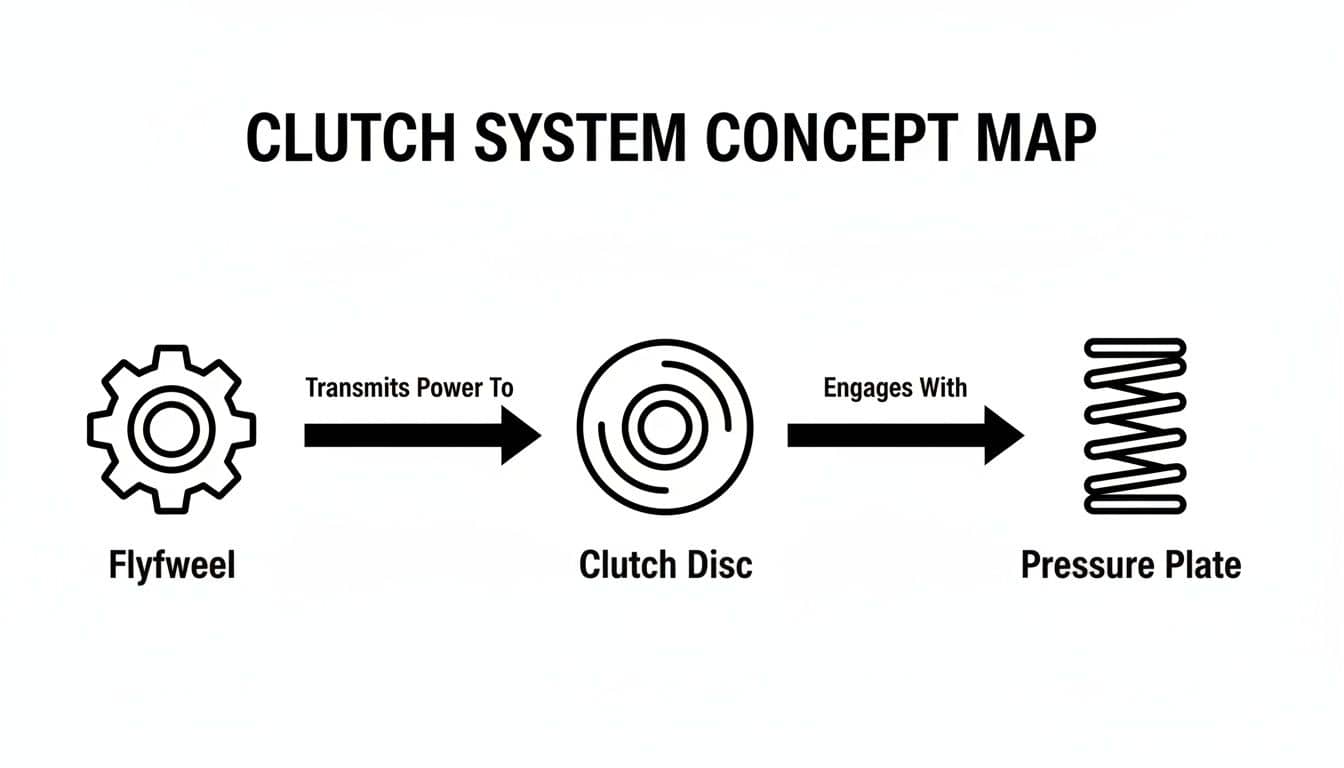
As you can see, the flywheel is the first link in the power transfer chain, making its role absolutely central to the vehicle's drivetrain.
The Real-World Trade-Off
So, which type is right for a replacement? The choice depends on your priorities.
Choose a Dual Mass Flywheel (DMF) if:
You want to maintain the quiet, comfortable ride your vehicle had from the factory. It’s the ideal choice for daily drivers and modern diesels where noise, vibration, and harshness (NVH) reduction is a priority.
Choose a Single Mass Flywheel (SMF) if:
You value maximum durability, a lower replacement cost, and a more direct, mechanical feel. It’s a great option for modified cars, high-mileage vehicles, or for those seeking a robust, long-term solution after a DMF has failed.
Ultimately, the decision balances comfort against cost and performance. A DMF provides a smooth, refined ride but comes with a higher price and more complex internal components. An SMF offers durability and a direct connection to the engine for less money, but at the cost of increased cabin noise and vibration.
Warning Signs of a Failing Clutch or Flywheel
Recognising the early symptoms of a failing clutch kit and flywheel can save you from a sudden breakdown and a more costly repair. Your vehicle will almost always provide sensory clues that something is amiss. By learning to interpret these signs, you'll know when it's time to seek a professional inspection.
Diagnosis comes down to using your senses. Listen for unusual noises, feel for changes in the car's behaviour, and even pay attention to strange smells. Each symptom is a clue pointing to a specific part that may require attention.
What to Feel When Driving
Often, the first indication of a failing clutch comes through the feel of the pedal and the car's response. A healthy clutch should feel smooth and predictable. When it begins to wear, you'll notice distinct changes.
The classic symptom is clutch slip. This occurs when you accelerate, the engine RPM increases, but the car's speed does not correspond. It feels as if the engine has momentarily disconnected from the wheels, a sure sign the friction material on the clutch disc is worn and can no longer grip the flywheel effectively.
Pay attention to the clutch pedal itself. A pedal that feels spongy, soft, or goes to the floor with little resistance could indicate an issue with the hydraulic system (master or slave cylinder). Conversely, a pedal that feels unusually stiff or only engages at the very top of its travel often means the mechanical clutch components are worn. A worn clutch release bearing can also cause these symptoms.
What to Listen For
Unusual noises are your car's way of signalling a problem. A worn clutch or flywheel will produce sounds that are hard to ignore once you know what they mean.
The most common sound is a chattering or rattling noise when the car is idling in neutral. This noise often disappears as soon as you press the clutch pedal. This is a classic sign of a failing dual-mass flywheel (DMF), where the internal damping springs have worn out and can no longer absorb engine vibrations.
A grinding or high-pitched squealing sound when you press the clutch pedal typically points to a worn-out release bearing. If you hear grinding while changing gear, it may mean the clutch isn't disengaging fully, causing the gear teeth to clash.
A juddering or shaking sensation as you pull away, particularly in first gear, is a significant red flag. This shudder, which can feel like the car is about to stall, is a strong indicator of a warped flywheel or contamination on the clutch disc from an oil or fluid leak.
Symptom Checker for Clutch and Flywheel Failure
It can be difficult to discern whether the fault lies with the clutch or the flywheel. This table breaks down common symptoms to help identify the likely cause.
Symptom | Likely Cause (Clutch Kit) | Likely Cause (Flywheel) |
Engine revs but car doesn't speed up | Worn clutch disc (clutch slip). | Less common, but a severely damaged flywheel surface can reduce grip. |
Grinding when pressing the pedal | Worn or failing release bearing. | Not a typical flywheel symptom. |
Rattling/chattering noise in neutral | Usually a sign of a failing dual-mass flywheel (DMF). | A bad pilot bearing could also cause noise, but the DMF is the primary suspect. |
Shuddering or juddering when pulling away | Contaminated or glazed clutch disc (oil/grease). | Warped or heat-damaged flywheel surface (hot spots). |
Difficulty changing gears | Clutch not disengaging fully due to a worn disc or pressure plate. | A warped flywheel can prevent the clutch from disengaging cleanly. |
Spongy or stiff clutch pedal | Issue with the hydraulic system (master/slave cylinder) or worn pressure plate. | Not directly caused by the flywheel itself. |
While this table is a useful guide, remember that these components work as an integrated system. A problem in one area can quickly cause wear and damage to another, so a professional diagnosis is always the best course of action.
Ignoring these issues can lead to bigger problems. In the UK, clutch-related faults account for roughly 5-7% of MOT failures for cars over 10 years old, according to DVSA data. With around 70% of these repairs occurring at independent garages, there is a clear demand for quality, accessible parts. You can explore more data by reviewing trends in the European automotive flywheel market.
What to Smell
Finally, trust your sense of smell. A distinct, acrid burning odour—like burnt toast or sulphur—is a serious warning sign. This pungent smell is the clutch friction material overheating due to excessive slipping. It often occurs during aggressive driving, when towing a heavy load, or when labouring up a steep incline. This smell indicates that the clutch has sustained damage and requires inspection.
Should You Replace the Flywheel with the Clutch?
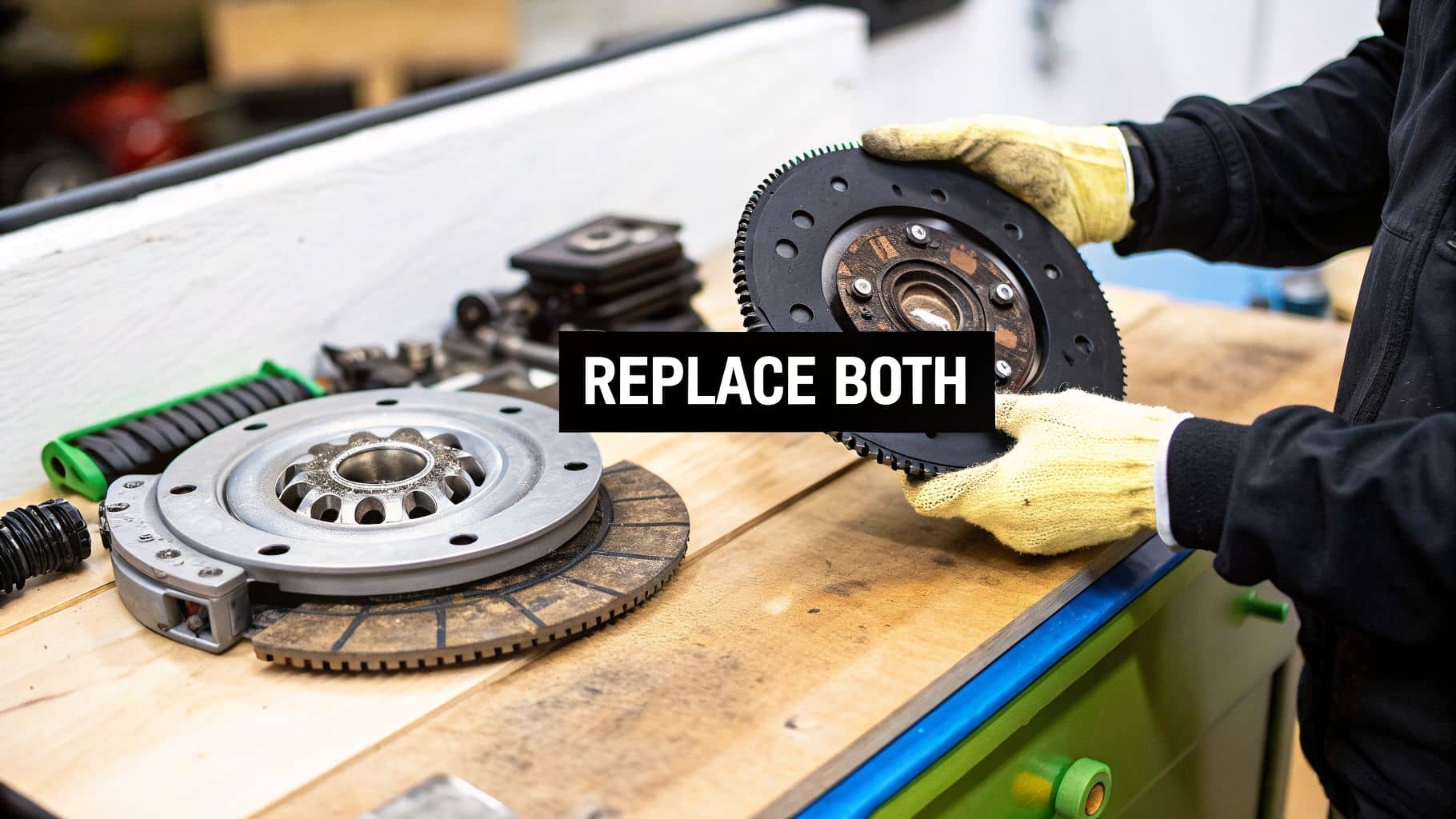
It’s one of the most frequently asked questions in auto repair: "My clutch is worn, but do I really need to replace the flywheel too?" While it’s tempting to save money on parts, replacing the clutch kit and flywheel together is almost always the most logical and cost-effective decision in the long run.
Attempting to save money by reusing an old flywheel is a classic example of a false economy. It can easily result in paying for the entire labour-intensive job all over again in just a few thousand miles. Let's break down why doing the job once and doing it right is the best approach.
The Labour Cost Is the Real Factor
A clutch replacement is a major undertaking. The vehicle's gearbox must be removed to access the clutch assembly, a process that requires several hours of skilled labour. This labour constitutes a significant portion of the final repair bill.
Here’s the critical point: whether the mechanic replaces only the clutch kit or the clutch kit and flywheel together, the amount of labour involved is nearly identical. The flywheel is directly accessible once the clutch is removed. Skipping its replacement doesn't save hours of work; it only omits the cost of the part itself, which is often a smaller fraction of the total expense.
You are already paying for the most expensive part of the job—the labour to access the components. For the relatively small additional cost of a new flywheel, you ensure the entire system is new, reliable, and will last for its full intended service life.
Why Mating a New Clutch to an Old Flywheel Is a Bad Idea
Pairing a brand-new clutch disc with a worn-out flywheel is a recipe for poor performance and premature failure. Over tens of thousands of miles, a flywheel's friction surface develops imperfections such as glazing from heat, microscopic heat cracks, and hard spots. It is no longer the perfectly flat, uniform surface that a new clutch requires to bed in and grip correctly.
This imperfect surface prevents the new clutch disc from engaging properly. The consequences are immediate and detrimental:
Clutch Judder: You will likely experience a shuddering or vibration as you pull away from a standstill.
Premature Wear: The new clutch disc will wear out rapidly as it struggles to maintain a solid grip against the uneven surface.
Clutch Slip: The system will begin to slip far sooner than it should, returning you to the original problem.
In short, a worn flywheel will degrade a new clutch. You will end up with the same symptoms you started with, forcing you to pay for a second clutch replacement—including the substantial labour charge—much sooner than necessary.
So, Can a Flywheel Ever Be Reused?
Are there any circumstances where it is acceptable to reuse an old flywheel? The answer depends on the type of flywheel and its condition.
If your vehicle has a solid, single-mass flywheel and it's in truly excellent condition (with no visible heat spots, cracks, or warping), it may be possible to have it professionally resurfaced. This process involves machining a thin layer off the surface to restore its flatness. However, resurfacing costs £40 to over £100 and must be done by a specialist machine shop to ensure it remains correctly balanced.
For vehicles equipped with a dual-mass flywheel (DMF), replacement is considered mandatory. Its complex internal spring and damper system cannot be reliably resurfaced or repaired. Given that a DMF's service life is very similar to that of a clutch, it is highly likely to fail soon after a new clutch is installed. Always replace a DMF when you replace the clutch.
Right, so you've determined you need a new clutch. Choosing the correct clutch kit and flywheel can feel daunting, but it doesn't have to be. With the right knowledge, you can select parts that ensure reliability for tens of thousands of miles. Let's clarify the process.
The most critical first step is ensuring a perfect fit. Modern vehicles have highly specific component requirements, and "close enough" is not an option. The easiest way to guarantee compatibility is to use an online parts finder, like the one at GSF Car Parts. Simply enter your vehicle's registration number, and the system will display only the components engineered for your exact make, model, and year. This eliminates guesswork.
Matching Parts to Your Car's Needs
Once you have a list of compatible parts, consider how you use your vehicle. Not all clutch kits are created equal; they are designed for different applications. A key specification to check is the part's torque rating.
Your engine produces a specific amount of torque, and the clutch must be strong enough to handle it without slipping. If you have modified your engine for increased power, the standard factory-spec clutch may no longer be adequate.
Think about your typical driving scenarios:
Daily Commuting: For standard city and motorway driving, an OE-quality clutch kit is ideal. It provides a smooth, comfortable pedal feel suitable for stop-start traffic.
Heavy-Duty Use: If you frequently tow a trailer, haul heavy loads, or drive a high-performance vehicle, you will need a clutch with a higher torque capacity and superior heat dissipation.
Performance Driving: For track days or spirited road use, a performance clutch offers a more aggressive engagement "bite" and can handle the extreme heat and stress of rapid gear changes.
Choosing a clutch that aligns with your engine's torque output and your driving style is vital for its longevity. An underrated clutch will wear out prematurely, while an overly aggressive one can make daily driving feel jerky and unpleasant.
The Importance of Trusted Brands and Suppliers
When dealing with a component as critical as a clutch kit and flywheel, the brand name carries significant weight. Opting for a cheap, unproven brand is a gamble that often results in poor performance and early failure. Sticking with established, OE (Original Equipment) quality manufacturers is the best way to ensure reliability and peace of mind.
Brands like LuK, Sachs, and Valeo are global leaders that supply parts directly to vehicle manufacturers. When you choose one of these, you are getting a component made to the same exacting standards as the one fitted to your car at the factory. You can find a full range of these top-tier parts when you browse for a new clutch system online.
Just as important as the brand is the supplier. A trusted supplier like GSF Car Parts provides the after-sales support that protects your purchase and helps you get back on the road faster.
Here’s what you get:
Warranty: A minimum 12-month warranty provides cover against manufacturing defects.
Straightforward Returns: If you order the wrong part, a simple returns process makes it easy to exchange it for the correct one.
Local Collection: With our Click & Collect service, you can often pick up parts from a local branch in as little as 30 minutes —a significant advantage when your vehicle is off the road.
By focusing on a guaranteed fit, matching parts to your needs, and choosing trusted brands from a reliable supplier, you can purchase the right clutch kit and flywheel with confidence.
DIY vs Professional Clutch and Flywheel Replacement
How to Replace a Clutch in Your Car
So, you have the new parts, and the job looms ahead. Now for the crucial question: should you attempt to replace the clutch and flywheel yourself? To be clear, this is one of the most advanced and physically demanding repairs you can perform on a vehicle, far more complex than changing oil or brake pads.
Deciding between a DIY approach and hiring a professional is a serious consideration. It depends on your mechanical experience, the tools at your disposal, and your tolerance for risk. While the satisfaction of completing the job yourself is immense, a mistake can lead to very expensive damage. This is not a task for a novice; it requires genuine mechanical skill.
The Reality of a DIY Clutch Replacement
Undertaking a clutch and flywheel replacement on your driveway is a monumental task. The core of the job involves separating the engine and gearbox—a heavy, awkward, and potentially dangerous procedure without the correct equipment. This is not a casual weekend project.
Before you begin, you must be honest about the specialised tools required. A standard socket set is insufficient. The following are non-negotiable for performing the job safely and correctly.
Essential DIY Tools and Equipment:
Transmission Jack: This is the most critical piece of equipment. A standard trolley jack is not designed to safely support the weight or provide the precise control needed to remove and reinstall a gearbox.
Clutch Alignment Tool: This simple tool ensures the new clutch disc is perfectly centered before you tighten the pressure plate. Without it, reinstalling the gearbox input shaft is nearly impossible.
Engine Hoist or Support Brace: You need a way to securely support the engine once the gearbox, which also serves as a mount, is removed.
Comprehensive Socket and Wrench Set: This should include deep sockets, long extension bars, and universal joints to access hard-to-reach bolts.
Torque Wrench: Every bolt, particularly on the flywheel and pressure plate, must be tightened to the manufacturer's precise torque specifications. Guesswork is not an option.
The biggest risks in a DIY job are personal injury from a falling gearbox and causing catastrophic damage to your new components, the transmission, or the engine. A poorly installed part or an incorrectly torqued bolt can destroy your investment in a matter of miles.
Finding a Trustworthy Mechanic
For most drivers, hiring a professional is the safest and most sensible option. A qualified mechanic possesses the right tools, experience, and knowledge to complete the job correctly the first time, and their work will be covered by a warranty. If you are a serious DIYer looking to acquire the right equipment, you can check out professional-grade transmission jacks on our website.
When searching for a garage, look for independent specialists with positive reviews for clutch and transmission work. In the UK, you can expect labour costs to range from £300 to over £600, depending on your vehicle's complexity and the garage's hourly rate.
Always request a detailed, itemised quote that separates the cost of parts from labour. This transparency is key—it helps you understand what you are paying for and avoids unexpected charges on the final bill.
Frequently Asked Questions About Clutch Kits and Flywheels
Even with a solid understanding of the components, it's normal to have more questions about your clutch kit and flywheel. To help, we’ve compiled straightforward answers to some of the most common queries from drivers.
How Long Should a Clutch Kit and Flywheel Last?
The lifespan of a clutch is highly variable. A new clutch kit and flywheel should typically last between 60,000 to 100,000 miles, but this depends almost entirely on driving habits and conditions.
An aggressive driving style, frequent towing, or constant stop-start city traffic will cause these parts to wear out much faster. Conversely, a vehicle used primarily for motorway driving with smooth, infrequent gear changes could see its original clutch last well beyond 100,000 miles.
Can I Convert My Dual Mass Flywheel to a Single Mass Flywheel?
Yes, this is possible and quite common. Solid flywheel conversion kits are a popular option for vehicles originally equipped with a dual-mass flywheel (DMF). Drivers often choose them for their enhanced durability and lower replacement cost compared to a new DMF.
Be prepared for the trade-off. Swapping to a single-mass flywheel (SMF) will almost certainly introduce more noise and vibration into the cabin. It lacks the sophisticated damping system of a DMF, so the choice is a classic one: balancing cost-savings and long-term durability against factory-level refinement and comfort.
What Is the Average UK Cost to Replace a Clutch and Flywheel?
The cost to replace a clutch kit and flywheel varies significantly based on the vehicle and local labour rates. For the parts alone from a supplier like GSF Car Parts, you can expect to pay anywhere from £200 to over £800.
The main expense is labour, which typically adds another £300 to £600+ because it is a time-consuming job. In total, a professional replacement is likely to fall within the £500 to £1,400 range. Sourcing your own quality parts beforehand can often result in significant savings compared to main dealer prices.
Is a Juddering Feeling Always a Sign of a Bad Flywheel?
A judder or shudder, especially when pulling away in first gear, is a classic symptom of a failing dual-mass flywheel. However, it is not the only potential cause.
That juddering sensation could also be triggered by:
Contamination on the clutch disc from an oil or grease leak.
A warped pressure plate that is not applying even clamping force.
Worn or failing engine or transmission mounts allowing excessive movement.
However, if the judder is accompanied by a distinct rattling noise at idle that disappears when you press the clutch pedal, a faulty flywheel is the primary suspect. The only way to know for certain is to have the vehicle inspected by a professional.
Ready to find the perfect clutch kit and flywheel for your vehicle? At GSF Car Parts, our easy-to-use parts finder and huge stock of trusted brands make it simple. Order online for fast delivery or use our free Click & Collect service to get your parts in as little as 30 minutes. Visit https://www.gsfcarparts.com to get started.





