


You've taken the car for its MOT and the tester has found a blowing joint, a loose silencer, or a section of pipe weakened by corrosion. The garage says “complete exhaust system” and quotes for everything from the manifold back. Before approving that work, you need to know whether the whole assembly has completely failed or whether one damaged section can be replaced safely and economically.
That distinction matters particularly in the UK. Road salt, coastal air, damp storage and repeated short journeys attack exhausts in different ways, while MOT rules focus on leaks, security, noise and emissions-control equipment rather than surface rust alone. A complete exhaust system can be the right answer, but it shouldn't become a default substitute for a properly assessed partial repair.
What a Complete Exhaust System Actually Includes
A rattling backbox doesn't automatically mean every exhaust component needs replacing. A modern system is a chain of parts, and the damaged link may sit anywhere between the cylinder head and the tailpipe.
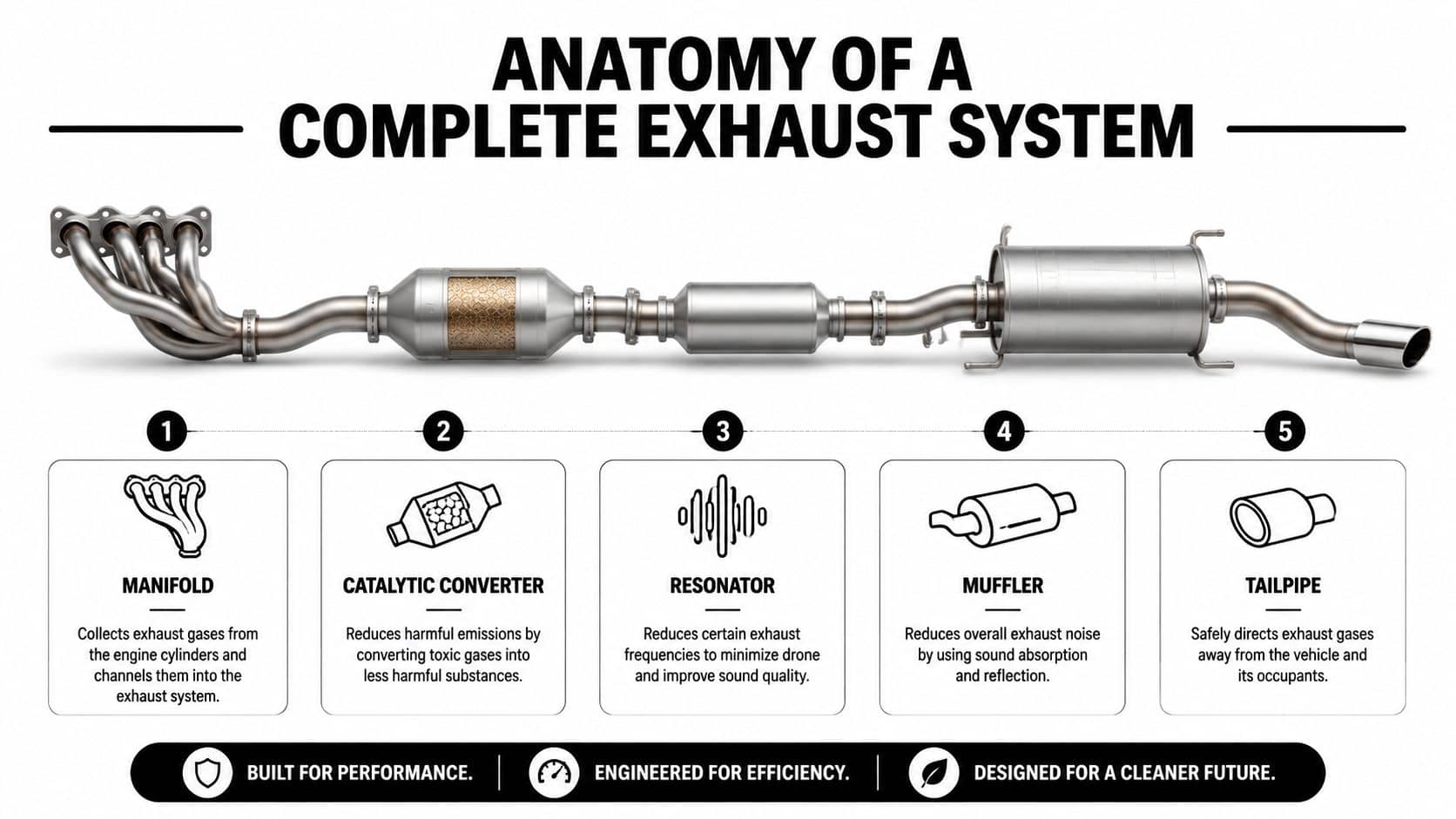
From the engine to the road
The manifold collects exhaust gas from the engine's cylinders. On some vehicles it's a separate cast or fabricated component, while others use a manifold integrated with the catalytic converter. Heat shields may surround it because exhaust temperatures are high enough to damage nearby wiring, hoses and bodywork.
The catalytic converter sits further downstream, or forms part of the front assembly. Its job is emissions treatment, so it isn't just a piece of pipe. Oxygen sensors monitor exhaust conditions before and after the catalyst on many petrol vehicles, and their wiring must remain undamaged and correctly positioned.
A flex pipe absorbs movement between the engine and the fixed exhaust underbody. Without that flexible section, engine rocking can stress flanges, welds and the manifold. Flex pipes often fail as a braided outer layer becomes damaged or the inner bellows split.
The gases then travel through intermediate pipes, resonators and silencers. A resonator changes particular frequencies and can reduce harshness, while the main silencer, often called the backbox or muffler, controls overall noise. Hangers, rubber mounts, brackets, clamps, flanges and gaskets hold the system in place and seal its joints.
Why the word complete causes confusion
Suppliers use “complete” differently. One listing may mean a cat-back assembly, beginning behind the catalytic converter. Another may include the front pipe and flex section but exclude the catalyst. A vehicle-specific kit might contain pipes, a centre silencer, a rear silencer, clamps and gaskets, yet require the original mounting brackets or heat shields.
Use this checklist before accepting a quote:
System boundaries: Ask whether the price covers the manifold, catalyst, front pipe, flex section, centre pipe, resonator, backbox and tailpipe.
Fitting hardware: Confirm whether gaskets, clamps, springs, bolts and rubber hangers are included.
Emissions equipment: Check whether the catalytic converter or diesel particulate filter is part of the assembly, rather than assuming it is.
Vehicle matching: Verify the exact engine, body style, wheelbase and exhaust configuration.
Workshop rule: A complete system is a description of coverage, not a guarantee that every component is included.
The distinction protects you from paying for parts you don't need or discovering halfway through installation that the essential gasket, flange or sensor boss wasn't supplied.
Full Replacement Versus Partial Repair
The right repair starts with the condition of the sections that haven't failed. A garage should inspect the entire system on a lift, not diagnose it from the noise alone. Surface rust on a silencer can be harmless, whereas a perforation, failed seam, leaking joint or insecure mount can make the vehicle unsafe or cause an MOT problem.
UK driving conditions complicate the decision. UK-focused guidance on exhaust corrosion identifies road salt, coastal air and frequent short journeys as important influences on damage. Short trips leave condensation inside the system, where moisture can remain trapped and encourage internal corrosion. Coastal and northern drivers may also expose the outer surfaces to more salt and humidity.
When a section-only repair makes sense
Partial replacement is usually sensible when the failed area is clearly isolated and the adjacent components remain structurally sound. For example, a rear silencer with a rotten seam can often be replaced without disturbing a healthy catalytic converter and centre pipe. The same applies to a flex section that has failed while the rest of the system is clean, secure and free from thinning metal.
A section repair becomes less attractive when removing one part destroys neighbouring flanges or when several components are already weakened. Cutting through seized clamps, replacing a pipe, then finding that the centre silencer and rear box collapse during removal can turn a small job into a sequence of labour charges and extra parts.
A practical decision test
Ask the installer to separate the estimate into parts and labour. Then compare the likely life of the remaining system with the cost of returning to the garage later.
Condition found during inspection | Sensible direction |
One failed section, solid adjoining pipes and usable fasteners | Replace the failed section |
Several perforations, thin pipe and rotten joints | Consider a complete assembly |
Healthy catalyst but damaged rear silencer | Keep the catalyst and replace the rear section |
Corroded flanges that won't separate cleanly | Price a wider replacement before work begins |
Repeated short trips or heavy salt exposure | Pay closer attention to the condition of hidden sections |
The UK market outlook itself is mixed. One forecast estimates the market at US$619.1 million in 2023, reaching US$792.4 million by 2030 at a 3.6% CAGR, while another projects a decline from US$417.1 million in 2026 to US$347.4 million by 2031, a -4.5% CAGR. These conflicting forecasts, documented by MarketsandMarkets' UK exhaust system market analysis, reflect a market balancing replacement demand against electrification and changing tailpipe requirements. For owners, the useful lesson is simple: don't buy more hardware than the vehicle's condition justifies.
A MOT tester may reject leaks, insecure components or excessive noise, but cosmetic rust alone isn't necessarily a failure. If the tester can identify a sound, securely mounted system with no dangerous leakage, a localised repair may be entirely appropriate. If the metal is visibly failing in several places, a full replacement often offers better value than paying repeatedly for patches.
Real Exhaust Repair - without welding + many tips.
Choosing the Right Exhaust Material for UK Conditions
Material choice changes how an exhaust copes with Britain's wet, salted roads. The cheapest system may be perfectly adequate for a lightly used car in a dry environment, but it can be a false economy for a vehicle that spends winter commuting through treated roads and rarely reaches full operating temperature.
Mild steel generally has the lowest purchase price. It can perform well when new, and an accurately made mild-steel system is often a sensible repair for an older vehicle with limited remaining life. Its weakness is corrosion, particularly around welds, seams, drain points and areas where road spray collects.
Aluminised steel adds a protective aluminium coating to a steel substrate. It can offer a useful middle ground, but the coating is vulnerable where the surface is cut, scratched or welded. Inspect the quality of the welds and the finish rather than treating “aluminised” as a guarantee against rust.
Stainless steel costs more initially but resists external corrosion far better. UK-focused material guidance commonly describes mild-steel systems as lasting 2 to 5 years in harsh conditions, while stainless systems may last 10 years or the life of the vehicle, as outlined by Rustec's advice on UK road salt and corrosion. Those are broad descriptions, not promises. Driving pattern, grade, weld quality and the design of the system still matter.
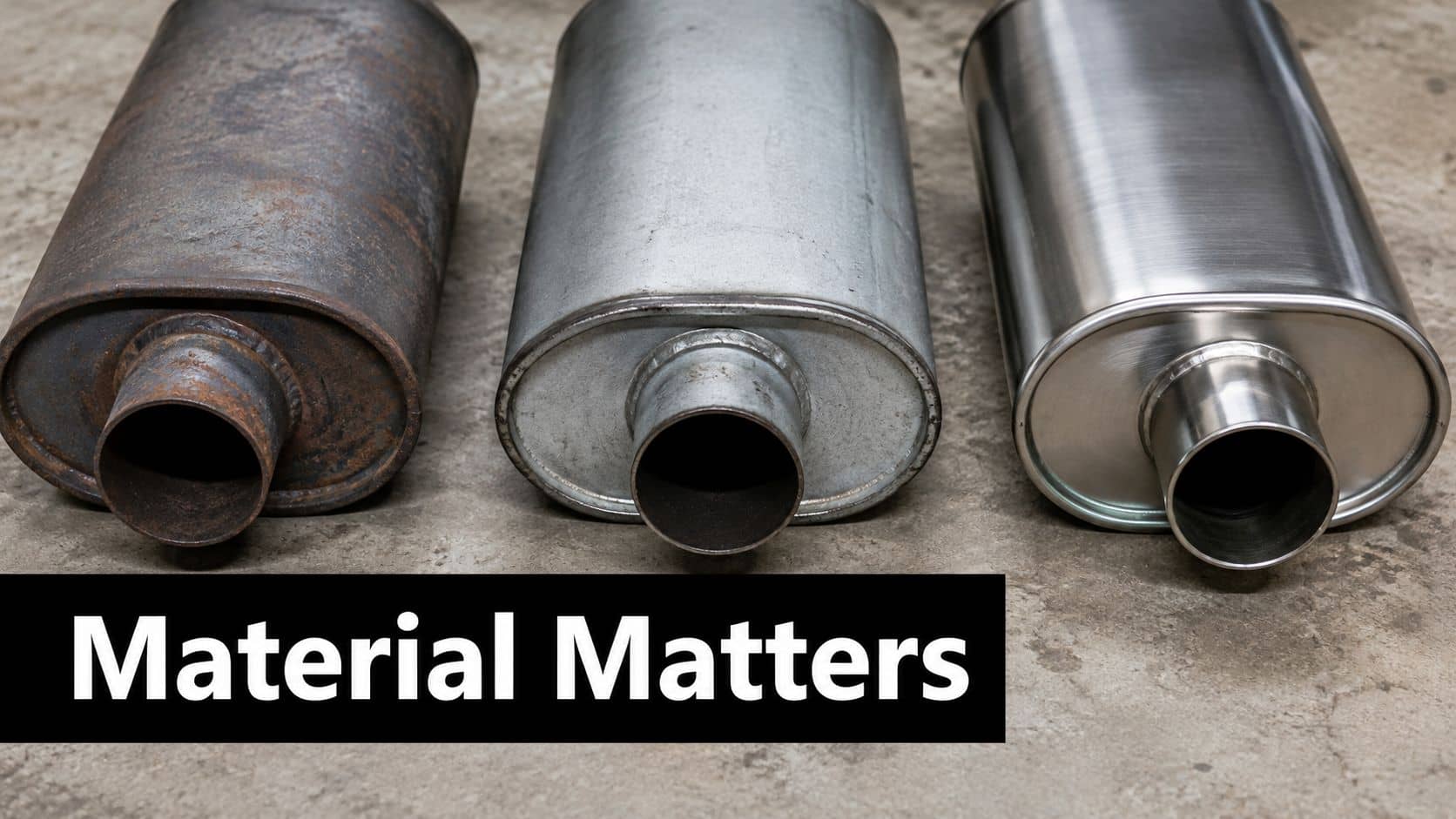
Match the material to the vehicle
A short-trip driver may benefit more from durable construction than from an attractive polished finish. Condensation can remain inside the silencer and pipes when journeys are too brief to evaporate it, so the internal design and drainage provisions matter alongside the outer material.
A coastal driver should examine welds, seams and brackets carefully because those areas often start deteriorating before a straight pipe looks seriously rusty. A regularly used motorway car may warm the system more thoroughly, but it still receives plenty of spray and grit underneath.
Look for a clearly stated material specification, not just “premium exhaust”. Check whether the warranty covers corrosion-through, what exclusions apply, and whether the manufacturer distinguishes surface oxidation from perforation. A longer warranty doesn't prove that a system will outlast every cheaper alternative, but vague coverage should make you cautious.
Value judgement: Stainless steel is worth paying for when the car is sound, you plan to keep it, and corrosion exposure is high. It isn't automatically sensible on a vehicle already approaching the end of its useful life.
UK MOT Rules and Legal Requirements for Exhaust Systems
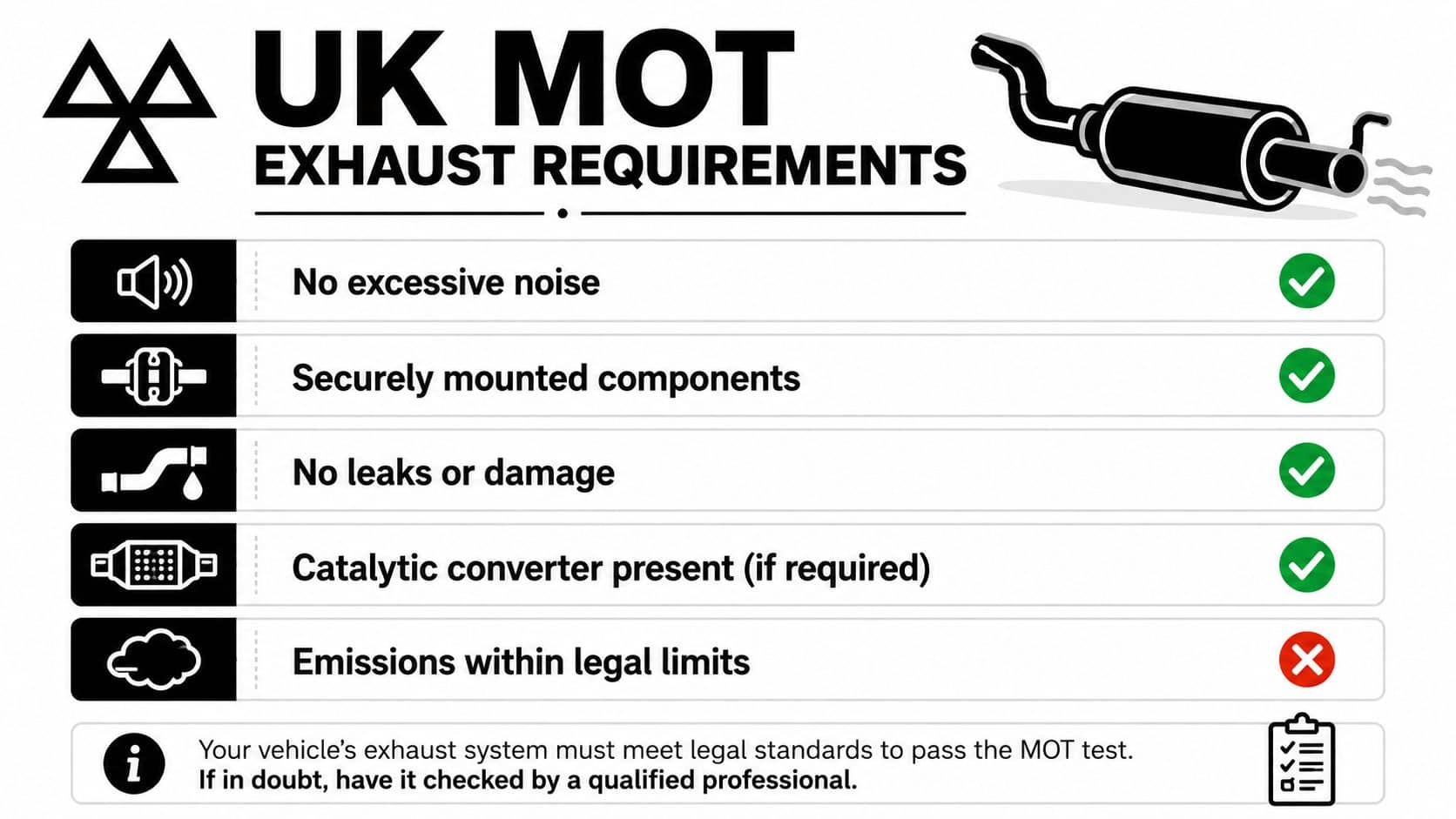
An exhaust has two jobs at MOT time. It must control emissions and noise, and it must remain securely attached without dangerous leakage. A replacement that improves appearance but fails either duty is a poor repair.
UK construction rules require vehicles to have a silencer, with exhaust gases passing through it rather than escaping directly to the atmosphere. The system must be kept in good and efficient working order, and altering it after manufacture to increase noise is illegal under the Road Vehicles Construction and Use Regulations.
What the tester examines
The MOT inspection manual for nuisance items requires inspection of exhaust silencers and visible, identifiable emissions-control components. These can include catalytic converters, oxygen sensors and exhaust gas recirculation valves.
For petrol vehicles first used on or after 1 September 2002, missing, modified or obviously defective original emissions-control equipment is a rejection item. Don't remove a catalyst because the car seems to run acceptably without it. The absence may be obvious to a tester, and the vehicle can also fail its emissions test.
Diesel owners need particular care with the DPF. Rule changes introduced on 20 May 2018 mean a diesel receives a major fault if the tester sees smoke of any colour from the exhaust or finds evidence that the DPF has been tampered with, as set out in the government's in-service exhaust emissions standards guidance.
Noise is part of legality
New-car type-approval noise limits have tightened from 82 dB(A) in 1978 to 70 dB(A) currently, with a further reduction to 68 dB(A) for most new passenger cars by 2026, according to UK government noise-pollution guidance. An aftermarket system must preserve the vehicle's approved noise performance, not just make it louder.
The UK also retains a non-catalyst emissions test route for petrol vehicles without advanced emissions-control systems, described in the government's exhaust-emissions standards document. That doesn't make emissions equipment optional on a vehicle designed to use it.
Installation Considerations and Fitment Overview
Exhaust fitting looks straightforward until a clamp snaps, a stud shears or the old pipe refuses to separate from the catalyst. Safe support is the first requirement. Use proper axle stands on solid ground, allow the exhaust to cool, and never rely on a jack alone while working underneath.
Remove without creating a larger job
A competent installer will inspect the route before loosening anything. They'll identify heat shields, oxygen-sensor wiring, rubber hangers and nearby brake or fuel lines, then apply penetrating fluid to fasteners that can be removed without damaging the surrounding components.
Common tools include deep sockets, breaker bars, oxygen-sensor sockets, pry tools, a hacksaw or reciprocating saw, and a torque wrench. Heat can help with stubborn fasteners, but it needs careful control around fuel lines, underbody coatings and wiring.
Vehicle-specific systems usually offer the cleanest route to correct positioning. Universal pipe may be cheaper, but it can require cutting, bending or welding to clear the floorplan and rear axle. That work isn't a sensible driveway job if you lack fabrication equipment or a safe way to verify clearances.
Alignment matters more than appearance
Start by loosely assembling flanges and clamps, then position the system so it has even clearance from the body, suspension and heat-sensitive components. Tightening one end fully before aligning the other can pull the system sideways and load the rubber mounts.
Replace crushed gaskets rather than reusing them. A new pipe with an old gasket can still blow, and an overtightened clamp can deform a joint instead of sealing it. Check that the rubber hangers aren't stretched, that the tailpipe sits correctly in the bumper aperture, and that no section contacts the body when the engine moves.
Fitment check: Start the engine only after confirming sensor wires, heat shields and hangers are correctly routed. Listen for a leak when cold, then inspect again once the system has warmed and expanded.
A professional installation is justified when fasteners are heavily corroded, the catalyst or DPF needs handling, welding is required, or the system won't align without modifying the vehicle. DIY replacement is more realistic when the kit is vehicle-specific, the fix is downstream, and you have safe support and suitable tools.
Performance, Sound, and the Backbox Decision
The backbox controls much of the exhaust note, but it doesn't work alone. Pipe diameter, internal silencer design, resonator placement and the condition of the rest of the system determine whether the result is mellow, sharp, boomy or unpleasant on a long journey.
A larger pipe can reduce restriction in an engine and exhaust combination designed to use it, but fitting the biggest available tube to a standard road car isn't automatically an upgrade. Excessive diameter can alter gas velocity and create packaging problems, while a poorly chosen silencer can introduce motorway drone without delivering a useful driving benefit.
What “sport” usually changes
A sport backbox may use less internal sound attenuation, different chambers or a freer-flowing core. The driver may notice a deeper note and stronger presence under acceleration. That doesn't mean the car has gained meaningful performance, particularly if the original system wasn't the limiting factor.
Noise also changes with wear. A silencer that develops a hole can sound more aggressive, but that isn't a performance modification. It's a fault, and an exhaust that has been altered to increase noise can breach UK requirements.
The sensible road-car choice is usually an OE-style or restrained performance system that keeps the catalyst, resonator and silencer configuration appropriate for the vehicle. Ask whether the system has been designed for the exact engine and whether it retains the required emissions equipment. Check the mounting points and tailpipe position as carefully as the advertised sound.
A car used for commuting needs a different compromise from a weekend project. Prioritise quiet cruising, low cabin resonance and reliable corrosion protection if the vehicle covers long daily journeys. If sound is the main reason for replacing the backbox, choose a system with a documented noise design rather than relying on a dramatic marketing photograph.
Sourcing Compatible Parts and Getting Value from GSF
A registration lookup is a useful starting point when buying exhaust parts, but it does not confirm every fitment detail. Engine code, emissions standard, body length, transmission and the presence of a separate centre silencer can change what is required. Compare the catalogue result with the car before ordering.
Confirm the assembly before paying
Use the registration-based search, then match the diagram and description to the vehicle on the ramp. Check whether the listing covers a front pipe, centre section, rear silencer, cat-back assembly or a wider system. A “rear pipe silencer” is not the same as a complete exhaust from the manifold rearwards.
Check these points:
Included hardware: Confirm whether clamps, gaskets, bolts and rubber mounts are supplied.
Emissions compatibility: Match catalytic converters and DPF-related parts to the vehicle's original specification.
Fitment notes: Read restrictions for body style, engine variant and production changes.
Returns and warranty: Check the warranty period and whether corrosion-through, fitment and labour are handled separately.
Collection timing: If the vehicle is already dismantled, confirm stock at the chosen branch.
GSF Car Parts provides registration, make and model filtering for exhaust components, including exhaust pipes and catalytic converters. Click & Collect can help when the car is off the road and the correct part is available locally. Established brands and clear warranty terms also give more protection than an unbranded listing.
Aftermarket parts can be good value when their dimensions, material and emissions specification are correct. Main dealer parts may be needed for unusual assemblies or exact original fitment, but they are not automatically the sensible choice. Compare the full installed requirement, including gaskets, clamps and likely labour, rather than judging the price of the longest pipe.
Ordering habit: Photograph the old system before removal, record each flange and hanger position, and keep the registration lookup details with the invoice. These records make wrong-part disputes easier to resolve.
A single failed section surrounded by sound metal usually supports a partial repair. Order the matching section with the correct gasket and clamps, then inspect neighbouring joints before fitting it. UK corrosion often starts around seams, flanges and hangers, so a small visible hole may not be the only weak point.
If corrosion has spread through several joints, price a complete vehicle-specific assembly and compare the labour involved. Replacing one section can be false economy if the next joint breaks during removal or fails soon afterwards. The right purchase is the one that fits correctly, remains legal and suits how long you intend to keep the car.
Check the failed area, surrounding sections and MOT requirements before ordering. For exhaust pipes, catalytic converters and related car parts, visit GSF Car Parts, use the registration finder, and choose delivery or Click & Collect based on how urgently the repair needs completing.





