You turn the key on a cold morning, the engine catches, and for a few seconds it sounds wrong. Not a soft tappet noise. Not the harmless whirr of an old small hatchback. A dry, rattly clatter from the timing end that makes the whole car sound more diesel than petrol.
That noise puts a lot of Corsa owners on edge, and with good reason. On the wrong Vauxhall Corsa engines, timing chain trouble isn’t rare workshop trivia. It’s one of those faults that starts with a brief warning and can finish with a wrecked top end if it’s ignored.
The awkward part is that plenty of owners were told a chain should last the life of the engine. In practice, that isn’t how some Corsa petrols behave. Oil quality, service habits, tensioner condition and plain old wear all matter. Once the chain runs loose, it starts battering guides and throwing valve timing off.
For a DIY owner, the question is usually simple. Is this just a noisy start-up, or am I about to buy an engine? For an apprentice or small garage, the challenge is different. You need to know which Corsas are known for it, how to confirm it properly, and when the smart move is a full kit rather than a patch repair.
That Corsa Rattle A Sound Every Owner Dreads
The usual story starts the same way. The car has been parked overnight. It fires on the first turn, then gives a sharp rattle for a few seconds before settling down. The owner tells themselves they’ll keep an ear on it. A week later it’s louder. Then it starts doing it more often. Then the engine light appears.
That’s the point where a lot of people realise they’re not dealing with a harmless quirk. On affected Corsas, the timing chain is one of the few faults that announces itself early if you listen. Ignore it long enough and the chain can jump timing. Once that happens, valves and pistons can meet, and that repair bill changes fast.
Practical rule: A brief cold-start rattle from the timing side on a known-problem Corsa isn’t something to monitor for months. It’s something to inspect properly.
What makes this issue frustrating is that the car may still drive reasonably well in the early stages. It can idle, pull away, and even pass a casual road test. That fools owners into thinking the noise is cosmetic. It isn’t. The chain’s job is to keep crankshaft and camshaft movement synchronised. If that relationship starts drifting, the engine is running on borrowed time.
The notorious vauxhall corsa timing chain problem is usually tied to wear in the tensioner system and guides, not just the chain itself. That matters, because throwing one part at it rarely fixes the root cause.
The Unseen Heartbeat of Your Corsa Engine
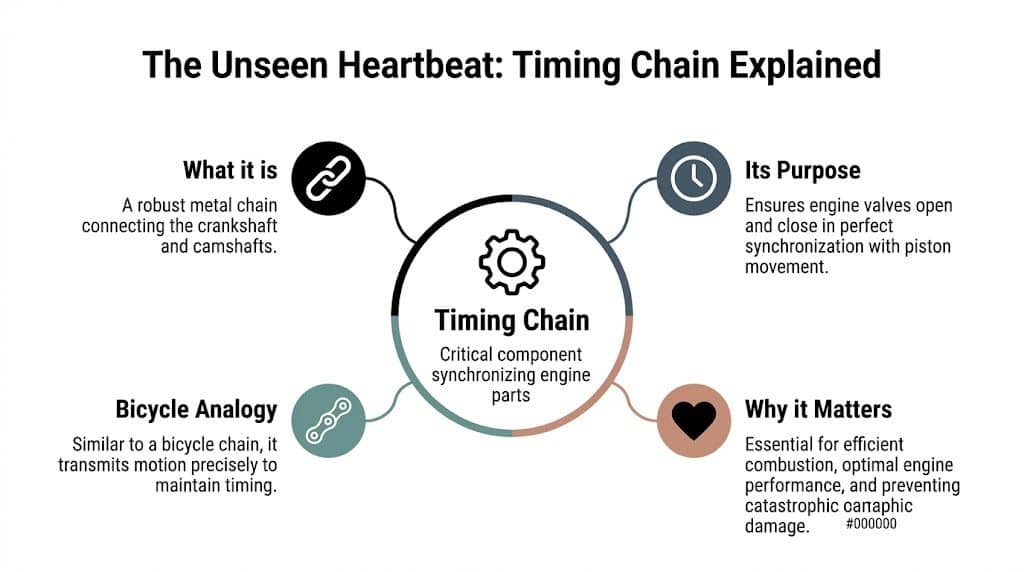
A timing chain is easiest to understand if you think of a bicycle chain. On a bike, the chain transfers movement from one gear to another. In your Corsa engine, the timing chain does a similar job. It links the crankshaft at the bottom end to the camshaft or camshafts at the top so everything stays in step.
When the pistons move, the valves have to open and close at exactly the right moment. If they don’t, combustion timing goes off and the engine runs badly, or not at all. On an interference engine, bad timing can do much worse than that.
Why a chain was used in the first place
Manufacturers often fit chains instead of belts because a chain is a metal component designed for long service life. In theory, that sounds ideal. It lives inside the engine, runs in oil, and isn’t treated like a normal service item in the way many belts are.
That’s the theory. The actual weakness on some Corsa petrol engines sits in the control system around the chain.
The key part is the hydraulic tensioner. It uses oil pressure to keep the chain tight. If oil pressure isn’t right, or the oil has degraded, the tensioner can’t hold the chain as firmly as it should. Then the chain starts to run slack.
What actually goes wrong
Once there’s slack in the system, the chain can slap against the guides. That’s where the familiar cold-start rattle often begins. As wear progresses, the guides, sprockets and chain all start suffering together.
In earlier Corsa models, particularly the Corsa C from 2000 to 2006, timing chain failure is primarily linked to a loose timing chain tensioner that relies on oil pressure to function. With degraded oil, pressure drops, the chain slackens, and failure often shows up around 60,000 to 100,000 miles. UK garages cited by ClickMechanic’s guide to common Vauxhall Corsa problems also report that pre-emptively replacing the tensioner kit and using 5W-30 Dexos-spec oil can prevent up to 90% of these failures.
That’s why oil changes matter so much on these engines. Owners often focus on the chain as if it’s a sealed-for-life item. It isn’t independent of the rest of the engine. Dirty or tired oil directly affects how the tensioner behaves.
A chain doesn’t just wear because it’s old. It wears because the parts controlling it stop controlling it properly.
What works and what doesn’t
Some habits help. Some don’t.
Good practice: Using the correct oil grade and changing it on time gives the hydraulic tensioner the best chance of doing its job.
Bad practice: Stretching service intervals and topping up with whatever oil is available tends to shorten chain life.
Good judgement: Replacing the full wear set when noise starts becoming consistent is usually the sensible call.
False economy: Fitting only a chain and leaving old guides or an old tensioner in place often lands the car back in the workshop.
If you understand that the Vauxhall corsa timing chain relies on oil pressure and guide condition, the whole failure pattern starts to make sense. It isn’t random. It’s mechanical, predictable, and usually audible before it gets expensive.
Which Vauxhall Corsa Models Have a Timing Chain
Owners need to be careful, because “Corsa” by itself doesn’t tell you enough. You need the generation, year and engine. Some Corsa's use a chain. Some use a belt. Even within one shape, the timing setup can vary.
For the well-known UK chain issue, the main engines people talk about are the smaller petrol units in the Corsa C and Corsa D, especially the 1.2 and 1.4 petrol engines. Those are the cars that most often come into conversation when a cold-start rattle appears.
Quick model guide
Corsa Generation | Years | Common Petrol Engines | Timing System |
Corsa C | 2000-2006 | 1.0, 1.2, 1.4 petrol | Timing chain on the commonly affected earlier petrol engines |
Corsa D | 2006-2014 | 1.2, 1.4 petrol | Timing chain on the commonly affected petrol engines |
Corsa E | Later generation | Petrol engines vary by engine | Check by registration or engine code before ordering parts |
Corsa F | Later generation | Petrol engines vary by engine | Check by registration or engine code before ordering parts |
That table is deliberately cautious on the later cars. Once you move away from the classic C and D problem years, you shouldn’t assume anything from badge size alone. Reg lookup or engine code is the safer route.
The models that deserve the closest attention
If you’re looking at workshop patterns rather than brochure theory, these are the cars that ring alarm bells first:
Corsa C petrols: Especially the 1.2 and 1.4 engines that built the car’s reputation for chain noise and tensioner trouble.
Corsa D 1.4 petrols: These need extra caution because there’s more than one failure path.
High-mileage town cars: Repeated cold starts, short trips and inconsistent servicing don’t help chain systems.
The Corsa D 1.4L engines from 2006 to 2014 can also suffer from fractured camshaft “fingers” that jam the chain. The issue was serious enough for Vauxhall to issue a UK recall to check camshaft bolt torque, and failures often peak around 70,000 miles in urban cars. Post-2010 models received updated cam phaser kits to mitigate the problem, as discussed in the Honest John forum thread covering the recall-related camshaft issue.
Why this detail matters before buying parts
A rattling Corsa C 1.2 and a rattling early Corsa D 1.4 might sound similar to the owner. They aren’t always the same repair in practice. One may be a straightforward chain wear job. The other may need a closer look at cam hardware and bolt history.
If you don’t identify the engine properly first, you can order the wrong kit, miss a known weak point, and waste a full day in the bay.
That’s also why experienced garages ask for the registration or engine code before quoting. On a vauxhall corsa timing chain job, the exact variant matters more than people think.
Recognising the Symptoms of a Failing Timing Chain
The sound is usually the first thing observed. It’s usually a diesel-like rattle on cold starts, often after the car has sat overnight. The engine fires, rattles from the timing side, then quietens down as oil pressure builds.
That short burst of noise is easy to dismiss. Owners often say, “It only does it for a second or two.” That’s still a warning. A healthy chain system shouldn’t need to clatter while the tensioner catches up.
What the noise usually sounds like
Owners describe it in different ways, but a few descriptions come up again and again:
A dry metallic chatter: More mechanical than a soft top-end tick.
Marbles in a tin can: Especially in the first moments after start-up.
A small diesel clatter: Common on petrol Corsas with chain slack.
If the fault progresses, the sound may stop being a start-up-only issue. It can turn into a metallic tapping at idle, or a more persistent rattle that follows engine speed.
The symptoms beyond noise
A stretched chain doesn’t only make sound. It can alter valve timing enough to change how the engine behaves.
Look for a mix of these signs:
Engine management light: Timing-related fault codes can appear, including P0011 and P0016
.
Rough idle: The engine may feel uneven, especially once warm.
Hesitation under load: Pulling away or accelerating can feel flat or ragged.
Fuel use creeping up: A timing issue can show up as reduced efficiency.
According to Star Garage Mansfield’s write-up on Corsa timing chain slap, the classic symptom is a diesel-like rattle on cold starts. The same source notes metallic tapping at idle, check engine lights with timing fault codes such as P0011, and a 10-15% reduction in fuel economy. It also states that UK replacement cost averages about £688, with regional variation from £550 to £800.
What a worsening fault feels like on the road
Once timing starts drifting, the car often feels slightly off before it feels seriously ill. That’s part of the trap. It may still start. It may still get through town. But throttle response can feel lazy, idle quality can go coarse, and the engine can sound harsher than it used to.
There’s also a point where the fault stops being gradual. If a guide breaks up or the chain jumps, the engine can go from noisy-but-running to non-running very quickly.
Plastic debris in the sump or timing cover area is a bad sign. It usually means the guides are no longer just worn. They’re coming apart.
What people often misdiagnose
Not every start-up noise is a timing chain. Auxiliary belt noise, tappets, weak oil filter anti-drainback valves and exhaust leaks can all confuse the picture. The difference is where the sound comes from, how long it lasts, and whether the engine behaviour has changed with it.
A top-end tick that doesn’t alter with timing faults is one thing. A timing-end rattle with poor idle and fault codes is another.
If the car has the known engine, the right noise, and one or two extra symptoms alongside it, don’t keep driving it and hoping for silence. That usually ends with a bigger invoice than the chain job would have been.
How to Diagnose a Suspect Vauxhall Corsa Timing Chain
A proper diagnosis starts with discipline. Don’t jump straight to ordering parts because the engine made one bad noise. Equally, don’t ignore a pattern that keeps repeating. Confirm it methodically.
Start with the simple checks
Listen to the engine from cold, not after it’s already been run. The first few seconds tell you more than a warm idle ever will. Stand at the timing side and pay attention to where the noise begins and how quickly it fades.
Then check the basics:
Oil level and condition: If it’s low, thick, dirty or overdue, the tensioner may not be getting what it needs.
Service history: Long gaps between oil changes matter on these engines.
Fault memory: Even when the car seems to drive acceptably, stored timing codes can point you in the right direction.
Read the codes properly
An OBD-II scanner won’t tell you “the chain is stretched”, but it can tell you the cam and crank relationship isn’t where the ECU expects it to be. Codes such as P0011 or P0016 are strong reasons to look deeper when paired with noise.
Don’t make the mistake of treating those codes as purely electrical. People often chase sensors first because it’s cheaper. Sometimes a sensor is the issue. On a noisy Corsa with the known symptoms, mechanical wear is often the cause.
Use your ears and eyes
A mechanic’s stethoscope helps, because it lets you compare sounds across the rocker cover, timing cover and ancillary area. If the harshest noise sits at the chain end, that’s useful evidence.
If access allows, visual inspection tells you more. Depending on engine variant and how far you want to go, you may inspect under the cam cover for obvious slack, witness marks, guide wear or signs that the chain has been running out of line.
Don’t confuse “still running” with “safe to keep using”. Chains can stay noisy for a while, then fail suddenly after one more cold start.
Check the oil for clues
One of the most useful workshop checks happens during an oil drain. Look for debris. Fine metallic contamination is never good, but plastic fragments matter a lot on these engines because guide material can break up and drop into the sump.
If you find plastic pieces, you’re past the stage of wondering whether to monitor it. At that point the system needs opening up.
Locking tools matter if you go further
If you’re moving from diagnosis into strip-down, use the proper setting and locking kit. Guessing cam position with paint marks is how engines leave on a recovery truck. Dedicated timing setting and locking tools for engine work make the job more controlled and reduce the chance of setting the engine out by a tooth.
For a garage apprentice, that’s one of the first lessons worth learning. The diagnosis may begin with your ears, but confirmation often depends on proper mechanical setup. On a Vauxhall corsa timing chain job, shortcuts don’t stay hidden for long.
The Corsa Timing Chain Replacement Job Explained
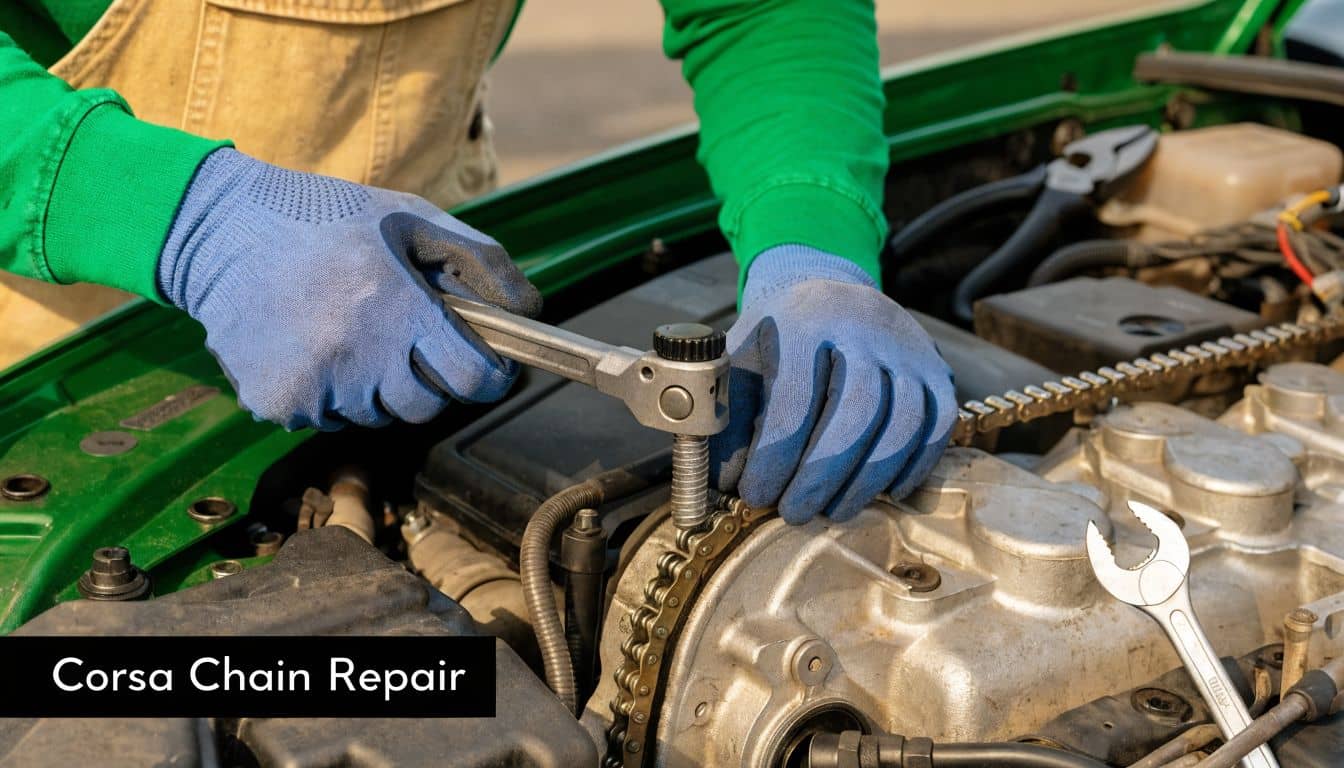
A Corsa timing chain replacement sounds simple when written on an estimate. In the workshop, it isn’t. This is one of those jobs where the phrase “while you’re in there” exists for a reason.
What should be replaced
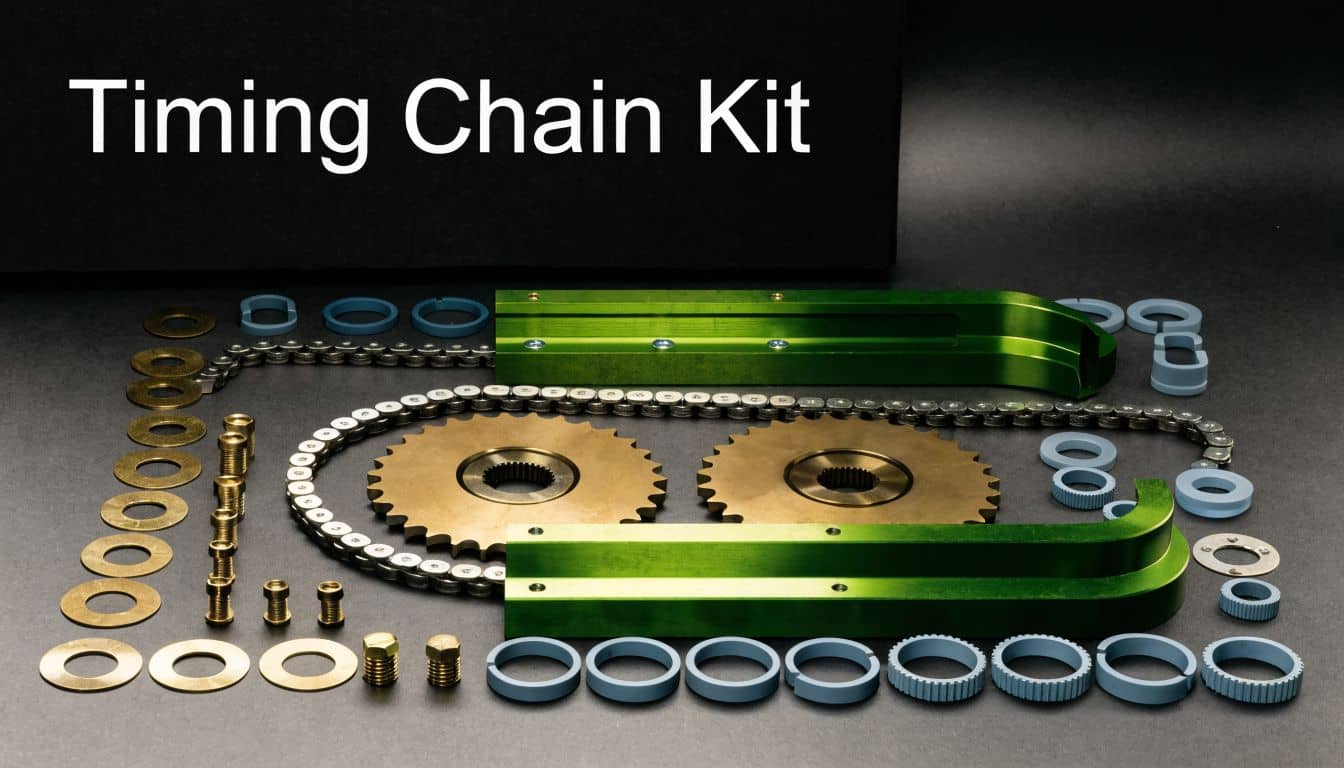
The smart repair is usually a full timing chain kit, not just a chain on its own. That means looking at the wear system as a package.
Typical kit contents include:
The chain itself: Obvious, but only one part of the failure pattern.
Tensioner: Essential on these engines because it’s often the root cause of slack.
Guides and rails: If the chain has been slapping, these may already be worn or cracked.
Sprockets where required: Worn mating surfaces can shorten the life of the new chain.
Seals and gaskets: Skipping these is how oil leaks begin right after the repair.
If the engine variant is one known for tensioner trouble, changing the timing chain tensioner components in isolation only makes sense in a very narrow set of circumstances. On a noisy, high-mileage engine with known wear, it’s usually false economy.
Why labour is the expensive part
This job takes time because access is awkward and precision matters. Depending on engine variant, the repair can involve removing covers, locking the engine in position, dealing with sealant joints, and in some cases dropping the sump because of how the front cover and lower sections overlap.
That’s why the labour bill often catches owners out. The parts aren’t the whole story. You’re paying for disassembly, correct timing setup, careful reassembly, and the risk that sits with the person doing it.
A lot of DIY owners also underestimate the clean-up and checking involved. Mating faces have to be right. Debris has to be removed. Oil pick-up contamination can’t be ignored if the guides have been disintegrating.
Real cost trade-offs
The earlier section covered the UK average and regional spread for a replacement job. In real terms, the decision usually comes down to this. Pay for the timing job while the engine is still in good shape, or risk paying for engine damage afterwards.
That trade-off gets sharper when the chain has already jumped timing, because then you’re not just discussing wear parts. You may be into valve damage and cylinder head work.
Here’s a practical way to understand it:
Repair path | What you’re paying for | Risk level |
Minimal repair | Selected parts only | Higher chance of repeat failure |
Full timing kit job | Chain system renewed properly | Lower comeback risk if fitted correctly |
Keep driving | No immediate spend | Highest risk of major engine damage |
DIY or professional
Some experienced DIYers can do this job. Most owners shouldn’t. That isn’t gatekeeping. It’s just honest.
DIY might make sense if you already have strong engine timing experience, proper locking tools, torque data, clean workspace discipline and enough time to stop if something doesn’t line up. If any of that is missing, the savings vanish quickly.
Professional repair makes more sense when:
You need the car back quickly
You don’t have locking tools or torque-angle equipment
You’re not comfortable checking timing by the book
The engine may already have secondary damage
This video gives a useful visual sense of what’s involved in a timing chain strip and refit on this kind of small petrol engine:
Corsa 1.2 Timing Chain Replacement
What works in the real world
A proper repair means replacing the worn system, setting timing accurately, changing the oil and filter afterwards, and listening carefully on first start-up. It also means not treating a fresh chain as a cure for every rattle. If the cam hardware has its own known issues, those need checking too.
The cheapest invoice isn’t always the cheapest outcome. A poor chain job can cost twice when the engine comes back mis-timed or still noisy.
For a trade garage, comeback avoidance is the whole game. For a DIY owner, the question is simpler. If you can’t guarantee timing accuracy, don’t gamble the engine to save labour.
Find the Correct Timing Chain Kit at GSF Car Parts
Buying timing parts for a Corsa gets messy when owners shop by guesswork. “It’s a 1.4 Corsa” isn’t enough. Production changes, engine variants and kit contents all matter. The safest route is always to identify the exact car first, then filter parts around that.
The simplest way to narrow it down
Use a registration-based parts finder rather than browsing blind. On the timing chain kit section at GSF Car Parts, the usual process is straightforward:
Enter your registration number.
Let the site identify the vehicle details.
Go to the engine and timing category.
Check the kit contents against the job you’re doing.
That matters because some repairs need more than the chain alone. If you’re dealing with known wear, you’ll want to verify whether the listing includes guides, tensioner and related hardware.
What to confirm before you click buy
Don’t just match the badge. Confirm the details that affect fitment:
Engine size and code: Similar-looking Corsas can use different setups.
Build year: Mid-generation changes can alter parts.
What’s in the box: Some listings are chain-only, some are fuller kits.
Whether you also need ancillary items: Oil, filter, sealant and one-time-use fasteners can hold a job up.
If you’re ordering for the trade, it also helps to decide before collection whether you’re replacing only what failed or resetting the whole timing wear system. On these engines, the second option is usually the one that avoids repeat work.
Vauxhall Corsa Timing Chain FAQs
What oil should I use to help prevent timing chain wear
For the known problem engines, 5W-30 Dexos-spec oil is the safe recommendation mentioned in the earlier cited Corsa fault data. The reason is simple. The hydraulic tensioner depends on oil pressure and oil condition. If the oil is wrong, old, or contaminated, the tensioner can’t control the chain properly.
Using the right oil won’t rescue a worn-out chain, but it does help the system live longer.
Should I replace the chain before it fails
On these Corsas, a proactive approach makes sense once mileage and symptoms start lining up. Earlier verified trade guidance points to replacing the tensioner kit during 80,000-mile services on susceptible engines, and regular oil changes every 6,000 to 8,000 miles are part of keeping the chain alive longer on the known problem cars. If the engine is already rattling on cold starts, you’re beyond the stage of “wait and see”.
A chain doesn’t need to snap to justify replacement. If it’s noisy, showing timing faults, or there’s evidence of guide wear, that’s enough.
Can a timing chain last the life of the engine
Sometimes, yes. On the affected Corsa petrols, not reliably enough to treat that as a rule.
Marketing language and workshop reality often diverge. Chains can last a very long time in well-maintained engines. But these Corsas have a reputation for tensioner-related slack and wear. If the servicing has been poor, the “lifetime” idea doesn’t mean much.
“Lifetime” only means anything if the oil stays clean, the tensioner stays healthy, and the guides stay intact.
Are ULEZ and CAZ driving conditions making the problem worse
This is one of the more interesting current questions around the vauxhall corsa timing chain, especially on 1.4 petrol Corsas used in urban areas. Anecdotal forum data from 2025 suggests a 40% rise in chain stretch claims, potentially linked to increased idling in low-speed emissions zones that may accelerate tensioner degradation, according to this discussion of common Corsa problems and the emerging emissions-zone question.
That isn’t a reason to panic, but it is a reason to be stricter about maintenance if the car spends its life in slow traffic. The same source notes that high-zinc oils and quality filters from brands such as Mann or Mahle may help reduce rattle symptoms in those conditions.
If your Corsa has started rattling on cold starts, don’t leave it to chance. Check the exact vehicle details, inspect what the job really needs, and source the right parts before minor chain wear turns into major engine damage. You can look up compatible timing components, tools, oils and service items through GSF Car Parts using your registration so you’re working from the correct fitment rather than guesswork.