If you're searching for timing belt Nissan Qashqai, you're probably in one of three situations. You've bought a used Qashqai and don't know if it has a belt or chain. Your garage has mentioned a belt service and you want to know if it's really due. Or you've heard a horror story about a snapped belt and don't want your engine to be next.
That caution is sensible. On a Qashqai diesel, the timing belt isn't just another service item you can put off until next month. Get it right and the engine keeps everything in sync. Get it wrong, or ignore the hidden weak spots, and the damage can be severe.
A lot of guides stop at the replacement interval. That helps, but it doesn't tell the whole story. On these cars, especially the 1.5 dCi, two less-publicised risks matter just as much in the UK: an older belt-friction issue on some early cars, and water pump trouble that can take the belt out with it.
Your Qashqai Engine Timing System Belt or Chain
A lot of wasted money starts here. Owners book a belt job on a petrol Qashqai that uses a chain, or assume every Qashqai is chain-driven and miss a diesel belt service that can end badly.
On this model, the basic rule is simple. Most diesel Qashqais, including the 1.5 dCi and 1.7 dCi, use a timing belt. Most petrol Qashqais use a timing chain. That sounds straightforward, but badges and model years can still catch people out, especially on used UK cars with patchy history.
A timing chain is a metal chain running inside the engine, lubricated by engine oil. A timing belt is a reinforced toothed belt designed to keep the crankshaft and camshaft in step. Both do the same job. They keep the engine's moving parts timed properly, like a conductor keeping an orchestra together. On a belt-driven diesel, that timing system is a scheduled maintenance item. On a chain-driven petrol, there usually is no routine replacement interval, but that does not mean no checks are needed.
Nissan Qashqai engine timing system reference
Engine Type | Engine Code (Example) | Timing System | Key Maintenance Note |
1.5 dCi diesel | K9K | Timing belt | Replace on schedule and change related components at the same time |
1.7 dCi diesel | Not listed here as a specific code | Timing belt | Age matters as much as mileage |
1.6 petrol | Example only | Timing chain | No routine chain change interval, but condition still needs checking |
2.0 petrol | Example only | Timing chain | General inspection still matters even without a belt service |
Later petrol variants | Varies by model year | Timing chain | Confirm by reg or engine code before ordering parts |
The 1.5 dCi K9K is the one I tell owners to identify first, because it carries the two Qashqai-specific risks many generic guides skip. Early versions had a known belt-friction issue on some vehicles, linked to misalignment and contact in the timing area. Renault issued technical action on related K9K applications, which matters because this engine family sits under the skin of many Nissan diesels too, as documented in the Renault technical recall record for affected 1.5 dCi models. If you are looking at an older diesel Qashqai with incomplete paperwork, that history is worth checking.
The second trap is newer and less talked about. On belt-driven Qashqai diesels, a failing water pump can start the chain of events that finishes with belt damage or belt failure. I have seen owners focus on the belt interval and miss slight coolant loss, bearing noise, or staining around the pump. That is backwards. If the pump starts to wobble or seize, the belt system suffers with it.
Why Nissan uses both systems
Chains usually suit engines designed around long service life and oil-fed internal components. Belts are quieter, lighter, and often cheaper to package and replace, but they age whether the car is doing motorway miles or sitting on a driveway.
That is why low mileage does not always mean low risk on a diesel Qashqai.
The other common mix-up is the timing belt versus the auxiliary belt. They are different parts with very different consequences. The auxiliary belt runs external accessories. The timing belt controls internal engine timing. Replacing one does not mean the other has been done.
How to identify yours properly
Use this order and you will avoid most mistakes:
Check the fuel type first. Petrol usually means chain. Diesel usually means belt on the common Qashqai engines.
Confirm the engine code.K9K is the familiar 1.5 dCi code many owners will see on parts listings and workshop systems.
Use the registration or VIN when buying parts. That is the safest way to match the exact engine variant.
Read old invoices carefully. A previous bill for a belt kit, tensioner, idlers, or water pump is a strong clue that the engine is belt-driven.
Do not rely on forum guesses or the badge on the tailgate. Qashqai generations, facelifts, and engine updates make that risky.
Get this part right before spending anything. Misidentifying a chain engine as a belt engine is inconvenient. Misidentifying a belt-driven diesel as a chain engine can cost an engine.
Symptoms of a Worn or Failing Timing Belt
Timing belts don't always fail without warning. Sometimes they do, which is why scheduled replacement matters. But before that point, many Qashqais give clues that something in the timing drive isn't happy.
The signs tend to show up in three ways. What you hear, what you feel, and what you can see.
What you might hear
A healthy timing belt system should be quiet. If the belt, tensioner, idler, or a driven component starts going off line, the noise often changes first.
Listen for:
A ticking or light slapping sound from the belt side of the engine. That can point to loss of proper belt tension.
A rougher mechanical whirr than usual. Often this suggests a pulley or tensioner bearing is getting unhappy.
Intermittent squealing that doesn't behave like a normal auxiliary belt squeal. Owners sometimes misread this and replace the wrong belt first.
The problem with sound alone is that several engine components can mimic each other. A worn auxiliary setup can sound similar. So noise is a clue, not a diagnosis.
What you might feel while driving
Once belt timing starts drifting, engine behaviour changes because the camshaft and crankshaft are no longer working in perfect sync. Even a small change in valve timing can show up in how the car starts and runs.
Common complaints include:
Hard starting, especially when the engine should normally fire cleanly
Uneven idle that feels rougher than normal
Lack of smooth pull through the rev range
Misfire-like behaviour or hesitation
These symptoms don't prove the timing belt is at fault, but they should move it up the suspect list, especially on a diesel Qashqai with an overdue service history.
If the engine suddenly starts running differently and the belt interval is unknown, don't keep driving it just to "see if it clears". That's how a manageable job turns into an engine rebuild.
For a general visual walkthrough of the area and components, this clip is a useful reference point:
SYMPTOMS OF A BAD TIMING BELT OR TIMING CHAIN
What you might see during inspection
On some cars, you can inspect part of the belt area once covers are removed. On others, access is limited and you won't see much without more dismantling. If the belt is visible, check its condition carefully.
Things that raise concern:
Fraying at the belt edge
Cracking in the belt material
Contamination from oil or coolant
Uneven wear marks
Dust or debris around pulleys and covers
Edge fray matters more than many owners realise. It can suggest misalignment, rubbing, or a related component starting to fail rather than simple age alone.
When symptoms become serious
The danger zone starts when a mild symptom turns into a sudden change. A belt that's only slightly noisy on Monday can become a non-start by Friday if a pulley bearing or pump seizes. At that point, you're no longer diagnosing wear. You're dealing with the aftermath.
If your Qashqai is due, overdue, or has an unknown history, don't wait for a perfect symptom list. Timing belt problems don't always read out neatly like a warning lamp. They often show up as small signs that get dismissed until the engine forces the issue.
The Complete Timing Belt Kit What You Must Replace
Replacing only the belt is one of the most expensive ways to try saving money.
A proper timing job on a Qashqai diesel is about the system, not the strip of rubber on its own. Belt, tensioner, idlers, and often the water pump all work together. If one old part fails after you've fitted a fresh belt, the new belt can be destroyed with it.
That’s why experienced technicians prefer a full kit. It's the same logic as fitting one new tyre on a car with three badly worn ones and expecting the whole set-up to behave properly. The newest part is only as reliable as the weakest one left behind.
What a complete kit usually includes
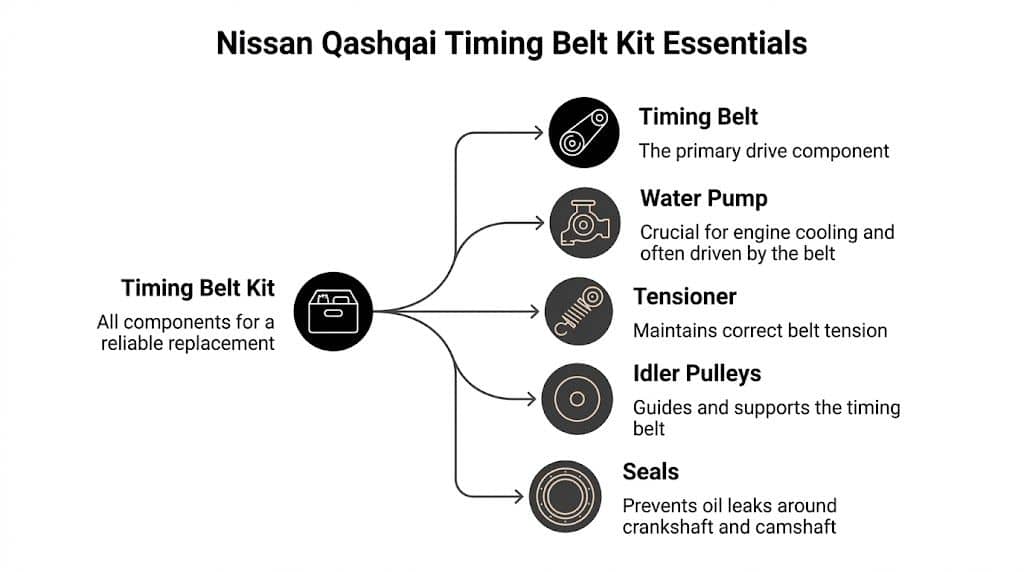
Most kits for a belt-driven Qashqai diesel are built around a few key pieces:
Timing belt
This is the main drive component. It synchronises the crankshaft and camshaft, and on these engines that timing has to stay exact.Tensioner
The tensioner keeps the belt loaded correctly. Too loose and the belt can flap, jump, or wear badly. Too tight and bearings and belt material suffer.Idler pulleys
These guide the belt path and support stable running. An idler bearing can fail even if the belt itself still looks decent.Water pump
This is the part many generic guides underplay. On the 1.5 dCi in particular, pump trouble is a real-world risk area, not a theoretical extra.Seals and small hardware
Depending on the kit and engine, seals and related fittings may be included. These matter because oil leaks and coolant leaks shorten belt life.
The straightforward way to avoid mixing mismatched components is to buy a complete timing belt kit for the Nissan Qashqai engine range rather than piecing the job together one item at a time.
Why tensioners and pulleys matter just as much
A belt lives by alignment and tension. If the tensioner isn't controlling belt load correctly, the belt can wear in ways that don't make sense at first glance. If an idler develops play, the belt path changes and edge wear starts.
Owners often look at the old belt and say, "It still looks alright." That can be misleading. A pulley bearing can be failing without obvious belt damage yet. Fit a new belt over worn bearings and you've built a short-term repair.
Workshop habit: When the front of the engine is already stripped for belt access, that's the time to replace the wear components around it. Doing half the job means paying twice if one old part gives up.
The water pump question
Trade experience often differs from the bare minimum schedule. The pump may not always be listed by owners as the headline timing component, but if it seizes or drags, it can take the belt down with it.
That’s why so many mechanics treat the pump as part of the timing service on the diesel Qashqai. It's preventive maintenance in every sense of the word. Not because every old pump will fail tomorrow, but because the labour overlap is there and the consequences of leaving it can be severe.
What doesn't work
These shortcuts usually end badly:
Changing the belt but reusing noisy pulleys
Ignoring a slight coolant issue near the pump area
Using mixed-brand components with uncertain fit
Skipping seals when there's already evidence of contamination
Treating the belt interval as the only thing that matters
The best timing belt Nissan Qashqai repair is the boring one. Correct parts, complete kit, clean installation, no guesswork.
Qashqai Timing Belt Intervals and Hidden Dangers
A Qashqai comes in on a recovery truck with no warning lights beforehand, just a sudden cut-out on the school run. The owner wants to know one thing. "But it wasn't due yet, was it?" That question comes up a lot on diesel Qashqais, and it misses how these failures often happen.
Service interval matters, but it is only part of the picture. On UK Qashqai diesels, especially the 1.5 dCi, two faults deserve as much attention as the mileage on the dash. One is an older friction issue on some early cars. The other is a water pump that starts dragging and takes the belt with it.
The interval depends on engine, age, and use
You will see broad timing belt advice across different cars, but the Qashqai needs checking by exact engine code and service schedule, not forum guesses. Some guidance for the 1.5 dCi points owners to a shorter replacement window than the headline diesel figure often repeated online, as noted by CompleteCar's Qashqai servicing guide.
Age matters just as much as mileage. A low-mileage car that does short trips, cold starts, and long periods standing can still be hard on the belt system. Rubber ages. Bearings dry out. Coolant leaks start small.
If you are checking the history yourself, confirm the exact engine first, then compare the paperwork against the proper schedule. If a garage is doing the job, they should be using the correct engine timing setting and locking tools for the engine variant rather than marking pulleys and hoping for the best.
Hidden danger number one, early 1.5 dCi belt friction
Some early UK 1.5 dCi cars had a known problem that still catches second-hand buyers out. A 2013 DVSA recall notice for certain Nissan Qashqai models records cases where the timing belt could chafe, with the risk of fraying and eventual failure.
In the workshop, belt edge wear always gets my attention because it usually points to a cause, not just age. If a belt has been rubbing, fitting another one without checking alignment, pump condition, covers, and surrounding hardware is asking for the same fault twice.
On an early 1.5 dCi, check these points before you trust the service history:
VIN recall history
Paperwork showing the recall work was done
Fraying at the belt edge rather than normal cracking
Dust or debris inside the timing cover area
Any previous notes about the high-pressure pump or belt tracking
Hidden danger number two, water pump drag or seizure
This is the one many owners never hear about until the belt has already gone. On these diesel engines, the water pump can become the trigger for failure if its bearing starts to roughen up or lock. The belt is then forced to drive a component that no longer turns freely, and the load goes up fast.
Gates, one of the main belt-system manufacturers, makes the trade point clearly in its timing belt and water pump replacement guidance. If the pump is worn, leaking, or starting to seize, belt life is affected, and replacing the belt alone leaves the main risk in place.
That matters on a Qashqai because a car can still be inside its interval on paper and already have a pump problem developing.
Watch for:
Coolant staining around the pump area
A chirping, rumbling, or rough bearing noise from the timing end
Past overheating or unexplained coolant loss
A previous belt change where the pump was left in place
What a careful owner should do
For a diesel Qashqai, especially a 1.5 dCi, treat the timing belt schedule as the starting point, not the full answer.
Check the engine code. Check the age of the last job. Check whether the pump, tensioner, and idlers were replaced together. On older 2009-era cars, ask a Nissan dealer to confirm recall history from the VIN. If there is fraying, belt dust, coolant trace, or a noise from the timing side, stop treating those as separate little issues until somebody has inspected the full belt path.
That is how you avoid the nasty version of a timing belt failure. The one that happens before the mileage says it should.
Timing Belt Replacement Costs and DIY Considerations
A Qashqai timing belt job often feels expensive right up until you price an engine rebuild. On these cars, the sensible comparison is not today's bill against doing nothing. It is planned maintenance against bent valves, damaged rockers, and a car off the road.
That matters even more on UK diesel Qashqais because the risk is not limited to the printed interval. As noted earlier, early 1.5 dCi cars had a known belt-friction issue on some vehicles, and a worn water pump can shorten belt life before the mileage suggests trouble. Those two faults change the cost equation.
What a garage quote is actually covering
Owners sometimes look at the price of a belt kit online and wonder why the fitted price is so much higher. The labour is the big part of it.
A proper job usually includes:
Stripping for access
Space is tight on a transverse Qashqai engine, especially the diesel, so getting to the timing end takes time.Locking the engine in the correct position
Timing has to be pinned and checked before any belt-driven parts come off.Replacing the matched wear parts
Belt, tensioner, idlers, and often the water pump are changed as one job.Careful reassembly
Mounts, covers, auxiliary components, and coolant system parts all have to go back correctly.Final checks before first start
The engine is turned over by hand and checked for correct alignment before it is started.
Dealer prices are usually higher. A good independent garage can be the better value if they know Renault-Nissan diesel timing systems and fit the full kit rather than cutting corners.
DIY is possible, but it is precision work
Plenty of capable home mechanics can service a Qashqai. Timing work sits in a different category because small errors do expensive damage.
The 1.5 dCi is a good example. Belt timing, pulley settings, and tightening procedure all have to match the technical method for that engine. If the crank, cam, or pump relationship is even slightly out, the engine may still turn over, but valve timing will be wrong. That is how a job that looked fine on the driveway ends up needing cylinder head work.
Using paint marks and best guesses is how these jobs go wrong.
The tools you need before you even loosen a bolt
For this work, the proper engine setting and locking tools for vehicle service work are part of the job, not an optional extra. You also need an accurate torque wrench, a way to measure angle tightening, and proper workshop data for your exact engine code.
Basic kit includes:
Crankshaft and camshaft locking tools
A torque wrench you trust
Angle-tightening equipment
Support for the engine if a mounting has to be removed
Correct technical data for the engine variant
If you do not already own those tools and know how the locking procedure works, the savings from DIY disappear quickly.
A practical way to decide
DIY makes sense for an owner who has done modern timing-belt jobs before, can identify the exact Qashqai engine fitted, and plans to replace the whole belt path rather than the belt alone.
Book it into a professional if any of this sounds familiar:
It is your first timing job
You are tempted to reuse the old water pump
You cannot confirm the engine code and kit fitment
You do not have the locking kit
You need the car back on the road without delays
I would add one more trade-off. If the car shows any sign of coolant loss, rough pump noise, or past overheating, this is not the job to learn on. On a Qashqai, timing belt replacement is straightforward for somebody equipped and experienced. For everyone else, paying once for the job to be done properly is usually cheaper than paying twice.
Find the Correct Nissan Qashqai Parts at GSF Car Parts
You can do everything right on the labour side and still get caught out by the parts order. I see that a lot with Qashqais, especially diesels, because Nissan used different engine variants across the model run and the listings can look almost identical at a glance.
Start with the registration, then verify the engine code before you buy anything. The reg lookup gets you close. The engine code confirms you are ordering for the unit fitted to the car, not just the badge on the tailgate.
A 1.5 dCi is a good example. Owners often assume every 1.5 dCi timing kit is the same. It is not. Mid-cycle changes, supplier differences, and kit contents can all affect fitment. If the car has had an engine swap at some point, the registration alone may not save you.
A practical way to avoid ordering the wrong kit
Use this checklist:
Enter the registration first
It narrows the catalogue to the correct vehicle family.Match the engine code to the car
Check the VIN plate, service records, or the engine data sticker if available. This matters most on diesel Qashqais where similar-looking variants can use different kit references.Choose a full timing belt kit rather than a belt on its own
You want the tensioner and idlers matched to the belt, not a mix of old and new parts.Read the kit contents line by line
Some kits include auxiliary bolts or seals. Some do not. Do not assume two similar listings contain the same parts.Decide whether you need a kit with pump before ordering
If your garage has quoted belt, tensioners, and pump, buy to that scope so the parts on the bench match the job booked in.
You can check matching options through the timing belt parts section for Nissan Qashqai service items.
Why engine-code checking matters on a Qashqai
Issues frequently arise with DIY jobs and owner-supplied parts. A Qashqai may be described online as "1.5 dCi" or "1.6 petrol", but that shorthand is not enough for timing parts. The exact engine code tells you which belt width, tensioner arrangement, and kit specification you need. Get that wrong and the fitter loses time, or the job stops halfway through.
I always tell owners the same thing. Order by verified engine details, not memory.
What to confirm before you click buy
Engine code, not just fuel type and size
Whether the listing is belt only or full kit
Whether bolts, seals, or ancillary items are included
Whether the car has any record of previous engine work or replacement
Whether your garage wants a specific brand or kit configuration
If you are supplying parts to a workshop, send them the exact part numbers before the booking date. That saves the usual back-and-forth and helps avoid the awkward situation where the car is stripped down and the box contents do not match the engine.
Frequently Asked Questions About Qashqai Timing Belts
Can I drive the car if I think the timing belt is failing
Stop using it until it is checked.
If a Qashqai is rattling from the timing side, cranking longer than usual, or showing signs the belt may be out of line, every extra mile raises the chance of bent valves and a recovery truck. I have seen cars come in with what started as a belt service and ended as an engine rebuild because the owner tried to "get it home".
That warning matters even more on the diesel models covered earlier, where known belt-friction issues on some early 1.5 dCi engines and neglected water pump faults can turn a small problem into a snapped belt.
Does low mileage mean my belt is fine
Low mileage helps, but it does not protect an ageing belt.
Rubber hardens with time, short trips mean more heat cycles, and a car that sits for long periods can still end up with a belt that looks tired before the odometer suggests trouble. I treat an older, low-mileage Qashqai with the same caution as a regularly used one, especially if there is no proof of a previous belt job.
Is a quality aftermarket kit acceptable
Yes, if the kit matches the exact engine code and comes from a decent manufacturer.
The trade-off is not dealer part versus aftermarket part. It is correct kit versus wrong kit, and full kit versus corner-cutting. A properly specified OE-quality kit with tensioners and, where required, a water pump is usually a sound choice. A bargain box with missing components is how repeat labour bills happen.
Does stop-start town driving make things harder on the system
Yes. Town use is hard on the whole front end of the engine.
Frequent heat-up and cool-down cycles, lots of idling, and repeated short runs put more strain on belts, tensioners, and pumps than steady motorway miles. On Qashqais, that is one reason I tell owners not to judge belt condition by mileage alone. Service history, usage pattern, and any hint of pump noise or coolant loss matter just as much.
If my Qashqai is petrol, do I ignore timing maintenance completely
No. Petrol Qashqais with chains still need attention.
A chain system avoids scheduled belt replacement, but chains can stretch, tensioners can weaken, and poor oil servicing speeds that up. Different system, same rule. Keep on top of maintenance and investigate noise early.
If you need parts for a timing belt Nissan Qashqai job, GSF Car Parts lets you search by registration so you can match the kit to the exact vehicle before ordering. That helps cut down guesswork, especially on diesel models where the right belt kit, tensioners, and pump need to match the engine exactly.