You're crouched beside the car at dusk, holding the blown H4 bulb you've just removed. On your phone, a £9 halogen sits beside a £45 LED “direct replacement” with the same fitting. The choice looks simple until three questions arrive at once: will the car pass its next MOT, will the new bulb dazzle oncoming drivers, and will you have to pay for the job again in two years?
That's why the right way to compare LED vs halogen bulbs in the UK is to start with legality, not brightness. A bulb can fit the socket, look whiter and claim higher output, yet still be incompatible with the headlamp housing and fail an MOT. The DVSA inspection manual tests the relationship between the light source and lamp, not just whether the part physically fits.
Why This Choice Matters for UK Drivers
At the parts counter, the usual question is simple: which bulb gives the brightest light for the money? In the UK, that is the wrong starting point. The first check is whether your headlamp is approved for the light source you plan to fit. Brightness, colour, power use and service life matter only after legality and beam control are settled.
LED packaging highlights whiter light, lower power consumption and longer life. Halogen remains cheap, familiar and easy to replace. Those advantages can disappear if the finished headlamp creates an uncontrolled beam, causes glare or fails the MOT.
For vehicles first used on or after 1 April 1986, UK MOT rules say an existing halogen headlamp unit must fail if converted to use HID or LED bulbs. The DVSA introduced the relevant MOT change on 22 March 2021. A halogen-to-LED swap in the original housing is therefore not a routine bulb upgrade. The MOT inspection manual lists the failure reason as “light source and lamp not compatible”.
Marketing often treats brightness and legality as if they increase together. They do not. An LED that sits incorrectly in a reflector can put extra light in the wrong area, producing glare without giving you a longer or more useful view of the road.
The three pressures behind the purchase
The next MOT: Matching the old bulb fitting does not prove compliance.
Other road users: A poor beam pattern can shine into approaching drivers' eyes.
Long-term value: A quality halogen may cost less overall than a retrofit you later have to remove.
Check whether the headlamp is designed and approved for the light source you want. If it is not, buy a quality halogen bulb or replace the complete approved headlamp unit. A “plug and play” label does not settle the legal question.
How Halogen and LED Bulbs Actually Work
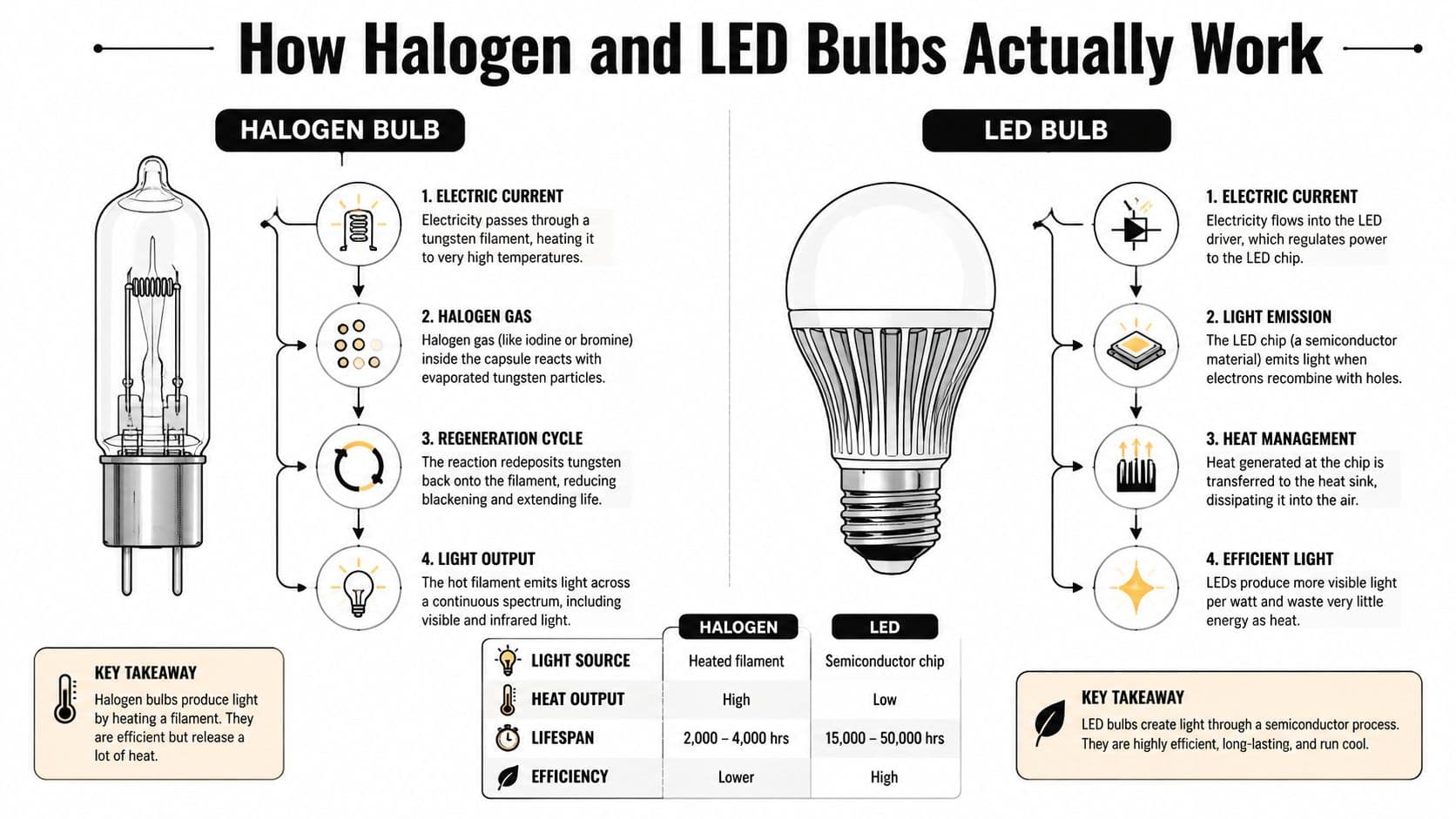
A halogen headlamp starts with a very simple idea. Electricity passes through a fine tungsten filament, heating it until the metal glows and produces light. The filament sits inside a small glass capsule filled with halogen gas, which helps return some evaporated tungsten to the filament instead of allowing it to settle permanently on the glass.
That process is called the halogen cycle. It lets the filament run hot and keeps the capsule clearer than a basic incandescent design, but the wire still operates at extreme temperature. Eventually it becomes thin, breaks or develops a weak spot. Heat is a central part of the design, not an unwanted side effect.
An LED works differently. It uses a semiconductor diode. When electrical current passes across the diode's junction, electrons release energy as photons, producing light without heating a wire until it glows. The colour comes from the semiconductor and, in many automotive designs, a phosphor layer that changes the light produced by the diode.
Why the construction affects the road
The filament in a halogen bulb is a small glowing line positioned precisely inside the capsule. The headlamp reflector or projector is designed around that position. Move the light-emitting area, even slightly, and the optics no longer behave as intended.
An LED retrofit replaces that filament with one or more chips mounted on a different structure. The bulb may have a heat sink, cooling fan, circuit board or remote driver. Those parts can improve heat management and electrical control, but they can't automatically recreate the exact position and shape of the original filament.
That's the engineering reason a powerful LED retrofit can perform worse than a good halogen bulb in the wrong housing. The LED may produce plenty of light, yet the headlamp can't focus it properly.
Lifespan is a design advantage, not a legal pass
Halogen bulbs are materially less efficient than LEDs and generally have a shorter working life. A commonly cited halogen service life is around 2,000 hours, described as roughly two years when used for about three hours each day, according to Tala's explanation of halogen lighting. LEDs are chosen partly because they use energy more efficiently and can last longer.
That makes LED attractive for maintenance, but it doesn't override approval rules. A longer-lasting light source is still the wrong part if the lamp wasn't designed for it.
Brightness, Beam Pattern and Colour Compared
The box figures are only the starting point. A headlamp is only useful if it puts light on the road in a controlled pattern. Feed a strong light source into the wrong reflector and you get glare, hot spots and dead patches in the beam.
Metric | Halogen H4/H7 | LED Retrofit | LED OEM Unit |
Raw light output | Predictable within the lamp's design | Can be high, but varies by design and fitment | Designed as part of the complete lamp |
Useful light on the road | Usually well controlled in the correct housing | Often compromised by chip position and reflector shape | Strong, controlled and engineered for the unit |
Beam cut-off | Matches the original optics | May be soft, uneven or misplaced | Designed into the approved headlamp |
Colour | Warm, familiar light | Often whiter or cooler | Manufacturer-selected for the lamp |
Heat behaviour | Filament creates substantial heat | Heat sink or fan is often required | Managed as part of the full assembly |
Electrical demand | Higher than LED technology | Usually lower, but vehicle compatibility varies | Designed around the vehicle's electrical system |
Lumens are not the same as useful illumination
Lumens describe total light emitted. They do not show how much of that light lands where you need it, on an unlit road in front of the car. Useful illumination depends on the reflector or projector, the focal position of the source, the lens, the headlamp's condition and its adjustment.
That is why independent testing matters more than marketing copy. Auto Express UK bulb tests use a figure of merit that combines light measured at 50 m and 75 m, and recent halogen performance bulbs such as Philips RacingVision GT200 have received best-buy recognition in those tests, as reported in UK coverage of headlamp bulb testing. The point is simple. A well-made halogen bulb can give strong usable beam performance without relying on raw lumen claims.
Colour and weather
Cool white light looks modern, but it is not automatically better on British roads. An LED rated at 6000K will look noticeably whiter than a 4300K halogen, yet cooler light can reduce contrast in heavy rain and spray. A warmer beam often gives a more comfortable view when the road surface is wet.
Wattage also needs context. LED technology can draw less power for the light it produces, but an automotive LED retrofit may still use a driver, fan or resistor to satisfy the vehicle's electronics. Lower wattage does not repair a wrong beam pattern, and more brightness does not make an unapproved conversion legal.
For replacement options, start with the correct vehicle fitment in the GSF Car Parts headlight bulb range, then check whether the part is intended for the complete lamp or for a compatible retrofit application.
UK MOT and Legal Rules You Cannot Ignore
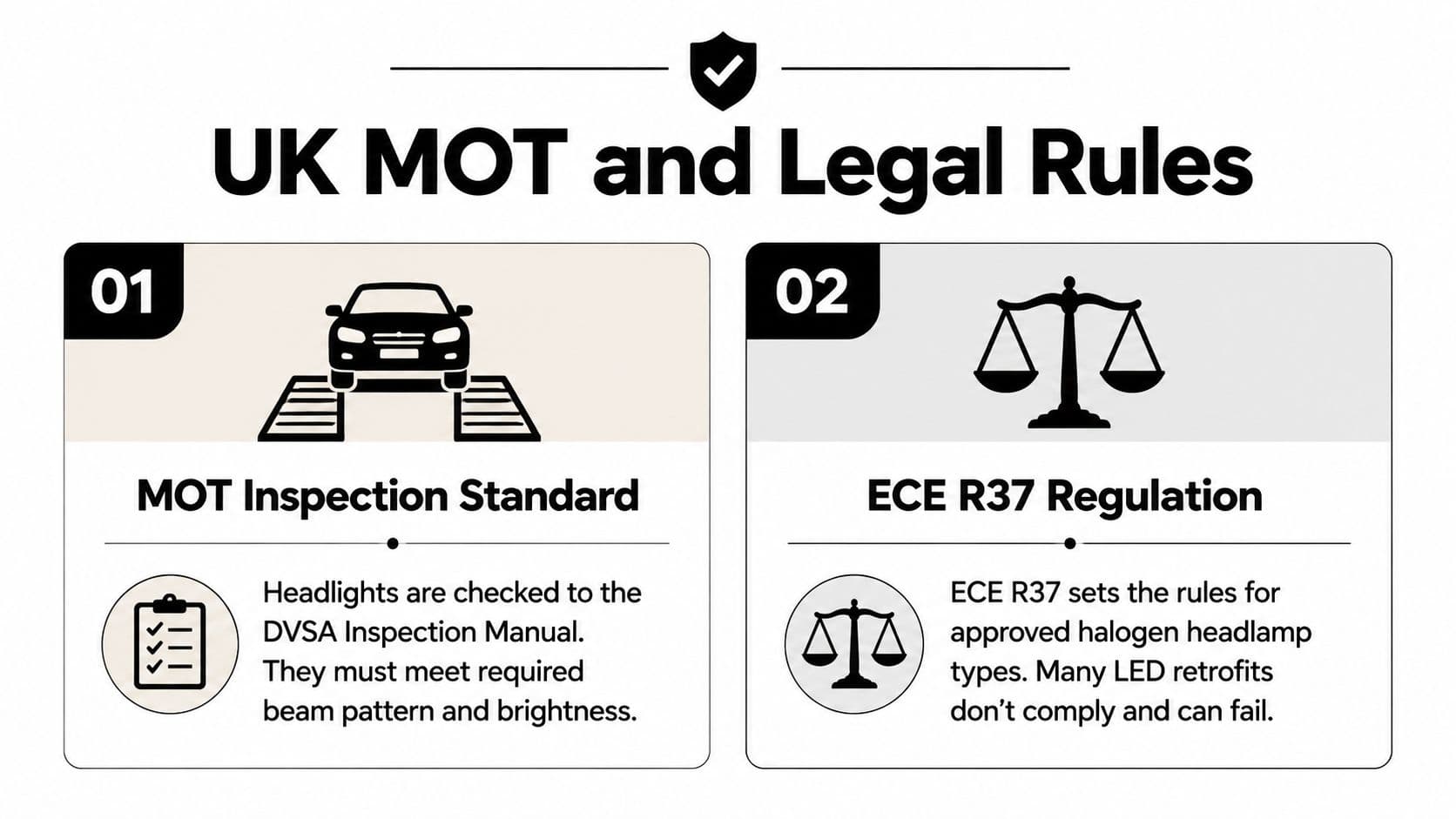
On a UK car, legality starts with the headlamp unit, not the bulb's plug shape. Road-legal halogen lighting uses ECE R37, while LED light sources for new vehicle fitment fall under ECE R128, as explained in Philips UK's guidance on LED upgrades.
An H4 or H7 base does not make an LED retrofit an approved halogen replacement. For a vehicle first used on or after 1 April 1986, fitting an LED bulb into a halogen headlamp can lead to an MOT defect because the light source and lamp are incompatible. The inspection wording changed on 22 March 2021. That rule decides whether an LED swap is viable for an ordinary UK car, regardless of the seller's brightness claims.
Bulb retrofit versus complete headlamp
A factory LED headlamp is an approved system. Its lamp housing, optics, light source, wiring and control electronics are designed to work together, so it is not equivalent to inserting an LED bulb into a halogen reflector.
An aftermarket LED bulb retrofit leaves the original halogen housing in place. That housing still controls the beam, regardless of how confidently the packaging describes the bulb as road legal. UK guidance separates an approved LED headlamp unit from an LED bulb fitted to a halogen lamp, as summarised by Autobulbs Direct's UK legal guidance.
The MOT assesses the lamp as fitted. It does not approve a conversion because the bulb carries a convincing label.
What the inspection is looking for
The decisive wording for relevant converted halogen units is “light source and lamp not compatible”. Beam aim, pattern and lamp condition remain important, but a neat-looking beam cannot make an incompatible light source compliant.
Headlamp levelling and washers may also apply where LED headlamps replace HID systems. Adding a washer kit or electronic adapter does not turn a halogen housing into an LED-approved unit. MOT testers use equipment such as the MOT equipment used for inspection work to assess the lamp's actual performance and compliance, not the seller's description.
Practical rule: If the housing was not designed and approved for LED, do not buy a retrofit expecting the tester to overlook it. Fit a quality halogen bulb, or replace the complete headlamp with an approved LED assembly.
The Construction and Use position also makes this a road-use issue, not merely an annual MOT concern. Check the vehicle's first-use date, the lamp approval and the exact replacement part before fitting anything. A brighter bulb is not worth buying if the finished installation is illegal.
Real-World Performance on British Roads
A wet rural A-road is where beam quality exposes marketing hype. A good halogen bulb gives a familiar, controlled spread when the reflector is clean and correctly adjusted. Its warmer colour can make road edges and spray feel less harsh, while an approved LED unit usually gives stronger forward illumination and a sharper, more deliberate beam.
The result changes if the LED is only a retrofit. In a halogen reflector, the chip may sit in the wrong focal position. You can see more light near the car, but less useful distance ahead, with stray light travelling towards approaching traffic.
Driving scenario | Halogen | Approved LED |
Wet rural A-road | Warm beam, predictable spread and comfortable contrast in spray | Stronger forward reach with a controlled cut-off when the complete unit is correctly designed |
Unlit residential streets in Leeds or Cardiff | Adequate visibility where the lamp is clean and correctly aimed | Clearer road-edge definition and stronger contrast in a properly approved unit |
Short motorway slip-road merge | Familiar beam response, though forward reach can be more limited | More decisive illumination of the merge area when optics and aim are correctly engineered |
On unlit streets, the difference is less about dramatic whiteness and more about how evenly the lamp covers the road. A properly designed LED unit can make signs, bends and road edges easier to pick out. A poorly focused retrofit can create a bright patch directly ahead while leaving the distance uneven.
The same applies on a short motorway slip road. You need a predictable beam that supports steering decisions, not a dazzling source that sends scattered light above the cut-off. Other drivers notice the problem first, particularly on dark roads where glare has no competing light around it.
The RAC survey of 1,866 drivers in December 2024 found that 95% believed at least some car headlights were too bright, according to the Lords Library briefing on headlight dazzle. That figure doesn't prove every LED retrofit causes glare, but it shows why beam discipline matters. Approved LED headlamps generally outperform halogen in measurable lighting performance. The advantage narrows sharply when the LED source is placed in the wrong housing.
Cost and Total Cost of Ownership
The cheapest bulb on the shelf isn't automatically the cheapest choice, but a proper ownership calculation needs real inputs. Those include the purchase price, service life, energy use, fitting labour and the cost of correcting a failed or unsuitable conversion.
A typical UK commuter covering 12,000 miles a year might compare a budget halogen H7, a premium long-life halogen and a legal LED headlamp unit. The exact five-year result depends on the vehicle, hours of night driving, garage rates, electricity pricing and the parts selected. Those figures weren't supplied here, so the table avoids invented prices and pretends no precision that the evidence can't support.
Cost factor | Standard halogen | Long-life halogen | Approved LED unit |
Purchase cost | Lowest initial outlay | Higher than standard halogen | Highest initial outlay |
Service life | Shortest of the three options | Longer than standard halogen | Designed for long service, subject to unit quality |
Energy draw | Highest of the three technologies | Similar to standard halogen | Lower electrical demand is a design advantage |
Garage labour | Usually a straightforward bulb swap | Usually a straightforward bulb swap | Can involve complete unit installation and electrical setup |
Replacement frequency | More frequent | Less frequent | Less frequent, but the complete unit can be costly |
MOT or correction risk | Low when the correct bulb is fitted | Low when the correct bulb is fitted | Low only when the unit is approved and correctly matched |
The common mistake is comparing a £6 halogen with a £90 LED retrofit and assuming the LED wins because it should last longer. If that retrofit fails the MOT, it has no useful ownership value until it's removed or replaced. A bulb that saves replacement time but creates a compliance problem is a false economy.
Where the saving really appears
Halogen bulbs are materially less efficient than LEDs and have a shorter working life, while LED's appeal comes from lower energy use and fewer maintenance intervals. That makes an approved LED unit attractive for a vehicle that's designed to use it. The saving is much less convincing when you're modifying a halogen lamp and risking wasted parts, extra labour or a retest.
A five-year ownership comparison should therefore include:
The pair of bulbs or complete units: Compare like with like, not a bulb against an entire headlamp.
Installation: Include garage labour if access is awkward or the lamp must be removed.
Replacement events: Use the selected product's stated life rather than a generic LED promise.
Compliance correction: Allow for removal and refitting if an unapproved conversion is rejected.
My trade-counter recommendation is blunt. Buy premium halogen for a halogen housing unless you're replacing the complete lamp with an approved LED system. The expensive option only earns its keep when the headlamp, source and vehicle electronics work together.
Fitting Bulbs Safely and Choosing the Right Part
Start with fitment, not colour or claimed brightness. Use the vehicle registration or VRM lookup to identify the likely bulb, then remove the old part and read the marking on its base. H4, H7 and H15 bulbs are different types, even when their packaging looks similar.
The GSF Car Parts vehicle filter can narrow the choice by make, model or registration. Treat the result as a starting point. Confirm it against the old bulb, the owner's manual, the lamp connector and the space behind the headlamp before ordering. A catalogue match does not prove that an LED retrofit is legal for that lamp.
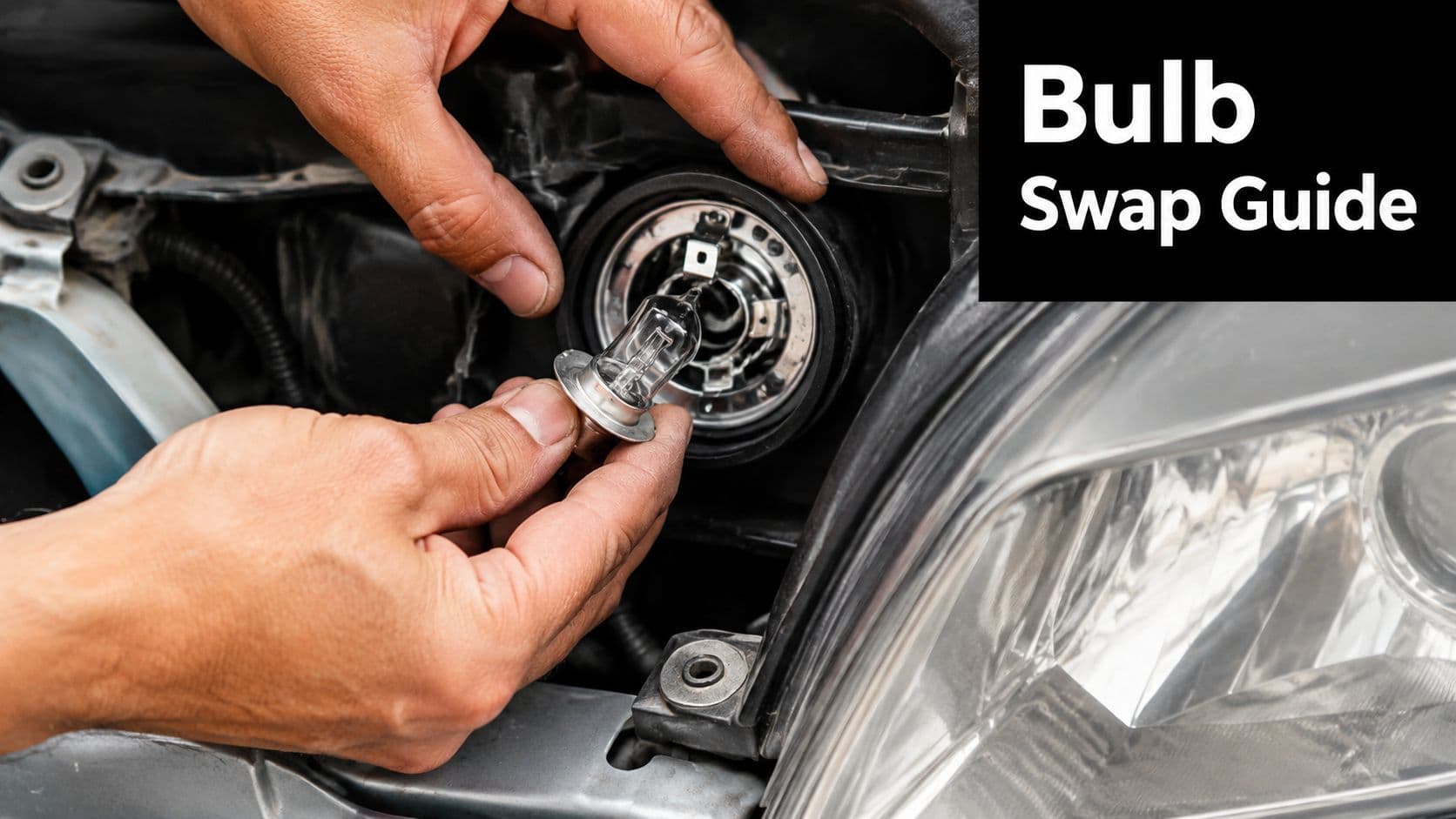
A clean, careful replacement
Wash your hands and keep fingers off a halogen bulb's glass capsule. Skin oil can create a hot spot on the quartz and shorten its working life. If you touch it, clean the glass with a suitable alcohol-based cleaner and let it dry before fitting.
Hold an LED by its designated base, not the diode or optical body. Keep cooling fins clear, and position the driver box so it cannot rattle against the headlamp or interfere with the rear cover.
Check each point before closing the bonnet:
Retaining clip: Confirm that it has located fully and holds the bulb squarely.
Focal position: The LED chips must sit in the specified position. A crooked bulb will produce the wrong beam.
Wiring: Do not cut factory wiring to force a connection. Route adapters away from hot components and moving parts.
Rear cover: Refit the dust cap properly. An oversized heat sink or fan must not leave the lamp open to moisture.
Beam check: Use a proper beam setter, or have a garage check the aim and pattern.
Stop if the reflector has been modified, the focal length is wrong, wiring has been cut or the rear cover will not refit. A CANbus adapter can clear a dashboard warning, but it cannot make an incompatible lamp legal. A bright patch on a driveway wall proves little about the beam on the road.
See the fitting process in action before tackling an awkward access point: 2001 - 2008 Honda Fit Headlight Bulb Replacement
After fitting, switch on dipped beam and inspect the cut-off against a flat surface. A scattered, asymmetric or unexpectedly high pattern means the bulb must come out for investigation. Do not assume the headlamp will settle into the correct pattern.
Which Bulb Should You Actually Buy
For most UK drivers with an original halogen reflector, the sensible purchase is still a quality H4, H7 or H15 halogen bulb. Osram and Philips offer performance ranges, including +130% products where legal, but the bulb must match the vehicle and remain within the permitted specification. A premium halogen upgrade can improve usable road light without changing the source that the housing was built around.
Owners of cars with factory LED headlamps don't need an LED bulb retrofit. They need the correct OEM-style replacement component or complete lamp-related part specified for that system. Don't dismantle an approved LED assembly to install a universal bulb.
Drivers wanting a whiter appearance from a halogen reflector should choose a premium halogen rather than an unapproved LED conversion. Those determined to move to LED should use a fully ECE R128-approved LED unit matched to the vehicle and housing, not a higher-output bulb with the same base. If the installation can't meet that standard, accept that the swap may create an MOT failure and choose another route.
Driver profile | Recommended bulb | Why |
Daily halogen user with an older vehicle | Quality H4, H7 or H15 halogen | Keeps the original lamp and source combination intact |
Owner of a car with factory LED headlamps | Correct OEM-style replacement | The approved system already has the right optics and controls |
Halogen-reflector owner wanting whiter light | Premium halogen | Improves the bulb choice without creating an incompatible retrofit |
Driver replacing the full lighting system | Approved LED headlamp unit | Delivers LED performance through a housing designed for it |
Before ordering, check the vehicle's first-use date, the bulb reference, the headlamp type and the approval status. Then confirm that the beam can be checked after installation. The GSF Car Parts headlight upgrade bulb range provides a place to compare suitable halogen and LED-related options, but fitment and legality remain your responsibility.
GSF Car Parts supplies halogen and LED-related bulbs, fitment guidance and parts for DIY owners and trade garages, with online ordering and Click & Collect available through its UK and Ireland store network. Check the correct bulb by registration, verify the lamp approval and visit GSF Car Parts before buying the part that your headlamp can legally use.