You turn the key and get a single click. The dashboard flickers, the headlights look weak, and the engine doesn't even try to turn over. If you're standing at the kerb with a car battery dead, don't buy parts at random or keep twisting the key. First establish whether the battery is discharged, internally failed, or being let down by the alternator or a hidden electrical drain.
A jump-start may get you moving, but it doesn't prove the battery is healthy. Treat the breakdown as a diagnosis job, then choose between a recharge, a replacement battery, an alternator repair, or professional help.
Spotting a Dead Car Battery and What Just Happened
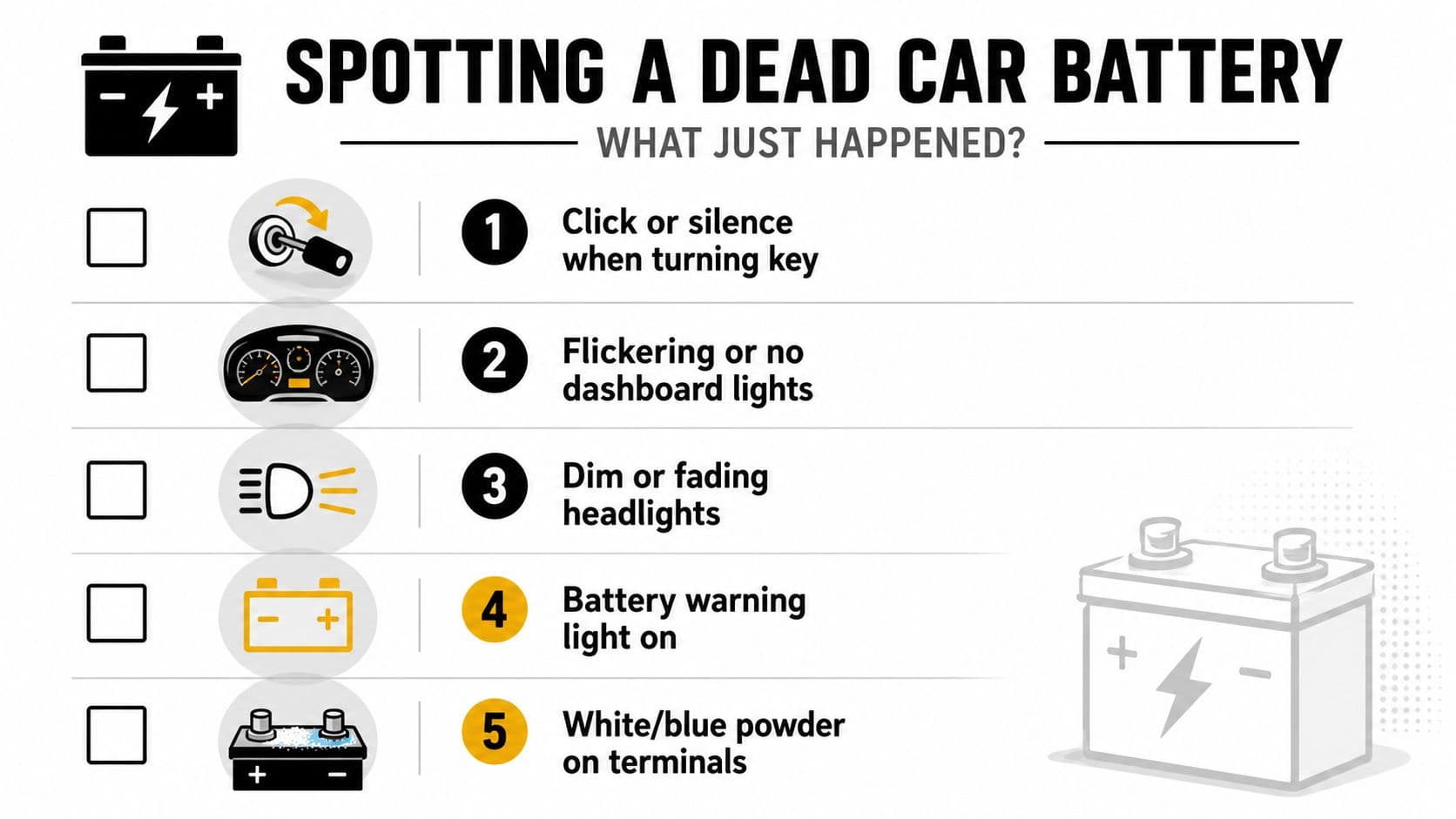
Start with the simplest check. Turn the key or press the start button once and listen. A slow, laboured crank, rapid clicking, dim lights or complete silence usually points towards low battery voltage. Flickering dashboard lights are especially useful because they show the battery voltage collapsing as the starter demands current.
Run this kerbside checklist
Check the lights: Switch on the headlights. If they're very dim or fade rapidly, the battery may be heavily discharged.
Check the dashboard: No warning lamps at all can indicate a disconnected terminal, a severe battery failure or a wider power fault.
Listen to the starter: Rapid clicks usually mean the starter solenoid is engaging and dropping out because the battery can't supply enough current. One solid click with bright dashboard lights points more towards the starter motor or solenoid.
Check the immobiliser: A flashing immobiliser symbol can prevent starting even when the battery is sound. Try the spare key if you have it.
Check the basics: A door left ajar, interior light, boot lamp, dashcam, tracker or key fob left inside the car can drain the battery while the vehicle is parked.
A car that has sat unused for two or three weeks in winter is also a strong suspect. Cold weather makes starting harder, while the vehicle's control modules continue to draw a small amount of power. A healthy 12V battery may still illuminate the dashboard even when it can't crank the engine, so a completely lifeless car deserves a careful look at the terminals, main fuse and earth cable rather than an automatic battery purchase.
Don't confuse an empty fuel gauge with a battery fault. Turn the ignition on and check whether the fuel display, warning lights and interior electrics behave normally. If the car has power but gives one click, investigate the starter; if it has no power, begin with the battery connections and voltage.
Kerbside rule: Don't make repeated ten-minute cranking attempts. You'll overheat the starter and flatten the battery further.
Stop before connecting cables if you smell fuel, see a swollen or wet battery, notice active hissing, or find heavy corrosion around the casing. Those conditions call for recovery or a technician, not a rushed jump-start.
Safe Ways to Jump Start a Car with Cables or a Pack
Use jump leads only when both vehicles have compatible 12V systems, are parked securely, and aren't touching. Switch off the ignitions, lights, heaters and audio systems, apply the handbrakes, and keep loose clothing away from belts and fans.
Cable order matters
Connect the clamps in this exact sequence:
Red to the dead battery's positive terminal.Look for the plus symbol or positive marking.
The other red clamp to the donor battery's positive terminal.
Black to the donor battery's negative terminal.
The other black clamp to an unpainted metal earth point on the dead car.Use a substantial engine or chassis point away from the battery, not a painted bracket.
The final earth connection can spark. Keeping it away from the battery reduces the chance of igniting hydrogen gas that may vent during charging. Connecting black directly to the dead battery's negative post is a common mistake, especially in a hurry.
Start the donor car and let it run at approximately 1,500 rpm for two to three minutes before trying the stranded vehicle. Then attempt one controlled start. If it doesn't fire, stop and check the clamps, terminal condition and gear position. Don't keep grinding the starter.
Once the dead car starts, leave both vehicles settled briefly, then remove the leads in reverse order:
Black from the dead car's earth point.
Black from the donor battery negative.
Red from the donor battery positive.
Red from the recovered car's positive terminal.
A lithium jump pack is the cleaner solo option. Switch everything off, connect the pack exactly as its instructions show, attach positive and negative securely, switch the pack on, and start the car. Disconnect it as soon as the engine is running. Never store a jump pack below freezing, and don't keep using it as a crutch after it has already made three attempts.
For dependable cable length and clamp quality, choose correctly rated jump leads for roadside use. Wear eye protection and gloves, and keep sparks, cigarettes and naked flames away from the battery.Don't jump a visibly swollen, cracked, wet or frozen battery.
A frozen battery can split internally or externally as it warms and charges. If nothing clicks on the first proper attempt, stop diagnosing by repetition. Arrange a battery test or recovery, particularly if the battery warning light remains on after the engine starts.
How to Properly Jump Start a Car
Testing the Battery and Alternator Yourself
A digital multimeter won't tell you everything, but it will separate a discharged battery from an obvious charging fault. Set it to DC volts, switch off every electrical load, and let the vehicle rest for at least four hours before measuring open-circuit voltage. Measuring straight after driving or charging can leave surface charge on the plates and make a weak battery look healthy.
Place the red probe on positive and the black probe on negative. Use these readings as a practical guide, while remembering that the vehicle manufacturer's test procedure takes priority.
Voltage Thresholds for Battery and Alternator Health
Test Point | Healthy Reading | Warning Reading | Fault Reading |
Battery at rest | About 12.6V or higher | 12.0V to 12.5V, partially discharged | Below 12.0V, deeply discharged or effectively dead |
Battery under load | Above about 9.6V | Close to 9.6V | Below about 9.6V |
Charging system with engine running | About 13.7V to 14.7V | Around 13.5V, investigate | Below about 13.5V, or excessive charging |
Charging system, broader guide | About 13.5V to 14.5V | Outside the normal band | Persistent low running voltage indicates a charging fault |
These battery thresholds are set out in UK battery testing guidance. A resting reading around 12.4V means the battery is partly discharged, while below 12.0V suggests it is flat or failing, as explained in this UK car battery voltage guide.
A load test is more revealing than resting voltage. If the voltage falls below about 9.6V while the engine is cranking, the battery is weak or failed. A proper tester applies a controlled load, whereas a multimeter only reports voltage without showing whether the battery can deliver starting current. For borderline batteries, especially older units, use a battery tester for a proper electrical check.
With the engine running, check the alternator output at the battery. A healthy charging system should raise voltage into the normal band. If it stays low, suspect the alternator, belt, wiring or earth connections. If it climbs excessively, the regulator may be overcharging and damaging the battery. Don't fit another battery until you've checked this, or the replacement may suffer the same fate.
Choosing the Right Replacement Battery
A replacement battery isn't just a box that fits in the tray. Match the physical dimensions, terminal layout, technology and starting specification to the vehicle. The registration lookup is useful, but compare the result with the label on the old battery and the vehicle handbook before ordering.
Decode the label before buying
Group size identifies the case dimensions and terminal arrangement. DIN and BCI references such as H6, 096 and 027 aren't interchangeable merely because they look similar. A battery can sit in the tray yet have the terminals on the wrong side, the wrong hold-down profile or insufficient clearance for the bonnet.
Cold Cranking Amps, or CCA, describes starting ability in cold conditions. Choose a replacement that meets or exceeds the original equipment figure. More isn't automatically better if the case, charging profile or electrical specification is wrong.
Battery technology must match the car's demand. A conventional flooded battery suits some older vehicles.
An EFB battery is designed for greater cycling ability, while an AGM battery handles demanding stop-start and electrical systems. A stop-start vehicle generally needs the technology specified by its manufacturer, so don't downgrade an AGM or EFB to a basic flooded unit.
Reserve capacity indicates how long the battery can support electrical loads if charging is interrupted. It matters more on vehicles with substantial electrical equipment, but the manufacturer's specification still comes first.
Spec | What It Means | What to Choose |
Case and group size | Tray dimensions and terminal position | The exact approved code, such as H6, 096 or 027 |
CCA | Starting output in cold conditions | Meet or exceed the original equipment figure |
Technology | Flooded, EFB or AGM construction | Match the vehicle's charging and stop-start requirement |
Terminal layout | Positive and negative post positions | The same layout as the old battery |
Reserve capacity | Support for electrical loads | Follow the vehicle specification |
Warranty | Coverage period and product confidence | Compare the available 2, 3 or 4-year options |
Warranty length is a useful comparison point, but it isn't a substitute for correct fitment. Longer warranty tiers can reflect different construction and plate thickness, yet the wrong battery remains wrong regardless of coverage. Most UK battery-life guidance places typical service life at about 3 to 5 years, with short journeys, cold weather and high electrical loads shortening it. See the UK car battery replacement guidance for that practical lifespan context.
Check the manufacture-date sticker before fitting. Reject stock older than six months where possible, particularly if it has been stored in uncertain conditions. For a registration-based match across case size, CCA and technology, compare the available replacement car batteries against the label already fitted to your vehicle.
Swapping the Battery at Home Step by Step
A home battery swap is manageable if the battery is accessible and the vehicle doesn't require specialist registration or coding. Some modern cars need the new battery registered in the vehicle's energy-management system, particularly after changing battery type or capacity. Check the handbook first.
Switch off the ignition, remove the keys and keep the radio code available. If preserving presets and learned settings matters, plug a memory saver into the OBD port or cigarette lighter, following its instructions. It can prevent avoidable resets, but it won't make an unsafe connection safe.
Prepare the job
Have these items beside the car:
Tools: A 10mm spanner or socket, an extension bar and the correct tool for the hold-down bracket.
Cleaning equipment: A terminal brush, plus baking soda mixed with water for external corrosion.
Protection: Gloves and eye protection.
Finishing material: Petroleum jelly for the clean terminals after tightening.
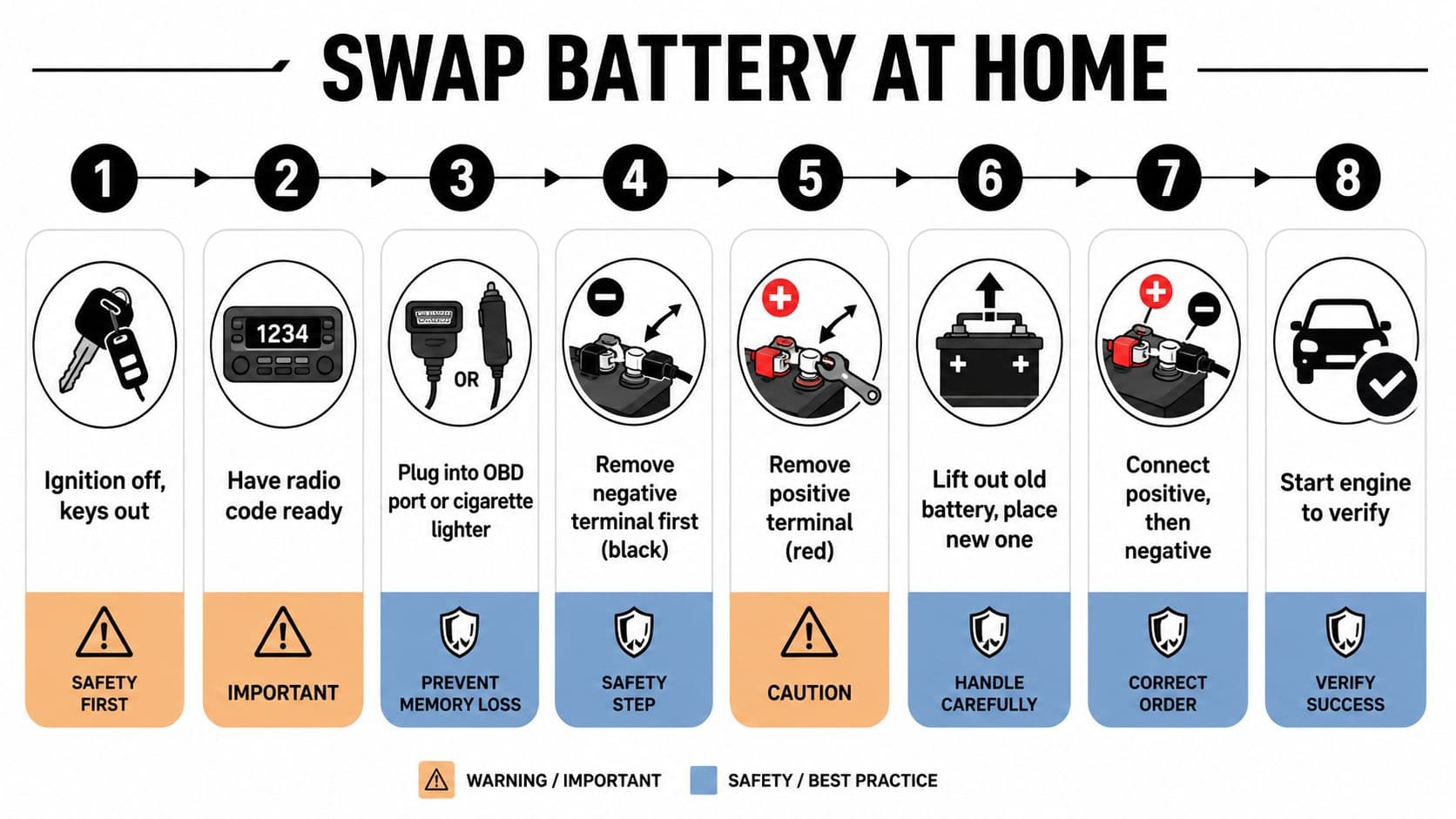
Remove the hold-down clamp before trying to lift the battery. Disconnect negative first, then positive. Removing the negative cable first reduces the chance of shorting a live positive terminal against the vehicle body with your spanner.
Lift the old battery straight out. It can be heavy and awkward, so use its handle if fitted and keep it level. Clean the tray and inspect the earth cable, then place the new unit in the same orientation and secure the hold-down firmly.
Reconnect positive first, followed by negative. This order reduces accidental short circuits while the positive terminal is being installed. Tighten the clamp and hold-down to the vehicle manufacturer's torque figures, because overtightening can damage the post or casing while undertightening causes resistance and starting faults. Don't guess a universal torque value.
Apply a light smear of petroleum jelly around the finished terminals, not between the mating surfaces. Start the engine, check that the battery warning light goes out, and confirm the car's electrical systems work normally. Take the old battery to a council tip, scrapyard or motor factor that accepts used units. Don't place it in household waste.
Preventing the Next Flat Battery
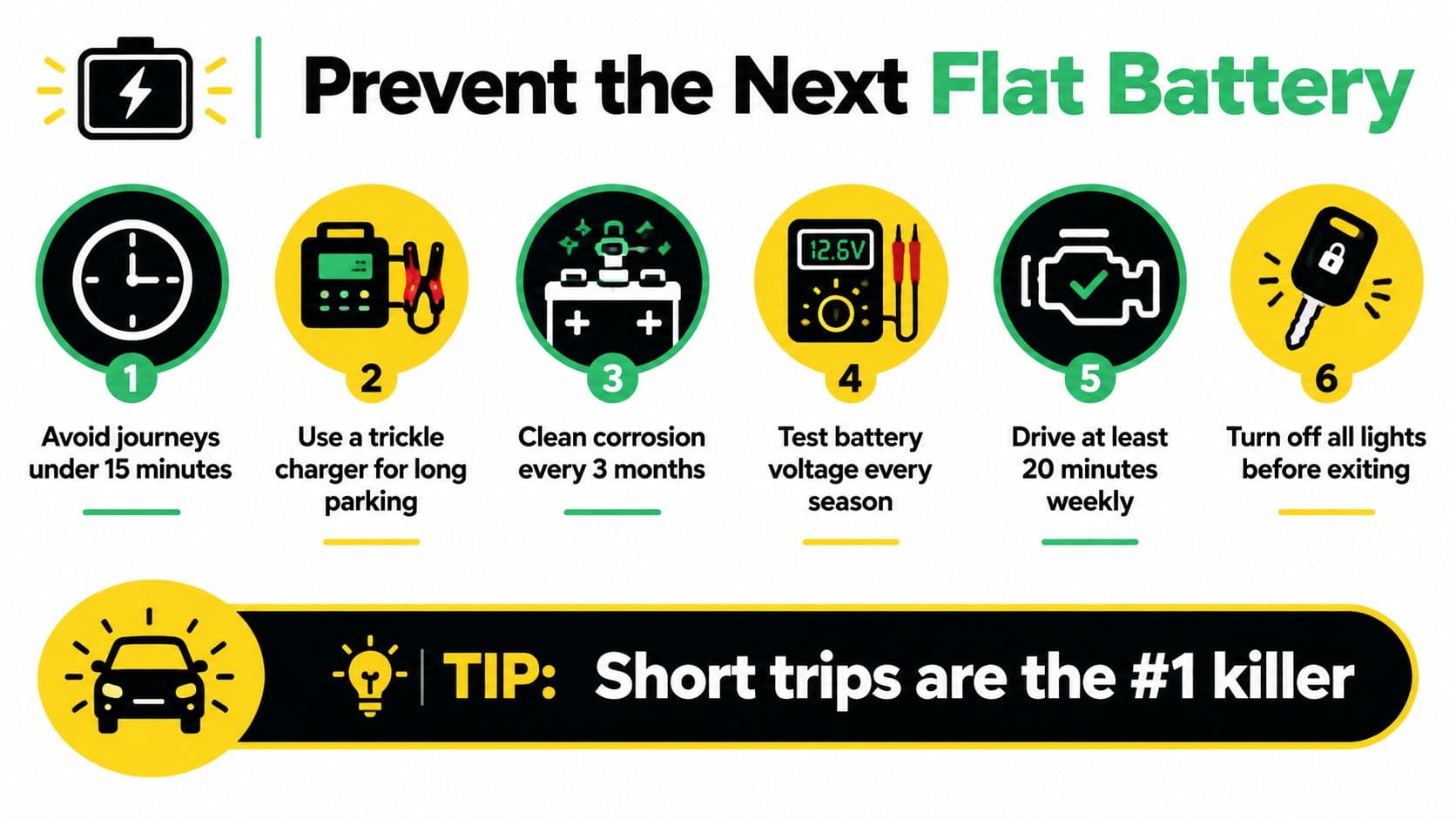
The most effective prevention starts with how you use the car. Repeated short journeys under 15 minutes can leave the alternator replacing only part of the energy used during starting, particularly when the heater, heated screens, lights and wipers are working in winter. If most trips are short, an occasional longer run or a smart maintainer is more useful than repeatedly jump-starting the vehicle.
Remove the avoidable drains
Check the accessories that remain live after you lock the car:
Dashcams and trackers: Confirm whether the hard-wiring kit has a low-voltage cut-off.
OBD dongles: Remove them if the vehicle will sit unused.
Boot and interior lamps: Make sure a latch or door isn't holding a light on.
Loose terminals: Clean corrosion and tighten connections so the alternator can charge efficiently.
A monthly rest-voltage check gives you an early warning. Around 12.6V or higher indicates a healthy resting battery, while a falling reading calls for charging or testing rather than waiting for the next no-start. Use a smart CTEK-style maintainer when the car is parked for extended periods, and aim to drive it for at least 30 minutes once a fortnight if normal use doesn't provide that opportunity.
Don't overlook the charging hardware. Belt-driven alternators and their belts wear as vehicles age, with belt-driven alternator wear becoming a practical inspection point around 80,000 miles. A loose belt, poor earth or tired alternator can leave a new battery undercharged.
Cold-weather planning matters across the UK. Green Flag analysis expected 472,000 car battery failures over November, December and January, equivalent to about five failed battery call-outs every minute (Green Flag winter breakdown analysis). That same report recorded nearly 150,000 failed-battery call-outs in November 2024, a 26% rise from the previous month. Test before winter, not after the first frost.
Decision Checklist and Where to Get Parts Today
Use the test results, not guesswork.
The battery holds charge and the alternator output is healthy: The battery is likely at the end of its useful service life or was drained by an obvious mistake. Recharge it if it passes a load test. Replace it if it fails the load test or repeatedly struggles.
The battery holds charge but running voltage is weak or excessive: Repair or replace the alternator, regulator, belt or charging connection first. A fresh battery won't cure an alternator fault.
The battery goes flat again within a day or two: Suspect parasitic drain. Dashcams, trackers, boot lights, control modules and wiring faults all deserve a proper current-draw test at a garage.
Battery problems remain a major breakdown category. RAC data recorded 130,575 dead-battery replacement incidents and 177,916 flat-battery jump-start call-outs in its 2006 Breakdown Britain report, while the report also described more than 2.5 million roadside assistance call-outs each year, or almost 7,000 each day (RAC breakdown data summary). More recent UK coverage has described battery failures as accounting for up to 40% of breakdowns in an industry summary, so treating a no-start as a diagnosis job is sensible.
Newer electrified cars aren't exempt. Which? data found 12V battery problems among 5.6% of self-charging hybrid owners aged 0 to 4 years, compared with 1.4% of petrol and 1.8% of diesel owners, while EVs were at 3.8% and plug-in hybrids at 3.5% (UK 12V battery findings for newer vehicles). The traction battery and 12V battery are different systems, and a healthy high-voltage battery won't prevent a failed 12V unit from immobilising the car.
If the vehicle won't start in a public place or after dark, call roadside assistance, an RAC patrol or a mobile mechanic. For an urgent replacement, use same-day Click & Collect from a national factor such as Halfords, GSF Car Parts or Euro Car Parts, entering the registration at checkout to match the group size, CCA and AGM or EFB specification. Return the old unit for recycling and ask whether the retailer handles any applicable core deposit.
GSF Car Parts supplies replacement batteries, jump-start products, tools and electrical testing equipment, with registration lookup and Click & Collect available for urgent repairs. Visit GSF Car Parts to identify the correct battery for your vehicle and arrange parts collection before you attempt the repair.