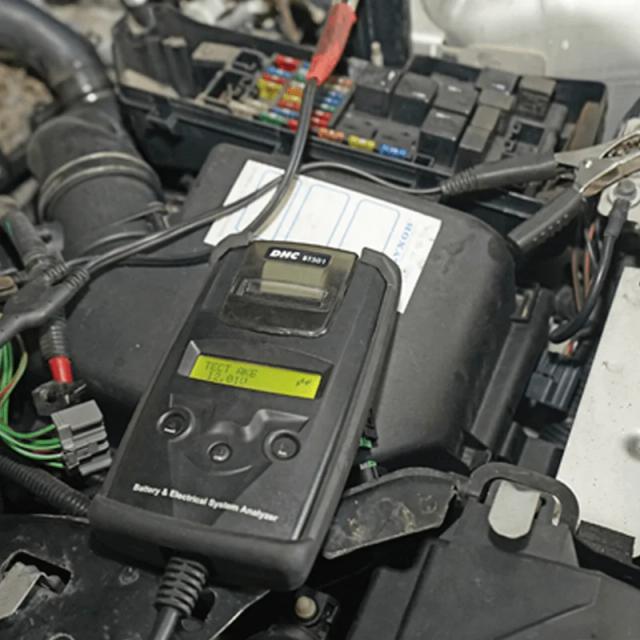
Nothing kills the morning rush like the dreaded silence when you turn the key. A flat battery is a headache, especially on a chilly UK morning, but it’s often a problem you can sort yourself. The surest way how to charge a car battery is with a dedicated charger, but understanding the parts involved and following a strict safety sequence is essential for getting it right.
Done correctly, it's a simple fix that gets you back on the road without risking your car's sensitive electronic components.
Getting Started with Charging Your Car Battery
A dead battery is one of the most common reasons for a breakdown call-out, but you don't always need to wait for the recovery truck. Before you connect any equipment, understanding the components you're working with is key. Think of your car’s battery as the heart of its electrical system – a little knowledge and care go a long way.

Key Safety Checks Before You Begin
Don't skip the safety prep. Car batteries contain corrosive acid and can release flammable hydrogen gas, especially when charging. These simple steps are non-negotiable.
Get Some Fresh Air: Always charge the battery in a well-ventilated area, like an open garage or your driveway. This stops any build-up of explosive hydrogen gas.
Gear Up: You absolutely need protective gloves and safety glasses. Battery acid is no joke – it can cause nasty burns and damage your eyes.
No Sparks, No Flames: Keep cigarettes, lighters, or any naked flames well away from the battery. A single spark is all it takes to ignite the hydrogen.
Taking a minute to get this right turns a potentially risky job into a straightforward bit of car maintenance. It's the workshop version of 'measure twice, cut once'.
The Correct Connection Sequence
The order you connect and disconnect the charger clamps is crucial for protecting your vehicle's components. Getting it wrong can create a spark, sending a voltage surge through your car that could fry expensive parts like the Engine Control Unit (ECU).
The golden rule is simple and easy to remember: positive on first, positive off last. This simple trick massively reduces the risk of a spark right next to the battery.
When connecting, clip the red (positive) clamp to the positive (+) battery terminal first. Next, connect the black (negative) clamp to a solid, unpainted metal point on the car's chassis or engine block. This "grounds" the connection safely away from the battery.
When you're done, just do it in reverse: remove the black (negative) clamp first, then the red (positive) one.
Modern Chargers Are Your Best Friend
You might remember old-school trickle chargers that just pushed a constant current, risking overcharging and cooking the battery if you forgot about them. Thankfully, charger technology has evolved significantly.
Modern smart chargers are a game-changer. They are sophisticated electronic devices that analyse the battery's health and use multi-stage charging algorithms to deliver the perfect amount of power. They’ll run through different phases—like desulphation, bulk charging, and a maintenance "float" mode—to charge optimally and safely.
This technology not only prevents damage from overcharging but can often recondition and extend the life of an ageing battery. A quality smart charger is one of the best investments you can make for your car's long-term health.
Why Car Batteries Fail and How They Work
Ever wondered what’s actually going on inside that little black box under your bonnet? A car battery isn’t just a simple power pack; it's a sophisticated piece of electrochemical engineering. Understanding how this component works is the first step to diagnosing why it failed—and preventing it from happening again.
Think of your battery as a tiny, rechargeable power plant. Inside, a chemical reaction between lead plates and an electrolyte solution (a mix of sulphuric acid and water) generates the electrical energy needed to crank your engine and power all your car's systems. This process is reversible, which is why your car’s alternator, or an external charger, can replenish its charge.
Understanding Different Battery Technologies
Here’s where a deeper knowledge of parts is crucial. Not all car batteries are created equal, and using the wrong type of charger for your battery’s specific technology can cause serious, and expensive, damage.
Conventional Lead-Acid Batteries: These are the traditional ‘flooded’ batteries you’ll find in many older cars. Their design consists of lead plates suspended in a liquid electrolyte. They’re robust, affordable, and compatible with standard charging routines.
EFB (Enhanced Flooded Battery): A more durable version of the traditional battery, EFBs are designed to support vehicles with basic stop-start systems. They feature a more robust internal construction to better handle the increased cycling of being charged and discharged more frequently.
AGM (Absorbent Glass Mat) Batteries: This is the premium technology found in modern cars with advanced stop-start functions and high electrical loads. In an AGM battery, the electrolyte is absorbed into special fibreglass mats placed between the lead plates. This makes them spill-proof, resistant to vibration, and capable of deeper discharge cycles. You must, use a compatible smart charger with a dedicated AGM mode for these batteries to avoid damaging them.
Not sure what you’ve got? The battery type is usually printed right on the sticker on top of the case. If you spot ‘AGM’ or ‘EFB’, you know you’ll need a modern smart charger. You can find great options from brands like Yuasa or DriveTec right here at GSF Car Parts.
Beyond Leaving the Lights On
While an overnight headlight mishap is a classic cause of a dead battery, most modern failures are due to more complex issues related to how the car's electrical system functions.
Cold weather is a major adversary for car batteries in the UK. Freezing temperatures slow down the internal chemical reaction, reducing its power output by as much as 30-50%. It’s no coincidence that most battery failures happen on a frosty winter morning.
Another frequent offender is a routine of short, stop-start journeys. Your alternator, the car's own generator, needs a decent amount of driving time to replace the energy used to start the engine. If your daily commute is just a few miles, the battery never gets a proper chance to recharge, and its state of charge gradually declines.
The silent assassin of car batteries is something we call 'parasitic drain'. This is a small but constant electrical current drawn by components like your car's alarm, clock, and onboard computers, even when the vehicle is off. While a tiny drain is normal, a faulty module or short circuit can increase this drain, emptying a perfectly good battery in just a few days.
Decoding Battery Jargon
When you start digging into batteries and chargers, you'll encounter a few key technical terms. Understanding them helps you grasp your battery's specifications and choose the right equipment.
Amp-hours (Ah) is a measure of the battery's total energy storage capacity. You can think of it like the size of a fuel tank. A 60Ah battery can, in theory, supply one amp of current for 60 hours. As a rule, bigger engines with higher electrical demands need batteries with a higher Ah rating.
State of Charge (SOC) is a percentage representing how 'full' the battery is. A healthy, fully charged battery has a 100% SOC (which corresponds to a voltage of around 12.6-12.8 volts). Once it drops to 50% SOC (around 12.2 volts), it will likely struggle to start your engine. Knowing how to charge a car battery is all about bringing that SOC back up to 100% safely.
A Practical Guide to Charging the Battery In Your Car
How to Charge a Car Battery | Like a Pro
Right, let’s get hands-on. We're going to walk through how to charge a car battery while it’s still in the vehicle, which is the most common method. The top priority here is protecting your car’s sensitive electronic components, like the Engine Control Unit (ECU), from voltage spikes.
Picture this: you’ve just got back from a two-week holiday to find your Ford Focus is completely dead. The small but constant power draw from the internal clock and alarm system (parasitic drain) has slowly depleted the battery. This is the perfect job for a straightforward, in-car charge.
Connecting the Charger Correctly
First, ensure your charger is unplugged from the mains. Now, attach the red (positive) clamp from the charger to the battery's positive (+) terminal.
Here comes the crucial bit for protecting your car's electronics. Instead of clipping the black (negative) clamp directly to the battery’s negative (-) terminal, find a solid, unpainted metal point on the car's chassis. This could be a sturdy bolt on the engine block or a dedicated grounding point. Many modern cars have a specific negative charging post for this very reason—check your owner’s manual if you're unsure.
This one simple step is all about safety. It prevents any sparks from occurring near the battery itself, protecting both you and your vehicle's delicate electrical systems. If you're in a pinch and just need an emergency start, our guide on using jump leads might be a better option.
Once you’re safely connected, you can plug the charger into the mains and switch it on. If you're using a smart charger, make sure you set it to the correct mode for your battery type, whether it’s a standard lead-acid or a more modern AGM.
Critical Safety Warning: Car batteries produce highly flammable hydrogen gas when they're charging. Never, ever create sparks or have naked flames anywhere near your work area. It's vital to work in a well-ventilated space, like an open garage or driveway, to let this gas disperse safely.
It’s worth remembering that battery technology has come a long way from the basic lead-acid models we all grew up with. Modern cars have far more complex needs.

This evolution from standard Lead-Acid to EFB and AGM batteries is a direct response to the massive electrical demands of modern vehicles, especially those with stop-start systems. Using a compatible smart charger is non-negotiable for protecting these advanced battery types. Your charger will then run its cycle, and most good ones will automatically switch over to a maintenance mode once the battery is full.
How to Safely Remove and Charge a Battery Out of the Car
There are times when charging the battery in the car isn’t practical. Perhaps access is difficult, you want to perform a thorough deep conditioning charge on a workbench, or you’d simply rather work in a controlled garage environment. Removing the battery is a straightforward job, but the key is following the correct procedure to avoid damaging any components.

It all starts with getting the disconnection sequence right to prevent sparks or short circuits that could harm your car's sensitive electronics. And don’t underestimate the physical component itself—car batteries are deceptively heavy, often weighing over 15-20 kg.
The Disconnection and Removal Process
First, make sure the ignition is off and the keys are well away from the car. This ensures no electrical systems are live.
Your first move is always to disconnect the negative (-) terminal clamp, which is usually black. Loosen the nut, then gently twist and lift the clamp off the battery post. Tuck it aside so it can’t accidentally touch the terminal again. Only once the negative is clear should you do the same for the red, positive (+) terminal.
Always disconnect the negative terminal first. This breaks the circuit’s ground connection to the car's chassis. If your spanner accidentally touches the car body while working on the positive terminal, it won’t complete a circuit and create a dangerous spark.
With both terminals disconnected, you can now unbolt the bracket or clamp holding the battery in its tray. Once free, get a firm grip with both hands and lift the battery straight up and out. Remember to bend at your knees, not your back!
Setting Up for a Safe Out-of-Car Charge
Place the battery on a solid, level surface in a well-ventilated spot, like on a workbench or the garage floor. Never place it directly on a metal surface, as this creates a risk of a short circuit. Sliding a piece of wood or sturdy plastic underneath is always a good safety measure.
Now you’re ready to connect the charger, which is even simpler when the battery is out of the car:
Attach the red (positive) clamp to the battery’s positive (+) terminal.
Attach the black (negative) clamp to the battery’s negative (-) terminal.
Once the clamps are secure, plug your charger in and switch it on. Many modern smart chargers have dedicated settings for an 'out-of-vehicle' or 'reconditioning' charge, which can be more intensive. Just select the right mode for your battery type (e.g., Lead-Acid, AGM) and let the charger do its work. This is easily the most thorough way how to charge a car battery and restore it to optimal health.
Choosing the Right Battery Charger for Your Car
Grabbing just any old battery charger off the shelf is a bit like pouring diesel into a petrol car – a costly mistake. Using an incompatible charger can cause serious harm, especially to the sensitive battery technologies and electronic systems in modern vehicles. Choosing the right charger is about more than just reviving a flat battery; it's about investing in the correct tool to protect and maintain a vital component of your car.
Think of it this way: putting a cheap, unregulated charger on a modern AGM battery is a recipe for trouble. The right bit of kit will not only get you going but will also significantly extend your battery's service life.
What Are My Options?
When you start looking at chargers, you’ll find several different types. Each is a distinct piece of hardware designed for different purposes, and knowing the difference is key to picking the right one.
Trickle Chargers: These are the simplest type of charger. They deliver a slow, constant, low-amperage current. The main drawback of older, basic models is their lack of automatic shut-off, meaning they can overcharge and damage a battery if left connected for too long.
Multi-Stage Smart Chargers: For most car owners, this is the best choice. These devices contain microprocessors that analyse the battery's condition and apply a tailored, multi-stage charging cycle. Brands like Yuasa and DriveTec offer excellent smart chargers that are safe, effective, and user-friendly.
Heavy-Duty Workshop Chargers: These are large, powerful units designed for professional garages. They can deliver a high current for rapid charging but are often too aggressive for regular home use and can cause damage if used incorrectly.
For the vast majority of us, a multi-stage smart charger represents the perfect balance of performance, safety, and value.
Why a Smart Charger Is a Smart Investment
A modern smart charger is a sophisticated diagnostic and maintenance tool for your battery. It runs a full analysis and treatment cycle to restore the battery's health safely and efficiently.
It usually works through a few key stages:
Desulphation: This initial stage uses small electrical pulses to break down sulphate crystals that can form on the battery plates, a common cause of battery failure. This step can often recover a battery that seems beyond repair.
Bulk Charge: Next, it delivers a strong, constant current to bring the battery up to around 80% of its capacity quickly and efficiently.
Absorption:
For the final 20%, the charger slows the process, reducing the current to carefully top off the battery without the risk of overcharging or overheating.
Float/Maintenance:
Once the battery reaches 100%, the charger switches to a low-power maintenance mode. It provides tiny top-ups only when needed to counteract natural self-discharge, allowing you to leave it connected for extended periods.
This intelligent, automated process is why a 'set-and-forget' smart charger is such a brilliant piece of equipment. It doesn't just charge a flat battery—it actively maintains its health and prevents the overcharging that can shorten its life.
Getting to Grips With the Jargon
To choose the perfect charger from our battery charger collection, you just need to understand two key specifications: amperage (A) and the 'C/10' rule.
A charger’s amperage (A) rating indicates how quickly it delivers its electrical current. A higher amp rating means a faster charge. However, charging too quickly can generate excessive heat, which is detrimental to battery health and longevity.
That’s where the 'C/10 rule' comes in. It’s a professional guideline for safe and effective charging. The principle is to select a charging amperage that is approximately 10% of your battery’s Amp-hour (Ah) capacity.
So, for a standard 60Ah car battery, a 6A charger is the ideal match (60 / 10 = 6). This more gentle approach ensures the battery can absorb the energy efficiently without being damaged by excessive heat.
With an estimated 1.7 million UK drivers needing a jump-start every year, maintaining your battery with the right equipment makes a huge difference. For modern cars with AGM or EFB batteries, using a compatible smart charger isn’t just recommended; it’s essential for the health of the vehicle’s complex electrical system.
How to Diagnose a Faulty Battery or Alternator
You've had the battery on charge, the charger indicates it's full, but the engine still delivers that dreaded, tired groan. This is a common diagnostic challenge: is the battery itself faulty, or is another component—the alternator—failing to do its job?
A flat battery isn't always a sign of a bad battery. Sometimes, it’s merely a symptom of a problem elsewhere in the electrical system. Learning to differentiate between a failed battery and a failing charging system will save you time, money, and the frustration of replacing a perfectly good part.
Quick Checks You Can Do at Home
You don’t need a workshop full of professional tools to investigate. A basic digital multimeter is an inexpensive and essential diagnostic tool for any car owner. These quick tests will give you a clear insight into your electrical system's health.
For these checks, set your multimeter to the 20V DC (Direct Current) setting, often marked with a V⎓ or DCV symbol.
Checking the Battery's Resting Voltage
This first test measures the battery's 'State of Charge' (SOC) when the car is off. It’s the best way to determine if the battery is holding the energy you've put into it.
First, ensure the car has been off for at least an hour, with no lights or radio on. This allows any surface charge to dissipate for an accurate reading. Connect the multimeter's red probe to the positive (+) terminal and the black probe to the negative (-) terminal.
A healthy, fully charged battery should show a reading between 12.6V and 12.8V. If you see around 12.2V, it's only at 50% charge. Anything below 12.0V indicates it's effectively flat and likely incapable of holding a charge.
If you've just finished charging your battery and its resting voltage is below 12.4V, that's a strong indication that the battery itself has failed and can no longer store energy effectively.
Testing the Alternator's Output
What if the battery voltage seems fine? The next component to investigate is the alternator. Its function is to generate electricity to power the car's systems and recharge the battery while the engine is running. A faulty alternator will allow even a brand-new battery to go flat.
To test it, keep the multimeter connected to the battery and have someone start the engine. As the engine idles, the voltage on the multimeter should jump up.
A healthy alternator will produce a charging voltage between 13.7V and 14.7V
.
A reading below 13.5V suggests the alternator isn't generating enough current to charge the battery.
A reading above 14.8V indicates the alternator is overcharging the system, which can damage the battery and other sensitive electronics.
If the voltage barely moves from the battery's resting voltage (e.g., 12.6V) even with the engine running, your alternator is almost certainly the culprit. You can learn more about this vital component by checking out our in-depth guide to the car alternator.
Telltale Signs of a Dying Battery
Beyond multimeter readings, a failing battery often provides clear physical clues.
Slow Engine Crank:This is the most common symptom. The starter motor sounds sluggish and weak, even after a full charge.
Bulging or Swollen Case: If the battery casing looks bloated, it's a sign of internal damage from heat or overcharging. This is a critical failure, and the battery must be replaced immediately.
Persistent Corrosion: While some light, fuzzy buildup on the terminals is normal, excessive and recurring corrosion can indicate an internal leak. In the UK, terminal corrosion is a factor in 25% of breakdowns
, according to Green Flag data. This problem gets worse in UK winters, as a battery can lose 20% of its capacity for every 10°C drop in temperature, explaining why up to 35% of rescues in Q1 are for flat batteries.
Age: The typical lifespan of a car battery is 3-5 years. If your battery is older than this, it is likely nearing the end of its reliable service life.
By performing these simple diagnostic tests, you can confidently determine whether you need a new battery or if the problem lies with the alternator. This knowledge empowers you to order the correct part from GSF Car Parts and get back on the road faster.
Common Car Battery Charging Questions Answered
Even with the right knowledge, a few common questions always arise when dealing with car batteries. Our experts are here to provide clear answers on these key components and procedures.
Can I Use Any Charger on My Stop-Start Car Battery?
That’s a definite no. Modern cars with Stop-Start systems almost always use advanced batteries, either AGM (Absorbent Glass Mat) or EFB (Enhanced Flooded Battery). These are fundamentally different technologies compared to the traditional lead-acid batteries of the past.
Using a basic, unregulated charger on an AGM or EFB battery is a fast track to damaging it. These simple chargers lack the intelligence to sense the battery's specific needs and will likely overcharge it, causing overheating and significantly shortening its lifespan. You risk ruining an expensive and vital component.
The correct tool for the job is always a modern multi-stage smart charger with specific modes for AGM and EFB batteries. Chargers from trusted brands like DriveTec or Delphi automatically detect the battery type and adjust the charging cycle, delivering the precise voltage and current required to protect the battery.
How Long Does It Take to Charge a Completely Flat Battery?
There's no single answer—it depends entirely on two key specifications: your battery's capacity in Amp-hours (Ah) and your charger's power output in Amps (A).
For a typical 60Ah car battery that's completely depleted, a standard 5A charger might take 12 to 14 hours to complete a full charging cycle. A more powerful 10A charger could potentially reduce that time to around 6-7 hours.
However, a slower, more controlled charge is generally better for the battery's long-term health. This is where a smart charger excels. It will manage the main 'bulk' charge phase and then intelligently switch to a 'float' or 'maintenance' mode once the battery is full. This ensures a 100% charge with zero risk of overcharging.
Is Driving Enough to Recharge a Flat Battery After a Jump-Start?
Not really. While your car’s alternator is a generator that recharges the battery during driving, its primary design is to top it up during normal operation, not to fully restore a completely flat battery.
A 30-minute drive might generate enough surface charge to allow another engine start, but it’s far from sufficient to restore the battery's full capacity. Relying on the alternator for this task places a significant strain on the component, potentially shortening its lifespan. After a jump-start, the correct procedure is to connect the battery to a proper external smart charger for a complete, deep charge.
What Is the Difference Between Charging and Jump-Starting?
It’s vital to understand that these are two very different procedures involving different equipment and principles.
Jump-Starting: This is an emergency measure. It uses a powerful burst of current from another vehicle's battery or a portable jump pack to provide the engine's starter motor with enough power to crank. It does not recharge your battery.
Charging: This is a slow, restorative process. It uses a dedicated charger to gently replenish the electrical energy within the battery's cells over several hours. This is the correct method for bringing a flat battery back to a full state of health.
Think of it like this: jump-starting is a quick push to get you rolling, while charging is the process of properly refilling the fuel tank for the journey ahead.
Whether you need to diagnose a fault or find the right replacement part, GSF Car Parts makes it easy. Just pop your number plate into our search tool to find the perfect battery, charger, or alternator for your vehicle and get back on the road with confidence. Find what you need at https://www.gsfcarparts.com.