You're standing beside your Volkswagen Golf with one dipped beam out, trying to work out whether you need an H7, H11 or something completely different. The parts counter asks for the registration, the online catalogue shows several bulb families, and the old bulb is difficult to reach. Buying the first bulb that looks familiar can leave you with the wrong connector, the wrong light source or a replacement that isn't suitable for the lamp unit.
The phrase headlight bulb for VW Golf covers a much wider range of parts than the badge suggests. Golf models sold in the UK span several generations and lighting systems, including halogen, factory xenon and modern LED arrangements. The correct choice depends on the exact year, variant, headlamp design and position being replaced.
Introduction to Headlight Bulb for VW Golf Fitment
A Golf with a failed dipped beam may need a conventional filament bulb, a xenon discharge bulb or, on some later cars, attention to a factory LED module rather than a simple bulb swap. Two Golfs parked side by side can look similar from the driver's seat while using entirely different headlight technology behind the lens.
That's why a registration lookup is more useful than searching only for “Golf headlight bulb”. It narrows the vehicle by its recorded specification, while the handbook, existing bulb and visible lamp markings provide a second check. If those details disagree, stop before ordering and verify the exact variant.
Practical rule: The Golf badge identifies the model family. It doesn't identify the bulb.
The UK fitment catalogues show why this matters. Current listings include families such as H7, H11, H15, H8 and H9 for newer Golf models, while earlier Mk4 and Mk5 cars commonly appear with combinations including D1S, D2S, H3 and H7. AUTODOC's Volkswagen Golf bulb fitment listings show the Mk5 with D1S, D2S, H11, H3, H7 and T4W options, and the Mk7 with D3S, H11, H15, H3, H7, H9 and T4W options. Its listings for Golf cars from 2017 to 2020 also include H8 variants.
This guide works as a reference rather than a generic list. First, establish the car's identity and lighting system. Then match the generation and position, read the code and approval marks, and check whether an upgrade remains compatible with UK MOT requirements. By the end, you should be able to approach a parts listing without guessing.
How to Identify Your VW Golf Model Year and Lighting System
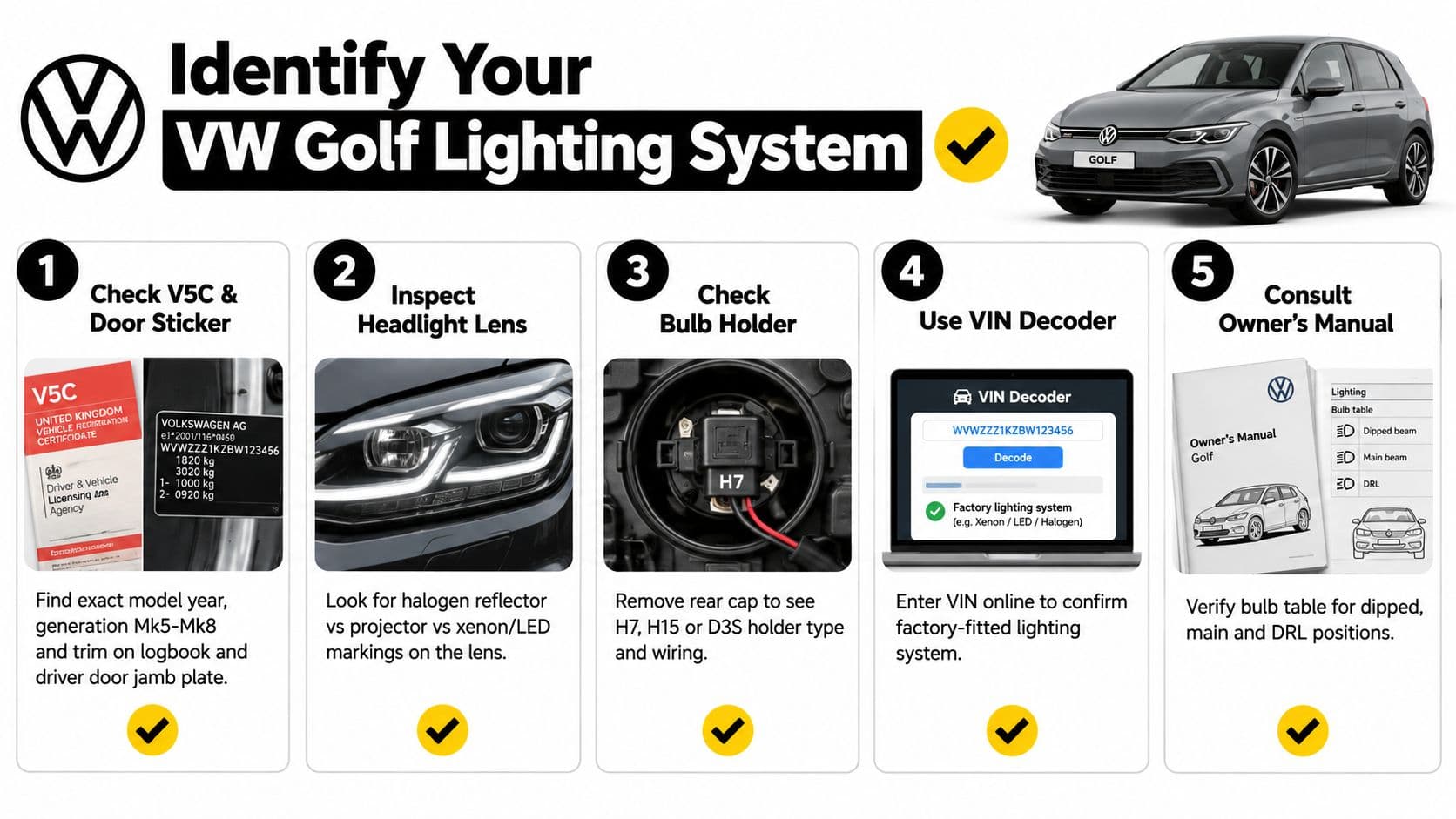
Start with the vehicle, not the bulb shelf. You need a reliable profile containing the Golf's model year, generation, trim and factory lighting type.
Build a verified vehicle profile
Use these checks in order:
Check the vehicle documents and identification labels.
The V5C and the driver's door-jamb plate can help confirm the model details. A VIN decoder may provide another way to verify the factory specification, especially where a car has changed hands or received replacement lamps.
Read the owner's handbook.
Look for the bulb table and separate entries for dipped beam, main beam, daytime running lamps, sidelights and fog lamps. The handbook may identify positions that use different bulb families.
Inspect the headlamp lens and housing.
A halogen reflector usually has a straightforward reflector appearance. A projector-style unit can indicate xenon or a particular halogen arrangement, but appearance alone isn't enough. Look for factory markings and inspect the rear of the lamp for ballast equipment, connectors or LED-module wiring.
Check the existing bulb carefully.
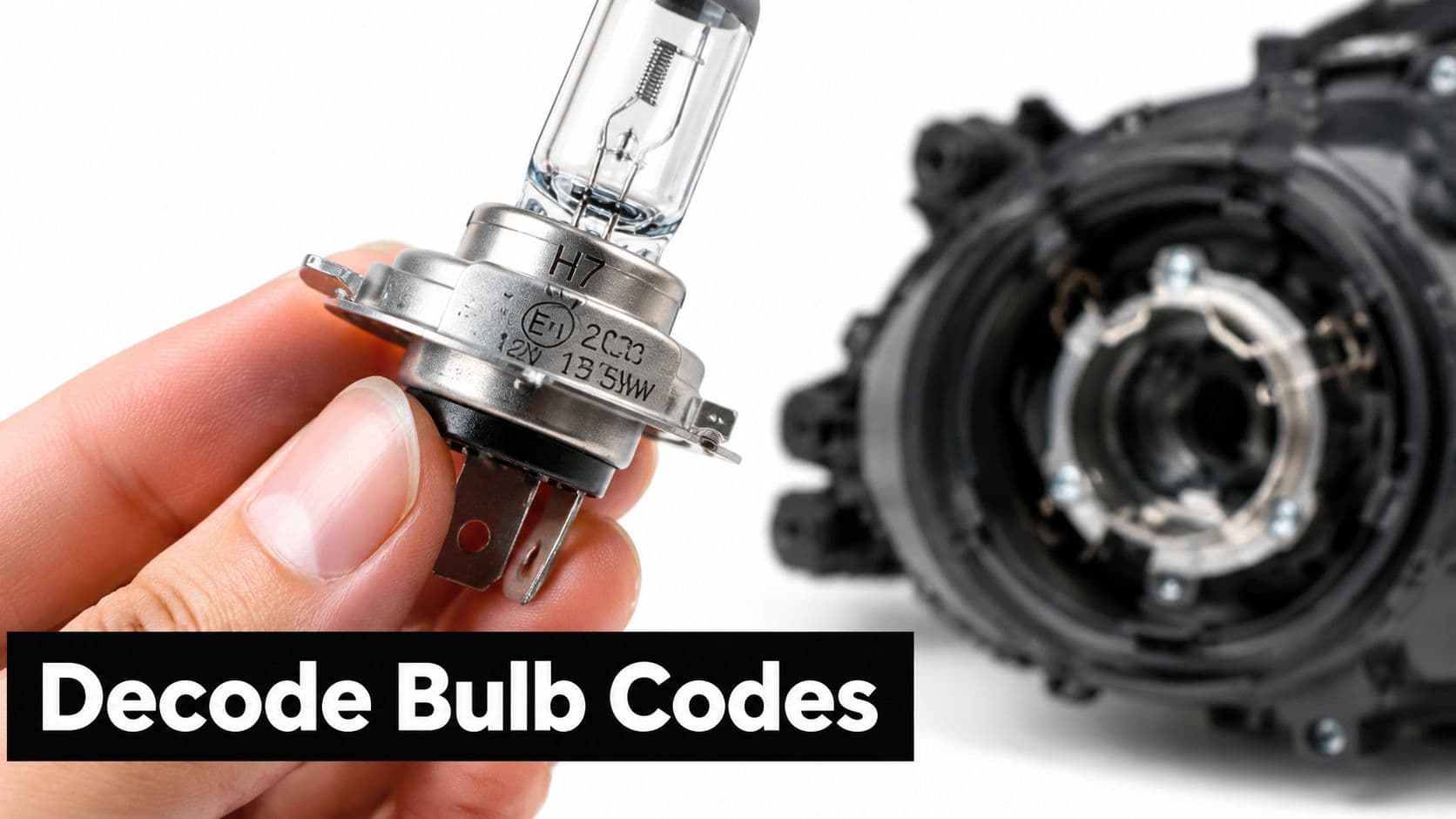
Once the lamp is safely accessible, read the marking on the bulb base or collar. You may see a code such as H7, H15 or D3S. Don't rely solely on shape, because several bulbs can look broadly similar while using different bases and electrical systems.
Run the registration through a parts finder.
A number plate lookup can produce a vehicle-specific result, but compare that result with the handbook and the bulb you've removed. This matters particularly when a Golf has optional xenon lamps, a replacement headlamp or a trim-dependent lighting package.
Separate the lighting positions
An H7 used for dipped beam doesn't mean every front lighting position uses H7. A Golf can use one family for dipped beam, another for main beam and another for an auxiliary or daytime-running function. Treat every position as a separate fitment unless the handbook or a verified catalogue says otherwise.
The most dependable result comes from combining the registration search with a physical check. If the catalogue returns multiple possibilities, the exact lamp type and existing bulb marking should decide which one you buy.
Understanding Headlight Bulb Types Used Across VW Golf Generations
Bulb codes identify a design family, not a universal replacement. The code tells you about the bulb's base and intended standard, but it doesn't give permission to install that technology in any lamp housing.
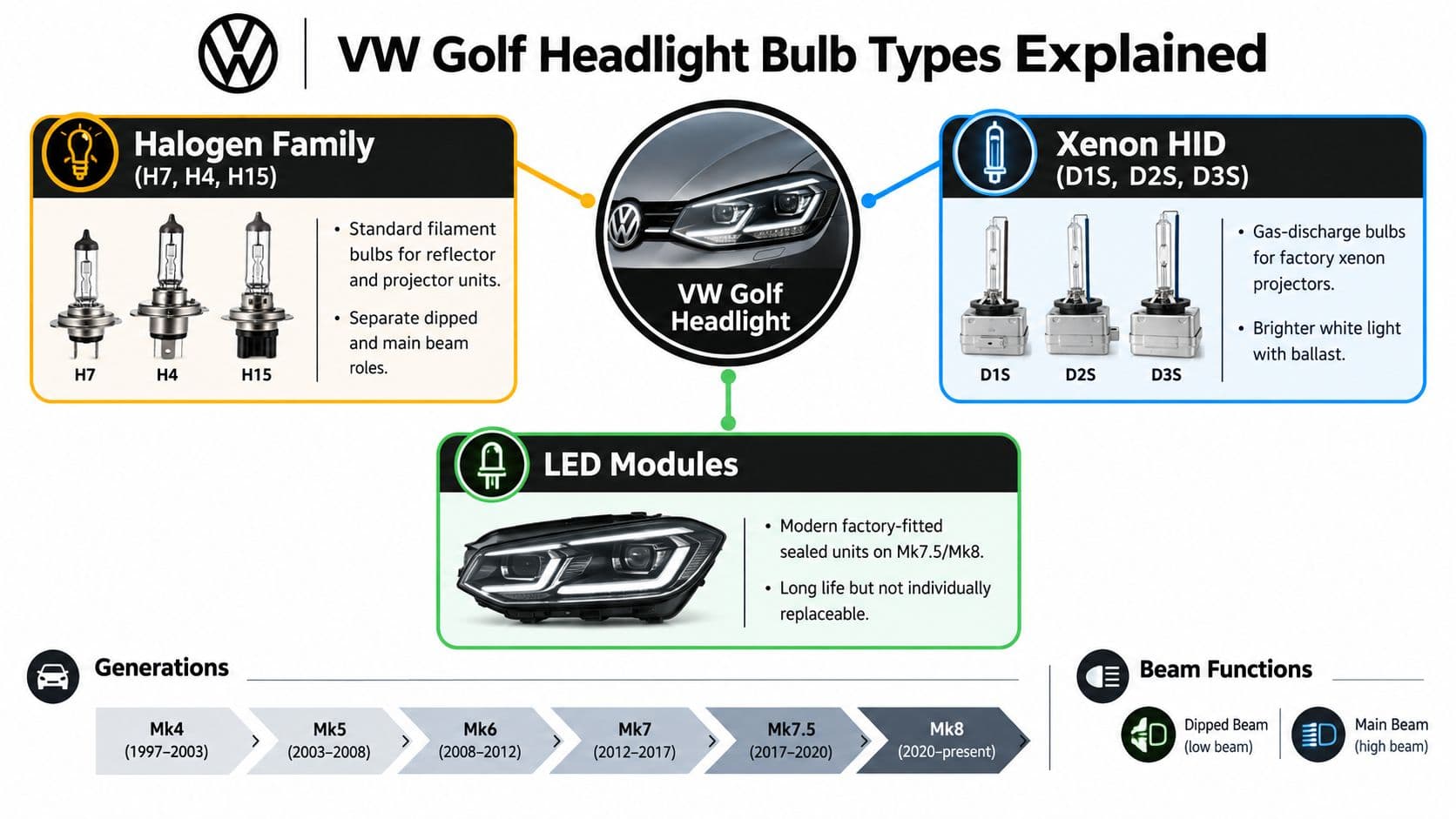
Halogen families
H7 is a single-beam halogen bulb. Depending on the Golf's headlamp design, it may serve dipped beam or main beam. Its base and connector differ from H11, so the two aren't interchangeable because both may appear in catalogue results.H11 is another distinct family, commonly found in selected low-beam, auxiliary or fog-light applications. H15 can appear in newer Golf listings, while H8 and H9 also occur in later UK fitment data. H3 and T4W appear in some earlier or auxiliary arrangements.
Halogen bulbs produce light from a filament. A like-for-like replacement keeps the approved light-source type and the lamp's original optical design aligned. That makes the bulb code, beam position and lamp approval important together.
Xenon HID families
Factory xenon systems use gas-discharge bulbs rather than a halogen filament. Golf listings can include D1S, D2S and D3S, depending on generation and equipment. These bulbs belong with the corresponding xenon projector and electrical hardware, including the ballast arrangement.
A D-series bulb isn't a substitute for an H7 just because both are used for headlamps. The base, electrical requirements and optical system differ. If your Golf was built with factory xenon, use the correct xenon family shown for that lamp rather than converting the unit to a different source.For a focused view of compatible xenon product categories, see GSF Car Parts xenon bulbs.
Factory LED systems
Later Golfs may use factory LED modules instead of a conventional replaceable bulb. The module is part of the lamp assembly and may not be serviced like an H7 or D3S. If the light has failed, check the lamp design and vehicle specification before removing anything.
The following video can help you visualise the differences between common headlamp bulb arrangements and installation approaches.
Volkswagen Dipped Beam Headlight Bulb Replacement - MK7 Golf - DIY
The important distinction is simple: physical fit doesn't prove system compatibility. Match the family, position, lamp design and approval status as one decision.
VW Golf Headlight Bulb Fitment by Generation and Year
Golf fitment changes across generations, and catalogues may show several options within one generation. The table below is a quick reference for common UK-listed families, not a substitute for a registration and variant check.
Golf Generation | Typical Bulb Families | Notes |
Mk4 | D1S, D2S, H3, H7 | Earlier cars can have xenon or halogen combinations. Confirm whether the lamp is factory xenon or halogen before ordering. |
Mk5 | D1S, D2S, H11, H3, H7, T4W | The catalogue range covers xenon, dipped or main-beam halogen and auxiliary positions. The same Mk5 badge can therefore lead to different bulb choices. |
Mk6 | Check exact year and variant | Treat Mk6 results as vehicle-specific. Confirm the lamp architecture and the position being replaced rather than assuming the Mk5 or Mk7 pattern. |
Mk7 | D3S, H11, H15, H3, H7, H9, T4W | Later lighting equipment can combine xenon, halogen and auxiliary families. Verify whether your car has factory xenon or a halogen unit. |
2017 to 2020 listings | D3S, H11, H15, H7, H8, H9 | These listings show why year, trim and lamp specification matter. H8 appears among the later options, but it isn't a universal Golf headlamp replacement. |
Mk4 and Mk5
Earlier Golfs often create the most confusion because one generation can contain both halogen and xenon arrangements. Mk4 listings commonly show D1S and D2S xenon families alongside H3 and H7 halogen options. A Mk5 catalogue entry can include D1S, D2S, H11, H3, H7 and T4W.Use the lamp itself to decide which branch applies. A factory xenon projector requires the relevant D-series bulb, while a halogen housing may use H7, H3 or H11 depending on its position. Don't fit an H7 because it appears in the same generation's catalogue.
Mk6
The Mk6 should be treated as a precise vehicle lookup rather than a bridge between neighbouring generations. Trim, market specification and optional lighting can affect the result. Check the handbook, bulb marking and registration search together before buying.
Mk7 and later cars
Mk7 listings show D3S, H11, H15, H3, H7, H9 and T4W families. Later 2017 to 2020 listings add H8 among the possible families. Those entries may relate to different lamp positions or equipment levels, so they're best read as a menu of possible fitments, not a list to buy from wholesale.
Fitment check: Match the bulb to the exact lamp position. “Golf Mk7” is not enough information by itself.
The safe sequence is generation, exact year or variant, lighting system, position, bulb code and approval. Missing any one of those checks can turn a correct-looking catalogue result into the wrong part.
How to Read Bulb Codes and Approval Marks Correctly
The code printed on a bulb is your first filter. H7, H11, H15, H8 and H9 identify different halogen families, while D1S, D2S and D3S identify xenon families used in relevant factory systems. The code must match the lamp position and the technology designed for that housing.
Read the marking before you compare brightness
Look at the metal base, collar and packaging. Confirm the bulb family, the intended beam position and the vehicle-specific fitment information. A bulb that has a similar connector or appears to sit in the same opening may still place its light source incorrectly.H7 is a single-beam family, so it can serve dipped or main beam depending on the Golf. H11, H15, H8 and H9 have different physical designs and applications. D-series xenon bulbs also require the correct factory xenon arrangement, rather than a halogen socket adapted by guesswork.
The approval marking is a separate check. UK-facing guidance describes approved dipped and main-beam components as carrying an E-mark or British Standard approval mark, and the relevant lamp must also be approved for its light source. Read the UK guidance on headlamp approval and LED retrofits alongside the markings on the product.
Check the whole match
Use this shelf or checkout test:
Code:
Does the bulb marking match the catalogue result and removed bulb?
Position:
Is it for dipped beam, main beam, daytime running light or another front lamp?
Technology:
Is it halogen, xenon or an LED module intended for that assembly?
Approval:
Does the packaging show the relevant approval marking?
Fitment:
Does the collar lock securely without forcing the connector?
The approval mark doesn't make an incompatible bulb legal. It must be considered with the lamp unit and source technology. Keep the packaging until the bulb works, the beam is checked and you're satisfied that the part matches the vehicle.
UK Road Legality and MOT Compatibility for Upgrades
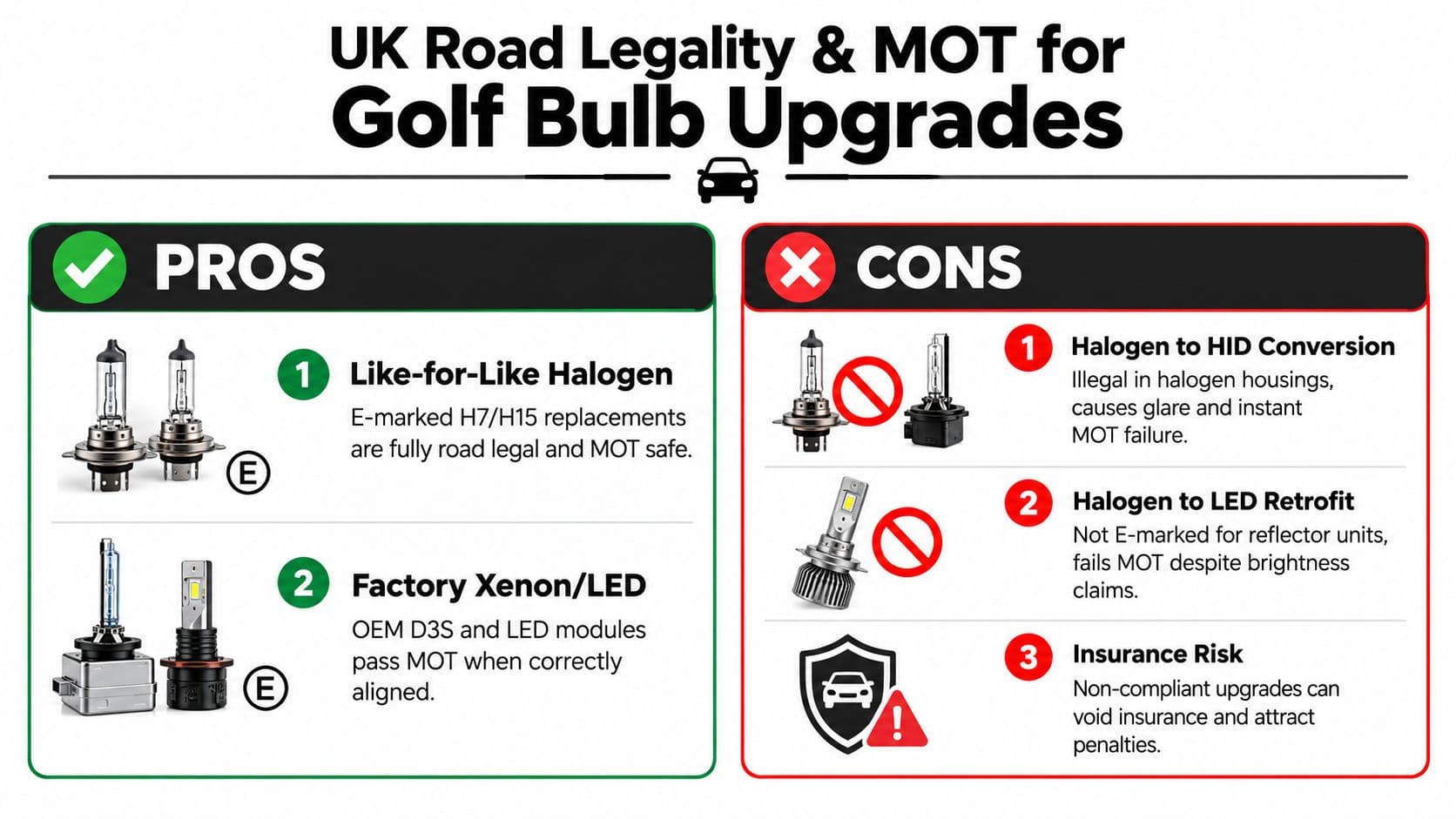
A brighter-looking bulb isn't automatically a legal or safer upgrade. UK MOT rules focus on whether the light source and lamp are compatible, whether the beam is acceptable and whether the lamp remains secure and correctly aimed.
The GOV.UK MOT inspection manual for lamps and reflectors states that an existing halogen headlamp unit on a vehicle first used on or after 1 April 1986 must not be converted to HID or LED bulbs unless the whole headlamp unit was designed for that light source. If that conversion has been made, the lamp can fail for “light source and lamp not compatible”.
The halogen to LED assumption
An LED retrofit may fit into an H7 or another halogen socket, but the physical connection is only one part of the assessment. The lamp's reflector or projector was designed around the original filament position and source. Changing the source can produce an unsuitable beam pattern, glare or an obviously incorrect colour.
UK-facing guidance also describes aftermarket LED upgrade bulbs fitted into existing halogen units as not road legal in those circumstances. The UK LED headlight legality guidance explains why approval of the bulb alone isn't enough. The complete lamp arrangement must remain compatible.
A compliant decision framework
Halogen replacement:
Choose a like-for-like halogen bulb with the correct code and approval marking for the lamp.
Factory xenon replacement:
Use the matching D-series xenon family for the installed projector and electrical system.
Factory LED problem:
Treat the lamp as a module-based system and seek the correct repair or assembly route.
Retrofit proposal:
Don't assume an LED or HID conversion is acceptable because the base fits. Check the complete lamp type and MOT implications first.
The Road Vehicles Lighting Regulations require headlamp light to be white or yellow. They also require dipped-beam lamps to be adjustable while the vehicle is stationary. For vehicles first used on or after 1 April 1991, approved dipped-beam headlamps on cars capable of more than 25 mph must carry a legible marking showing the manufacturer's recommended beam-setting inclination, as set out in Schedule 4 of the lighting regulations.
After any replacement, check the beam. A secure bulb can still be badly seated, and a displaced filament can alter the cutoff and aim.
Buying Tips and Replacement Pointers with Stock Availability
Start with the registration number when shopping for a headlight bulb for VW Golf. A vehicle-specific result is faster than scanning every H7, H11 and D-series listing, but it still deserves a physical comparison with the old bulb and the handbook.
Make the purchase match the repair
Check whether you need one bulb or a pair. Replacing a single failed bulb is appropriate when the other side is recent and working well, while replacing both sides can produce a more even appearance when the existing bulbs have similar age and wear. Follow the product instructions and confirm that the colour and specification match.
GSF Car Parts provides a Volkswagen Golf bulbs category with registration and make-and-model lookup options, plus headlight bulb products from recognised suppliers such as Osram. Stock visibility helps you choose between delivery and collection before dismantling the car.The service information supplied by GSF states that free Click & Collect can be available in as little as 30 minutes from more than 190 stores, while free UK mainland delivery applies to orders over £25. Check the current product page and checkout terms because availability depends on the selected branch and part.
Fit the bulb without creating another fault
Wash your hands before handling a halogen bulb, and don't touch the glass with bare fingers. Oil from skin can contaminate the surface and affect the bulb during operation. If you do touch it, follow the manufacturer's cleaning guidance before installation.
Seat the bulb fully in its locating tabs, refit the retaining clip or holder and reconnect the plug firmly. Make sure the rear dust cap closes properly and that no wiring is trapped against the housing. Test dipped beam, main beam and any affected auxiliary function before closing the bonnet.
After fitting: Check the beam setting on level ground and arrange a proper alignment check if the cutoff looks uneven, unusually high or different from the opposite side.
Keep the old bulb until the new one has passed those checks. It can confirm the code if the catalogue result looks uncertain, and it gives you a useful spare reference for the next purchase.
Quick Reference Lookup and Related Parts Cross References
Use this condensed lookup when you need a fast starting point:
Golf area | Common UK-listed families | Verification point |
Mk4 | D1S, D2S, H3, H7 | Establish halogen or factory xenon first. |
Mk5 | D1S, D2S, H11, H3, H7, T4W | Check the exact lamp position and equipment. |
Mk6 | Variant-dependent | Use the registration result, handbook and existing marking. |
Mk7 | D3S, H11, H15, H3, H7, H9, T4W | Don't treat every listed family as a dipped-beam bulb. |
2017 to 2020 listings | D3S, H11, H15, H7, H8, H9 | Confirm the later lamp arrangement and trim. |
Cross-check the surrounding lighting parts
A headlamp job often reveals other maintenance needs. Check the sidelights, indicators, daytime running lamps and fog lamps separately, because they can use different codes. Inspect the lens for clouding or damage, confirm the bulb holder isn't loose and include beam alignment in the final check.
Keep a note of the registration, generation, lighting type, bulb code and replaced position. That small record makes the next purchase quicker, especially after a trim change, lamp replacement or change of ownership.
For broader Volkswagen lighting searches, use the GSF Car Parts Volkswagen bulbs range. You can also combine a lighting order with other routine parts such as batteries, filters, wipers, brake components or screen-care consumables, provided each item is checked against the vehicle.
The central rule remains unchanged: identify the Golf precisely, match the bulb to the lamp system and confirm UK approval before fitting. That approach prevents the most common mistake, buying a bulb that fits the name of the car but not the headlamp.
GSF Car Parts offers registration-based bulb lookup, online stock checking and Click & Collect for drivers who need the correct Golf lighting part without unnecessary delay. Visit GSF Car Parts to check your Golf's fitment, compare suitable bulbs and arrange delivery or collection.