


You lift the bonnet, spot the coolant sitting low in the expansion tank, and suddenly a simple top-up doesn't feel simple at all. The bottle on the shelf says red, the fluid in the car looks pink-ish, and somewhere online someone says all modern coolant is basically the same. It isn't.
If you're searching what coolant for my car by reg, the safest answer is straightforward. Start with your registration plate, use it to identify your exact vehicle, and then confirm the coolant specification your manufacturer approves. That matters far more than the colour on the bottle.
A lot of expensive cooling-system trouble starts with a quick guess. A careful check only takes a few minutes.
Why the Right Coolant Is So Important
A coolant warning light often catches drivers at the worst time. You're heading to work, stuck in traffic, or doing a routine check before a long trip. The temptation is to buy any antifreeze that looks close enough and pour it in.
That shortcut can cost you.
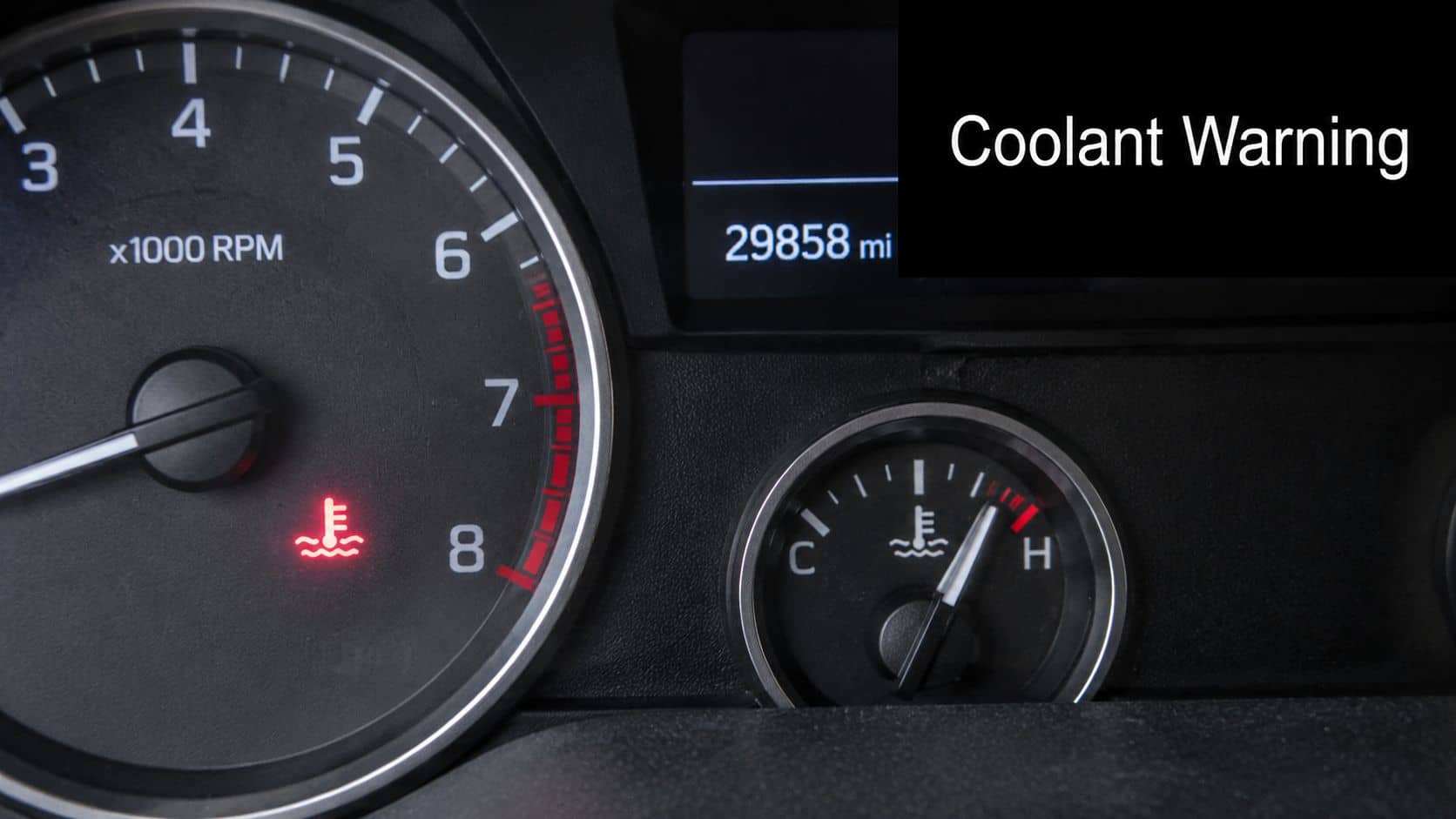
Coolant has a tougher job than generally understood. It helps control heat when the engine is working hard, stops the system freezing in cold weather, and protects parts such as the radiator, water pump, hoses and head gasket from corrosion and wear. That's why the vehicle manufacturer's specification is the most authoritative starting point. RAC also notes that service intervals can vary from 5 years or 50,000 miles to 10 years or 150,000 miles, depending on the vehicle and coolant type, which is one reason a reg check is useful before you buy or top up (RAC antifreeze guidance).
Why registration matters first
In practice, your registration plate is the quickest sensible starting point because it helps narrow the car down by make, model and year. That's far better than standing in the shop comparing blue, red and pink bottles and hoping one will do.
If you're checking related parts at the same time, the wider cooling system range can also help you look at the system as a whole, not just the fluid.
Practical rule: Coolant isn't a universal fluid. If the spec is wrong, the colour match doesn't save you.
What goes wrong when people guess
The most common mistake isn't neglect. It's assumption. Drivers often assume coolant is mostly there for winter protection, or that any modern bottle will be close enough for a top-up.
Neither is reliable. The cooling system depends on the right chemistry staying in place over time. Once the wrong product goes in, you can lose the corrosion protection the engine was designed around.
Find the Right Coolant for Your Car by Reg
If you want the shortest route to the right answer, use the registration lookup first and treat colour as background detail only.
A parts finder is useful because it strips away most of the guesswork. Instead of starting with bottle colour or marketing terms, you start with the car itself.
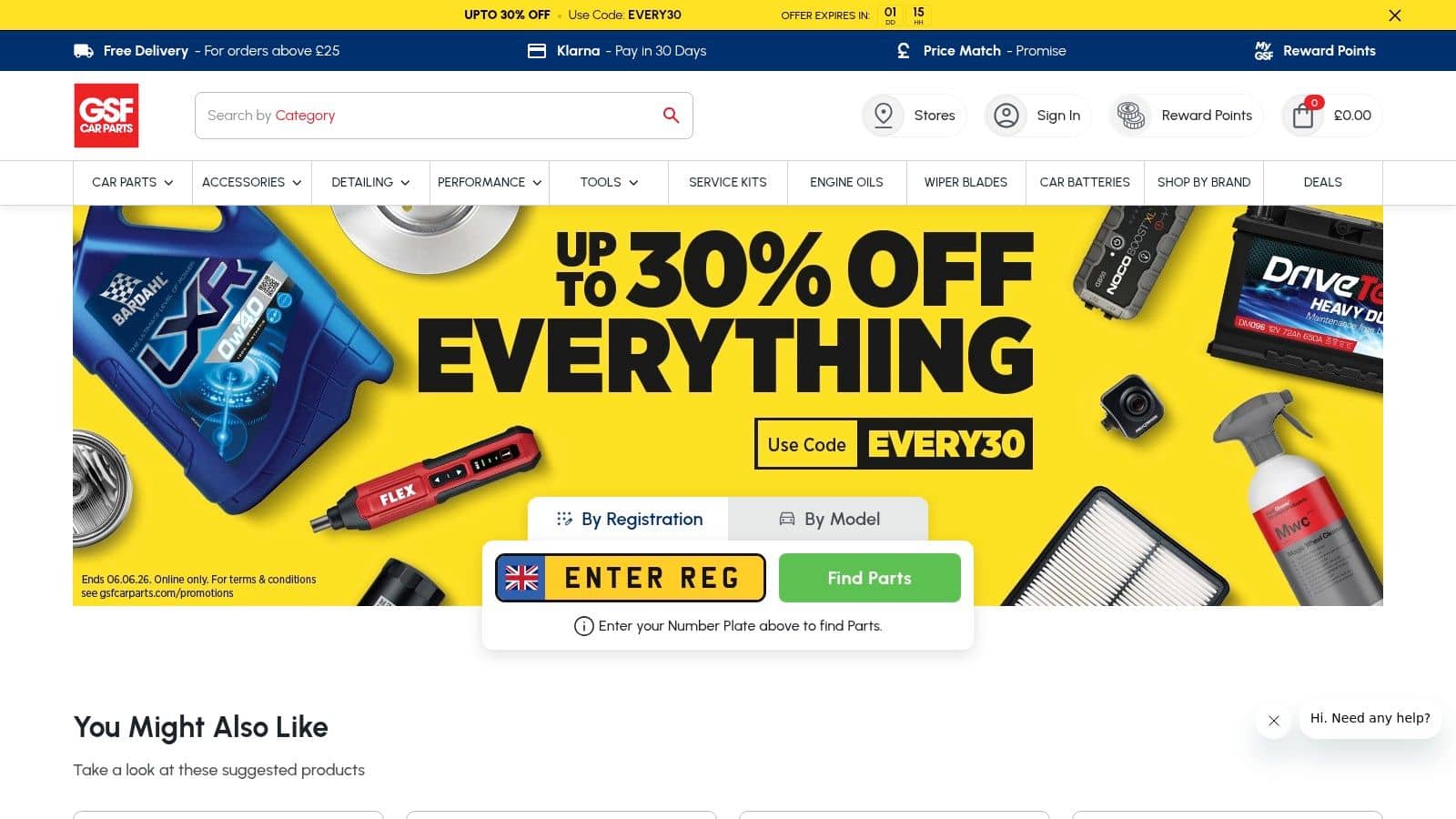
A simple way to do the check
Use this order:
Enter your registration into a vehicle lookup tool.
Confirm the matched vehicle details are correct, especially engine and model year.
Open the cooling category and look specifically for antifreeze or coolant.
Read the product specification, not just the front label.
Cross-check the result with the owner's handbook or manufacturer coolant chart if there's any doubt.
That final step matters because some vehicles have mid-generation changes, and coolant approvals can be more specific than people expect.
What the reg check actually helps with
A proper registration match helps you avoid three common errors:
Buying by colour alone when several chemistries can appear similar.
Buying by brand familiarity instead of by approval.
Buying a “universal” coolant when the car really calls for something more specific.
It also helps when a car has had a mixed service history. If you've just bought the vehicle, or there's no clear record of the last coolant change, the registration gives you a sensible starting point for what should be in the system.
For a visual walkthrough, this video shows the general process of finding the right parts online: How to check your car's coolant and antifreeze
When the result still needs a second check
A reg check gets you close quickly, but it doesn't replace common sense. If the vehicle has had engine work, radiator replacement, or unclear maintenance over the years, confirm the exact coolant approval before pouring anything in.
If the lookup result and the fluid already in the tank don't seem to line up, trust the specification, not the dye.
That's the bit many drivers miss when they search what coolant for my car by reg. The reg check is the first filter. The approved spec is the final answer.
A Quick Guide to Coolant Types and Colours
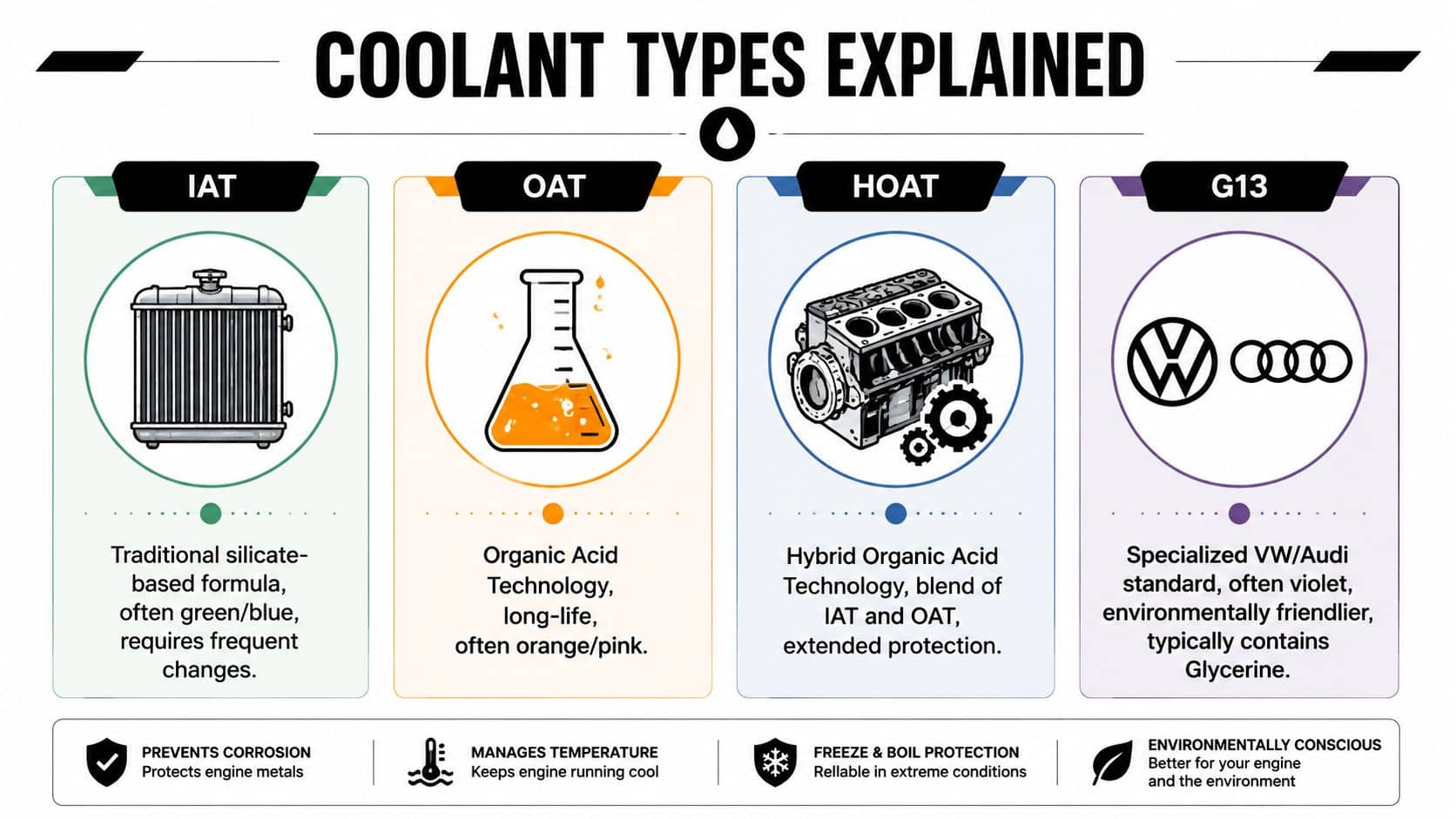
Once you start looking at coolant properly, the labels can seem needlessly complicated. IAT, OAT, HOAT, G13. It sounds worse than it is.
The key thing to understand is that coolant type is really about inhibitor chemistry. That chemistry decides how the fluid protects metal surfaces inside the engine and cooling system.
The main coolant families
Import Car cooling-system guidance explains the broad difference clearly. IAT uses fast-acting silicates and phosphates and is generally associated with older vehicles, with a typical life of 2 to 3 years or about 30,000 miles. OAT uses long-life organic acids and is commonly used in modern engines, typically around 5 years or 150,000 miles. HOAT is a hybrid blend, and mixing the wrong chemistries can reduce corrosion protection.
A simple way to think about them:
Type | Best thought of as | Typical use |
IAT | Traditional chemistry | Older cars |
OAT | Long-life modern chemistry | Many newer vehicles |
HOAT | Hybrid protection | Vehicles needing a blend of quick protection and long service life |
Why colours confuse people
Colour helps manufacturers identify products on the shelf, but it isn't a reliable technical standard. One red coolant can be very different from another red coolant. Blue isn't always old-school. Pink doesn't automatically mean it suits every modern engine.
That's why the old “red for new cars, blue for old cars” rule falls apart so often in real life.
Coolant colour is a clue at most. It isn't proof of compatibility.
What the letters mean in practical terms
If you're not interested in chemistry lessons, think of these formulations by how they behave in service:
IAT tends to suit older systems and usually needs changing more often.
OAT is built for long service life in many modern engines.
HOAT sits in the middle, combining elements of both approaches.
Some product ranges also use manufacturer-specific standards such as G11, G12 or G13. Those labels matter if your car's handbook calls for them, but they still don't replace the actual approval requirement for your engine.
The takeaway that saves hassle
When people ask what coolant for my car by reg, they often expect the answer to be a colour. The better answer is this: find the approved chemistry first, then buy the product that matches it.
That approach works. Guessing from the colour in the bottle doesn't.
Topping Up vs a Full Coolant Flush
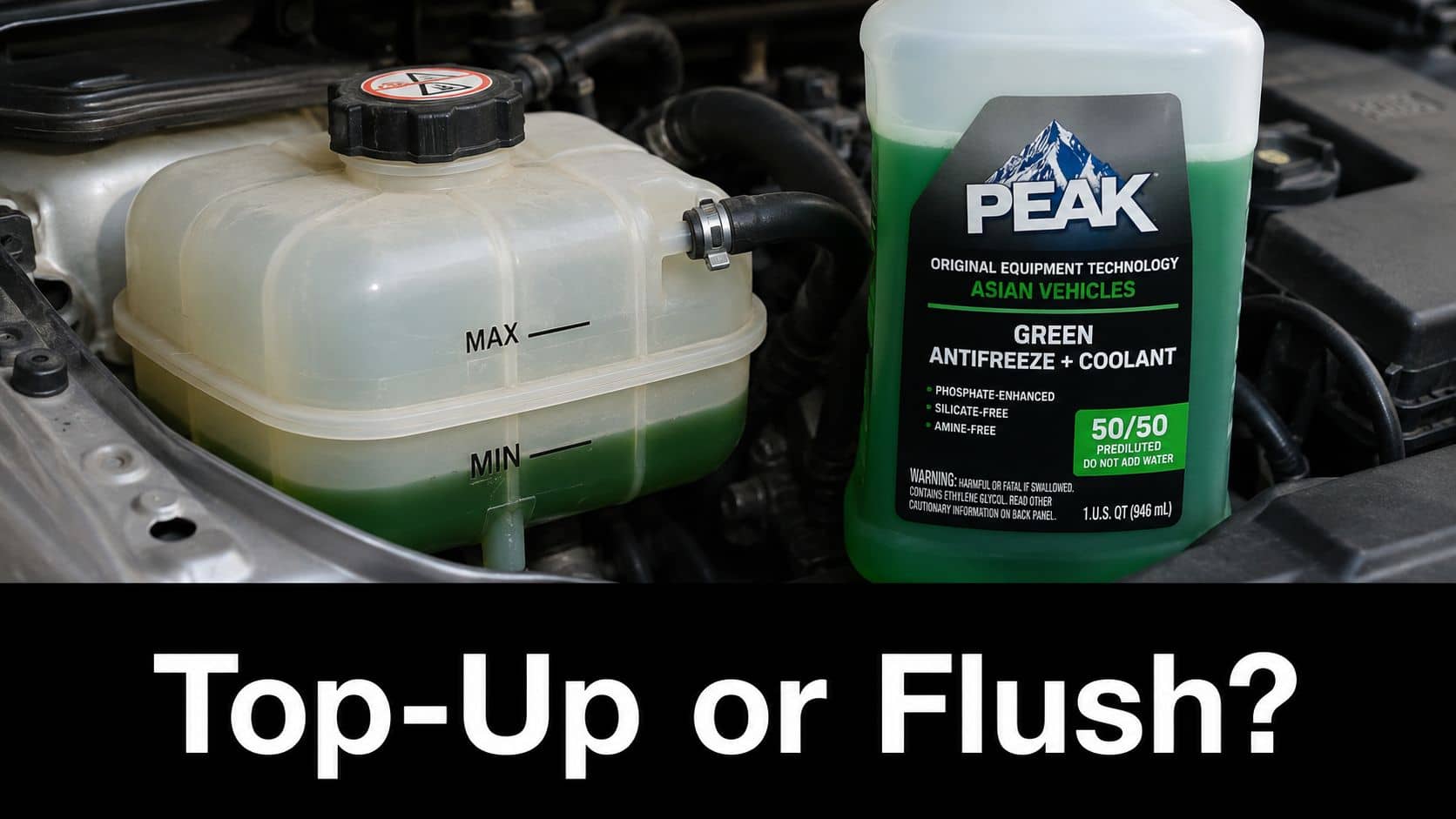
Real-world uncertainty matters more than theory. You've checked by reg, found a likely match, and now you're standing over a low expansion tank wondering whether to add a bit or start fresh.
The right choice depends on how sure you are about what's already in the system.
When a top-up is usually fine
A small top-up is generally reasonable if all of these are true:
You know the exact coolant already in the car and you're adding the same approved type.
The level is only slightly low, not disappearing rapidly.
The fluid looks clean, with no rusty staining, oil contamination or sludge.
The service history is clear enough that you trust what was used previously.
If the level is marginally down and the system is otherwise healthy, a careful top-up can be all that's needed.
When a flush is the safer call
Autotrader's coolant advice points to a common problem drivers run into after a reg check. If the expansion tank is low and you don't know the previous coolant type, a full flush is a much safer option than adding a potentially incompatible product.
That's the garage answer too. If the history is murky, don't build your maintenance around hope.
Consider a full flush if:
You've just bought the car and there's no trustworthy record.
The coolant colour looks odd or inconsistent with what the vehicle should use.
The fluid is dirty or the tank has visible deposits.
Different products may already have been mixed by a previous owner.
You're already doing cooling-system maintenance and want a known baseline.
If you can't identify what's in the system, reset the system.
A flush also gives you a chance to inspect hoses, clips and the reservoir cap while the system is being serviced. If you need supporting products for that job, cooling-system additives and maintenance products can be part of the wider check.
The Risks of Mixing and Getting It Wrong
“Any coolant will do for a top-up” is one of those workshop myths that refuses to die. It sounds harmless because the system may not complain immediately.
The trouble is that coolant problems often build subtly. By the time overheating, poor heater performance or corrosion shows up, the fluid choice that caused it may be long forgotten.
Mixing chemistry is not a harmless experiment
Different coolant types use different inhibitor packages to protect the metals inside the system. When the chemistry doesn't match, protection can drop off instead of improving. The result isn't always dramatic overnight, but it can leave aluminium components, pump surfaces and internal passages less protected than they should be.
That's why “close enough” isn't really close enough with coolant.
Concentration matters too
AAA coolant guidance states that a correct fill is typically a 50/50 antifreeze-to-water mix. That ratio balances freeze protection and heat transfer, and it's also why deionised water is the right choice. Minerals in tap water can promote scale and corrosion. If the mix is too weak, freeze protection drops. If it's too strong, heat transfer worsens.
A quick reference point helps:
Fill issue | Likely problem |
Too much water | Reduced freeze and boil protection |
Too much antifreeze | Poorer heat transfer |
Tap water used | Scale and corrosion risk |
Wrong coolant chemistry | Reduced corrosion protection |
What works and what doesn't
What works:
Matching the exact approved coolant
Using premix as supplied, or mixing concentrate correctly
Using deionised or distilled water where mixing is required
Treating uncertain history as a warning sign
What doesn't work:
Guessing from the bottle colour
Topping up with whatever's in the garage
Using tap water because it's convenient
Assuming a small mismatch won't matter
The cheapest bottle can become the most expensive repair if it leaves the system under-protected.
Buy the Right Coolant Today
The easiest way to handle coolant properly is to keep the decision simple.
First, identify the vehicle accurately by registration. Second, choose the coolant that matches the required specification. Third, if the car's history is unclear, don't gamble on a random top-up. Start clean with the right fluid.
A practical three-step plan
Run a reg check to narrow the search to your exact vehicle.
Read the spec on the product listing and match it to the car's requirement.
Choose coolant based on certainty. Top up only when you know what's already in the system. Flush it if you don't.
Modern coolant is built to last when the right product goes in from the start. UTI notes that some red antifreezes, typically a hybrid organic acid type, are replaced every 150,000 miles or 5 years, which is a good reminder that long-life coolant only works as intended when the chemistry is right from the outset (UTI coolant overview).
If you want to check compatible products, engine coolant options are easier to sort through once you already know the exact spec you need.
If you'd rather avoid guesswork, check your vehicle details and shop confidently through GSF Car Parts. A registration lookup gives you a sensible starting point, and from there you can choose coolant that matches your car instead of relying on colour or trial and error.





