


You're usually not asking “can you mix motor oil” in a calm garage with time to compare bottles. You're asking it at a petrol station, on a driveway before work, or after a warning light has made your stomach drop.
The short answer is yes, motor oils can usually be mixed in an emergency. The better answer is that the primary issue isn't whether the liquids will blend. It's whether the oil in the engine still matches the specification your engine was designed to use. That matters a lot more on modern UK cars than many drivers realise, especially on engines with turbochargers, emissions hardware, and long service intervals.
The Low Oil Light Dilemma What You Need to Know
If the oil light or low oil warning comes on, the first priority is simple. Don't keep driving blindly and hope it goes away. Check the level properly as soon as it's safe, and confirm whether you're dealing with low oil, a warning system issue, or something more serious such as low oil pressure.
If your car is low and you can't get your usual brand, a top-up with a different oil is often acceptable as a temporary measure. Independent oil guidance notes that different brands, colours, and even synthetic and conventional oils will mix because engine oils are designed to be compatible under industry criteria, but mixing can alter additive balance, so it's best to stay with the same viscosity and service grade and change the oil sooner if you've topped up with a different product, as explained in RevZilla's oil compatibility guidance.
What to check before you pour anything in
Start with the basics:
Read the handbook: It should list the required oil grade and approvals.
Check the dipstick on level ground: If the oil is only slightly low, you may need less than you think.
Look for warning signs beyond low level: Rattling, knocking, or a red oil pressure light needs a different response.
Check the oil level sensor if readings seem odd: Some faults come from the monitoring side rather than oil consumption. If you suspect that, an oil level sensor may be worth investigating.
Practical rule: Low oil level is usually less risky than running an engine with too little oil, but “any oil will do” is still the wrong mindset.
Emergency mixing is not the same as correct servicing
A common misunderstanding arises here. They hear that oils are compatible and assume all matching bottles are basically interchangeable. They aren't.
A roadside top-up is about avoiding immediate harm. Long-term engine protection is about using the correct specification, not just getting oil back onto the dipstick. If the engine was designed around a particular approval, a random bottle that only looks close isn't a proper substitute.
That's why mechanics often say a mixed top-up can get you home, but it shouldn't become your plan for the rest of the service interval.
Decoding Motor Oil Labels A Practical Guide
Most oil bottles look busier than they need to. Once you know what the label is telling you, choosing the right oil gets much easier.
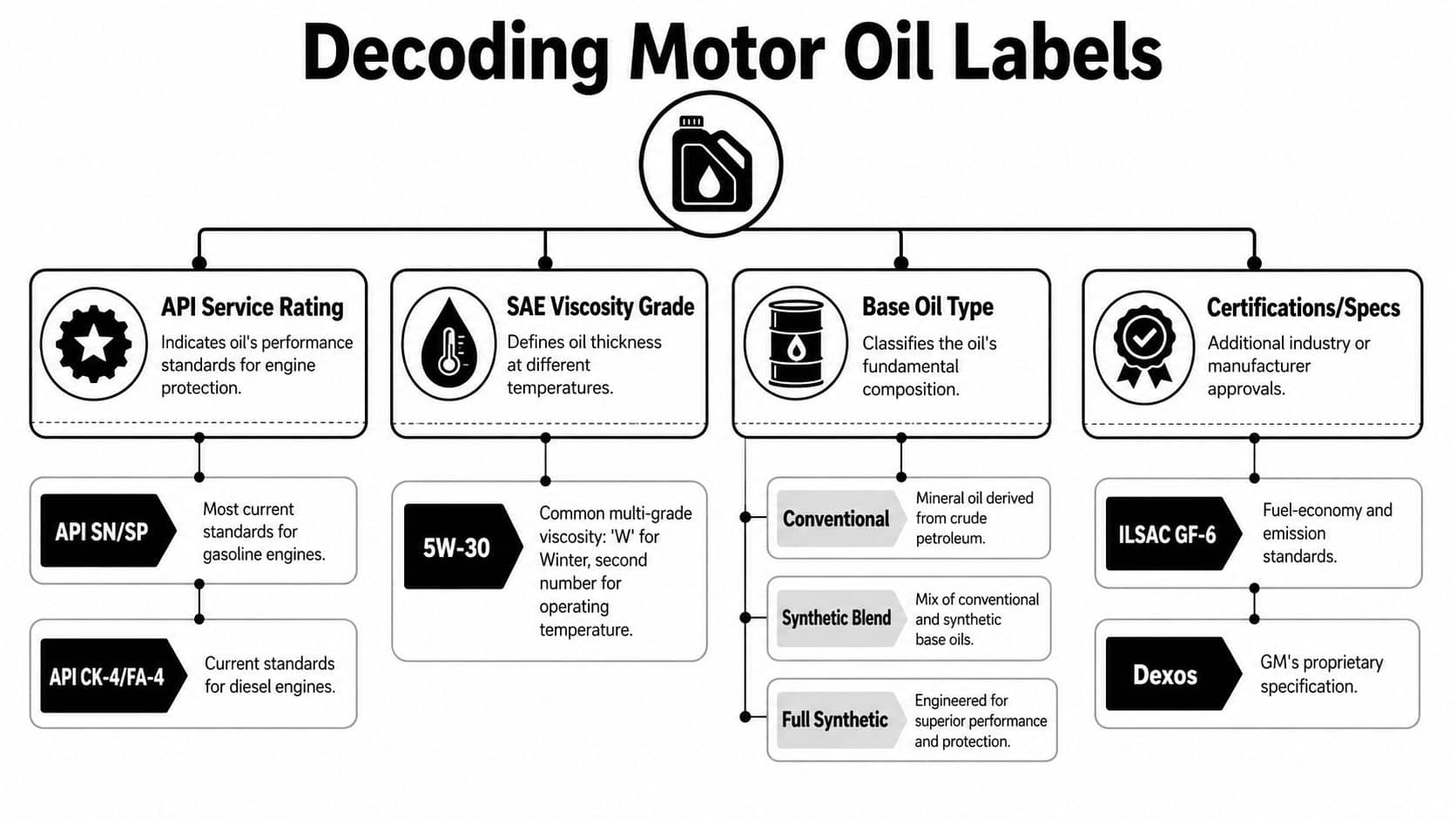
SAE grade tells you thickness, not full suitability
Take 5W-30 as the common example. The first part relates to how the oil behaves when cold. The second part refers to how it behaves at operating temperature. That matters in the UK because your engine has to cope with cold starts, stop-start traffic, and motorway heat.
A lot of drivers stop reading there. That's the trap.
Two bottles can both say 5W-30 and still be very different in the ways that matter to your engine. One may suit a petrol hatchback. Another may be formulated for an engine with stricter emissions-system needs. Same viscosity on the front. Very different purpose once you read the rest of the label.
API, ACEA and approvals matter more than many people think
For UK drivers, the critical detail is often the ACEA category and any manufacturer approval listed on the bottle. That's the part many quick guides skip over.
A practical top-up with a different motor oil brand is generally acceptable only if the oil matches the vehicle's required specification and viscosity grade. UK product guidance highlighted by 49 North Lubricants says mixing should be treated as temporary because additive packages are tuned to meet exact OEM, API, and ACEA performance targets rather than to optimise blended performance, as outlined in this guide to mixing different brands of engine oil.
A bottle that “fits” by viscosity can still be wrong for the engine in front of you.
Here's a simple way to read the label:
Label item | What it tells you | Why it matters |
SAE 5W-30 | How thick the oil is when cold and hot | Affects cold starts and running protection |
API rating | General service category | Helps confirm broad performance level |
ACEA rating | European performance category | Often crucial on UK and European vehicles |
OEM approval | Maker-specific requirement | Confirms it meets the engine maker's target |
The order I'd use in the real world
When choosing oil, read the bottle in this order:
Handbook approval first
Look for the exact ACEA or manufacturer requirement your car needs.Viscosity second
Match the SAE grade listed for your engine.Brand third
Brand matters less than correct specification.
If you need to compare options, checking a dedicated engine oil range can help you filter by vehicle and approval rather than guessing from the front label alone.
Mixing Conventional and Synthetic Oils
This is one of the oldest oil questions around, and the answer is more straightforward than the myths suggest. Yes, you can mix conventional and synthetic oils. They won't suddenly separate inside the engine or turn into sludge just because one came from a premium bottle and the other didn't.
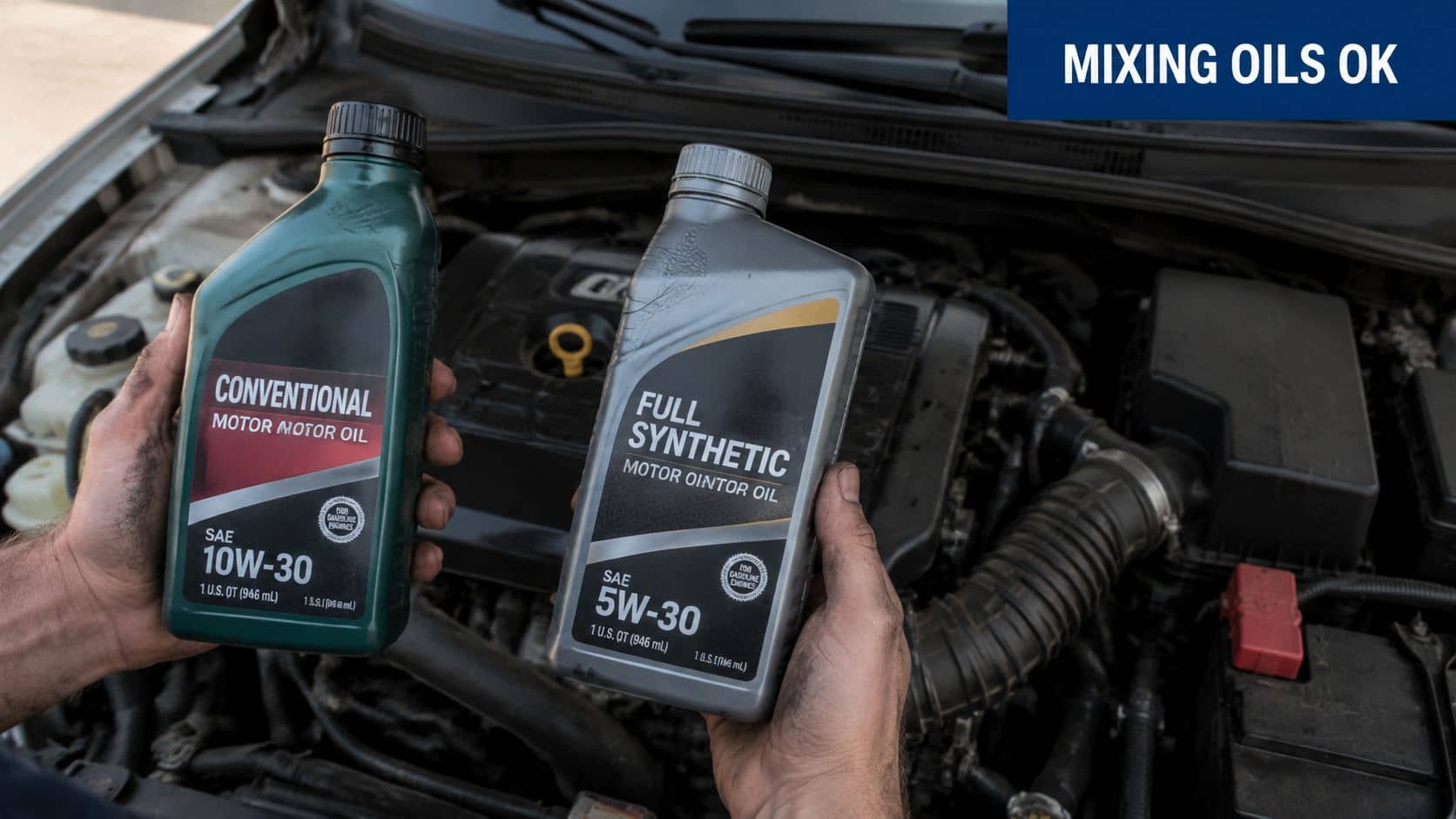
What actually changes when you mix them
What you lose is performance consistency.
Guidance from a major lubricant manufacturer states that switching between synthetic and conventional oil is safe as long as the oil meets the required viscosity and performance specifications, but it also says the engine should be serviced back to a single formula rather than left with a mixed fill for the rest of the interval, as explained by Valvoline's guidance on common motor oil misconceptions.
That lines up with workshop experience. If a car normally runs on a full synthetic oil and you top it up with a conventional one, the engine won't usually object immediately. But the finished mix is no longer the same product you originally paid for.
Consider it this way:
Full synthetic into full synthetic: usually the least disruptive, if the spec matches
Conventional into synthetic: workable in a pinch, but you dilute some of the premium oil's intended performance
Random mixed fill left for months: where convenience starts turning into poor maintenance
What doesn't work as a maintenance habit
Some drivers top up with whatever is cheapest and tell themselves the next service will sort it. Then they do the same thing again. Over time, the engine ends up running on a cocktail of products that may be compatible, but no longer closely match the intended formulation.
That's not careful maintenance. It's deferred correction.
For a quick visual refresher on the topic, this video gives a useful overview before you decide what to do next: Will Mixing 10 Motor Oils Damage an Engine? Let's find out!
The Real Risk Additive Clashes and Specification Mismatches
Base oils usually aren't the part that causes trouble. The additive package is where the main trade-off sits. Every engine oil is a formulated chemical package, not just a slippery liquid.
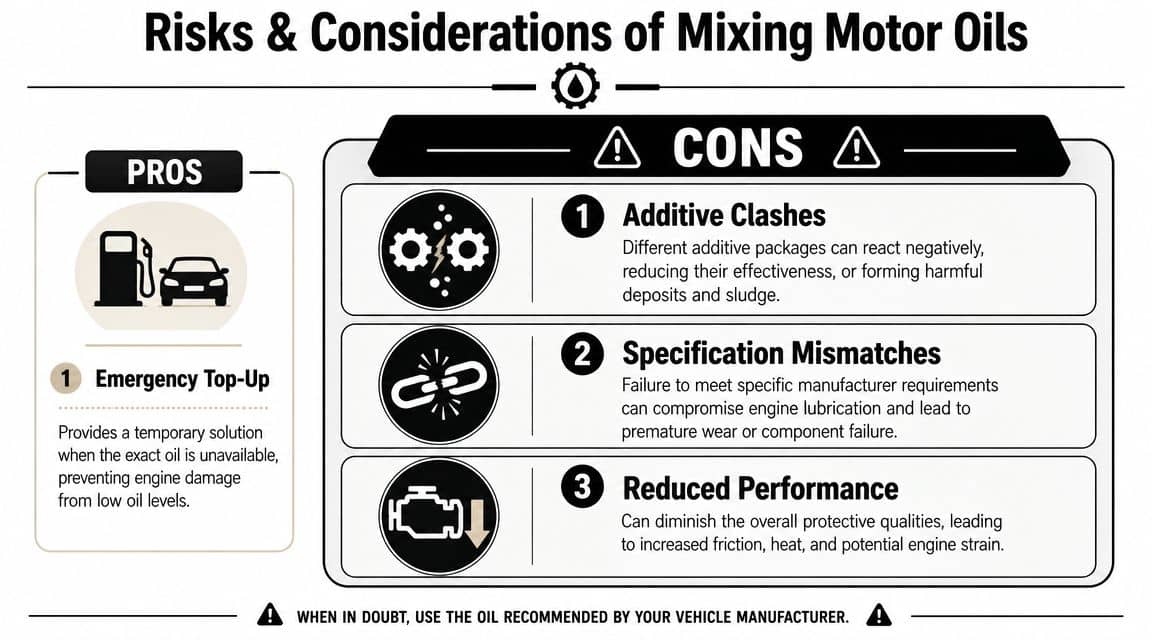
Why the additives matter
Oil has to do more than lubricate. It helps manage deposits, wear, contamination, corrosion, and heat. Manufacturers balance those additives to hit a target. When you mix two different oils, you may still have a usable lubricant, but you no longer have the original formula.
That's why two oils that seem close on the shelf can behave differently in service. One may be tuned for a particulate filter. Another may not. One may be designed around a specific manufacturer approval. Another may only meet a more generic standard.
Mixing two oils is a bit like combining two cake mixes. You'll still get something baked, but it won't be the recipe either manufacturer intended.
The UK-specific mistake I see most often
A bottle saying 5W-30 looks reassuring because it matches the handbook viscosity. But the practical risk for UK drivers is that a correct-sounding 5W-30 can still be wrong if it lacks the required ACEA or OEM approval for a modern Euro 6 petrol or diesel engine. The safest advice is to match the handbook specification first and treat brand differences as secondary, as explained in this advice on mixing different types of motor oil.
That's the underserved part of this whole topic. Most broad advice stops at viscosity. UK drivers often need to go one line lower on the bottle and check the ACEA category or the car maker's own approval.
What works and what doesn't
Situation | Sensible or risky | Why |
Same required approval, same viscosity, different brand | Usually sensible for a top-up | Brand is less important than matching spec |
Same viscosity, missing required approval | Risky | The bottle may still be wrong for the engine |
Different viscosity and missing approval | Poor choice | Too many variables at once |
Emergency top-up followed by proper service | Practical | Limits how long the mixed fill stays in use |
If you remember one thing, make it this. Match specification first. Viscosity second. Brand third.
Your Emergency Roadside Top-Up Guide
When you're standing at a forecourt shelf, you don't need theory. You need a clean decision process that reduces the chance of doing harm.
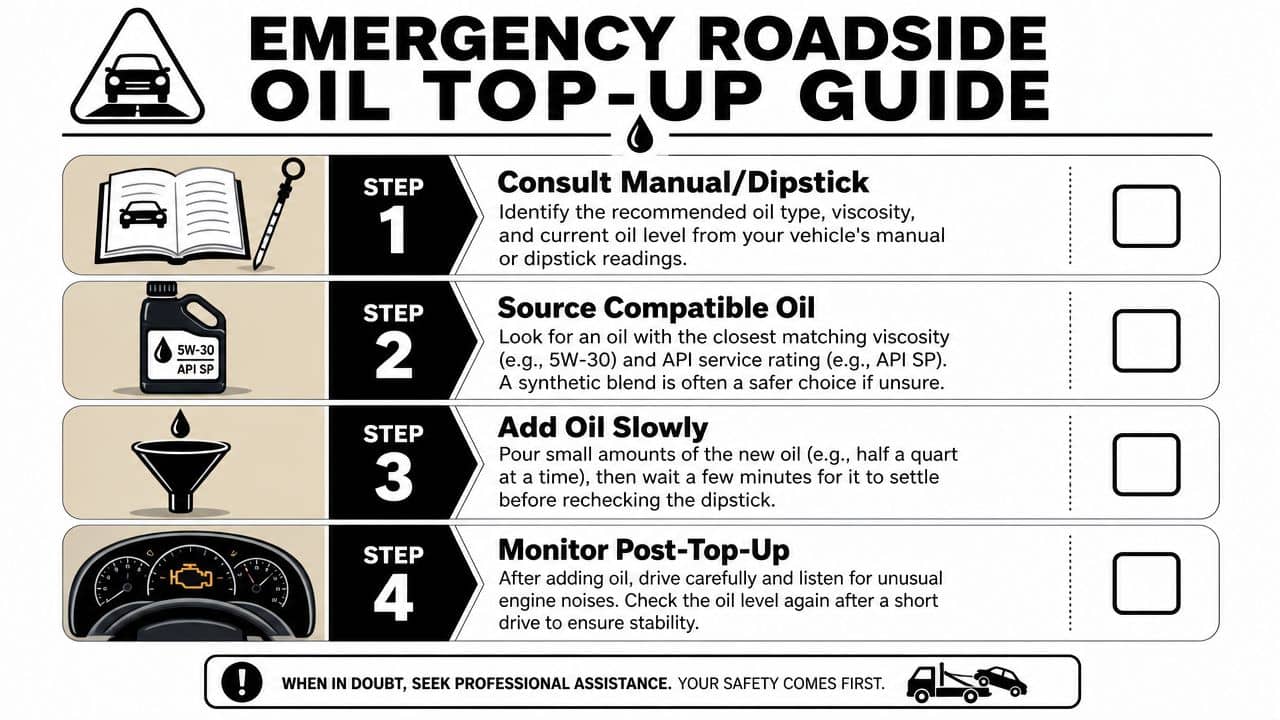
The order of choices that makes sense
Use this priority list:
Find the exact handbook approval
If your car requires a specific ACEA category or manufacturer approval, that's the first target.Then match the viscosity
If the correct approval is available in the right SAE grade, that's your proper top-up choice.If the brand is different, don't panic
A different brand is normally the lesser issue when the approval and viscosity are right.If you can't get a perfect match
Use the closest safe option only to restore level and treat it as temporary.
How to top up without overfilling
Overfilling creates its own problems, so add oil with some patience.
Use small additions: Pour a little, wait, then recheck the dipstick.
Use the right tool: A narrow oil funnel for cleaner top-ups helps avoid spills onto engine covers and belts.
Check on level ground: Slopes give misleading readings.
Stop before the top mark: You want the level within the safe range, not crammed above it.
If you've had to mix oils to get home, treat the engine as needing correction, not as “sorted”.
What to do after the emergency
Manufacturer guidance says switching between synthetic and conventional oil is safe if the oil meets the required viscosity and performance specifications, but the engine should be serviced back to a single formula rather than left with a mixed fill for the rest of the interval. In practice, that means arranging an oil and filter change sooner rather than assuming the mixed fill can stay in place until the usual service date.
Also keep an eye out for any change in engine noise, smoke, or warning lights. A top-up solves low level. It doesn't solve the reason the oil level dropped in the first place.
From Emergency Fix to Best Practice Oil Management
A low-oil top-up at the roadside is one job. Looking after the engine for the next 10,000 miles is another.
The difference is routine. UK drivers get into trouble when they remember the viscosity but forget the approval. On many cars, especially modern diesels and direct-injection petrol engines, ACEA spec matters just as much as the SAE grade on the front of the bottle. A 5W-30 that meets ACEA C3 is a different tool from a 5W-30 built for an older A3/B4 application. Get that wrong often enough and you can shorten the life of emissions equipment, increase deposits, or leave the engine with the wrong protection for its design.
Good oil management keeps that guesswork out of the job.
A simple routine that saves hassle
A practical routine looks like this:
Check the level before it becomes urgent: Once a month is sensible for many cars. Check more often if the engine uses oil, does long motorway runs, or has high mileage.
Keep the exact oil spec in the boot: Match the viscosity and the approval listed in the handbook. For many UK vehicles, that means checking ACEA as well as any manufacturer approval.
Use one oil for planned servicing: Emergency mixing is acceptable. Repeatedly topping up with whatever is available is how small compromises turn into wear, sludge, or DPF and catalyst trouble.
Write down what went in: If you had to use a temporary top-up, make a note of the brand, grade, and spec so the next service can put the engine back on the correct fill.
Treat repeat top-ups as a fault to diagnose: Oil loss usually has a reason. Leaks, consumption, turbo issues, and crankcase ventilation faults will not fix themselves.
Why this matters more on modern engines
Older engines were often more tolerant of a near-enough approach. Many newer engines are not. Low-SAPS oils, fuel-economy oils, and long-drain formulations are built around specific additive packages and approval targets. For a UK driver, that usually means the label needs to line up with ACEA and any maker standard, not just the viscosity printed in large type.
That is the part many DIY owners miss. Two bottles can both say 5W-30 and still be wrong for each other in practice.
If you need to confirm the correct product by registration, GSF Car Parts has a number plate finder that helps narrow the choice to vehicle-matched options. It is still worth cross-checking the handbook, because registration tools are useful for narrowing the field, while the spec on the bottle is what protects the engine.
If you have mixed motor oil once to get home, that was often the right decision. The better habit is to correct it promptly, return the car to one properly approved oil, and keep the right bottle in the boot so the next top-up is straightforward.





