


Standing in front of a shelf full of oil bottles is where a lot of Ford Focus owners get stuck. The labels all look close enough. Same brand family, similar numbers, similar promises. Then you search online and one page says 5W-20, another says 5W-30, and a forum thread swears one grade works for every Focus.
That's where people go wrong.
With engine oil for Ford Focus, the badge on the boot isn't enough. The correct oil depends on the exact car, its engine, and its model year. Ford's own guidance makes that clear. The recommended oil type, filter and refill amount vary by vehicle details, and Ford says the right match should be checked in the owner's manual or by VIN lookup. Ford also gives an example showing that a 2021 to 2024 2.0L engine uses SAE 5W-30 and takes 5.5 quarts in its worked example on Ford oil recommendation guidance.
If you get one thing right, make it this. Match the manufacturer specification first. Everything else comes after that.
Finding the Right Oil for Your Ford Focus
The usual mistake is shopping by viscosity alone. A driver sees 5W-30 on the shelf, remembers hearing that Focus models often use it, and assumes that's enough. It isn't. On a Focus, the safe way to choose oil is to treat it as a specification-led job.
Ford says oil recommendations vary by model year, model and engine type, and it directs owners to the manual or VIN-based lookup rather than relying on a generic answer in Ford's vehicle oil guide. That matters because the Focus has been sold in several generations, with different petrol and diesel engines, different service needs, and different lubricant approvals.
What actually matters when you buy oil
There are three checks that matter:
Exact vehicle identity. Registration, VIN, model year and engine code narrow the choice down properly.
Ford approval specification. This is the part many DIY owners skip, but it's the bit that decides whether the oil is suitable.
Correct refill quantity and filter pairing. Oil and filter should be chosen together, not as separate guesses.
A practical way to shop is to start with a vehicle-specific parts finder rather than a search bar. If you're browsing Ford engine oil options by vehicle application, enter the car details first and then check the listed approval against your handbook.
Practical rule: If the bottle matches the viscosity but not the required Ford approval, keep looking.
Why getting it right matters
Using the wrong oil doesn't always cause an immediate problem. That's why people get comfortable taking shortcuts. But the engine was designed around a particular oil standard, not just a rough thickness range. Modern engines are less tolerant of guesswork than older ones, especially if they use tighter internal clearances or have more demanding emissions and turbo hardware.
For a Focus owner, the calmest approach is also the safest. Don't ask, “What oil does a Ford Focus use?” Ask, “What oil does my Ford Focus require?”
That one change in mindset prevents most buying mistakes.
Decoding Ford Engine Oil Specifications
The label on the bottle gives you two separate pieces of information, and Ford Focus owners need both. The viscosity grade, such as 5W-20 or 5W-30, describes how the oil flows when cold and when fully up to temperature. The Ford approval specification tells you whether that oil meets the standard Ford set for a particular engine design.
That second part is where buying mistakes happen.
A Focus can use oil with the right viscosity on paper and still be wrong for the car. If the bottle does not match the Ford approval your engine was built around, the oil may not deliver the detergent package, wear protection or emissions-system compatibility that engine needs over a normal service interval.
Viscosity and approval do different jobs
Viscosity is only one part of the match. The Ford approval is the pass or fail check.
Independent retail listings for Ford Focus oil applications include both 5W-30 and 5W-20 products, which is a useful reminder that the Focus range covers different engines and different oil requirements across model years in independent retail listings for Ford Focus oil applications. That is why generic advice like "all Focus models use 5W-30" causes trouble.
In the workshop, the safer approach is simple. Read the approval first, then confirm the grade.
What the Ford spec is doing behind the scenes
A Ford approval code is more than a label for the shelf. It means the oil has been tested against Ford's requirements for that family of engines. That covers areas such as sludge control, deposit handling, wear protection, temperature stability and, on some engines, compatibility with hardware such as turbochargers or emissions components.
You do not need to memorise every code. You only need to match the one specified for your exact car.
For a DIY owner, the easiest route is to start with a vehicle-specific lookup rather than trying to decode bottles in isolation. Enter the registration in the GSF parts finder, check the listed Ford approval against the handbook if needed, then buy the oil that matches both the approval and the grade.
A practical check looks like this:
Identify the exact car by registration, VIN, engine code or handbook details.
Find the required Ford approval specification for that vehicle.
Check the bottle for the same approval and the correct viscosity grade.
Ignore forum shortcuts that treat every Focus as if it uses the same oil.
Two oils can both be 5W-30. Only one may be correct for your Focus.
Where owners usually go wrong
The usual mistake is shopping by viscosity alone, or choosing a familiar brand and assuming the rest will sort itself out. Oil brands sell several 5W-30 products, and they are not interchangeable just because the front label looks similar.
That is why a mechanic will ask for the registration or engine details before recommending oil. On a Ford Focus, that is not box-ticking. It is how you avoid buying the wrong spec first time.
Ford Focus Oil Grades and Capacities by Model
People often want a simple table, and that's understandable. The problem is that a generic list can create more confidence than accuracy. Ford's own guidance says the oil type, filter and refill amount should be checked against the owner's manual or quick-reference lubricant charts, because one model line can require different oils depending on engine size and year in Ford guidance on model-specific oil type and refill amount.
That means any chart should be treated as a starting point for checking, not a replacement for the handbook or registration-based lookup.
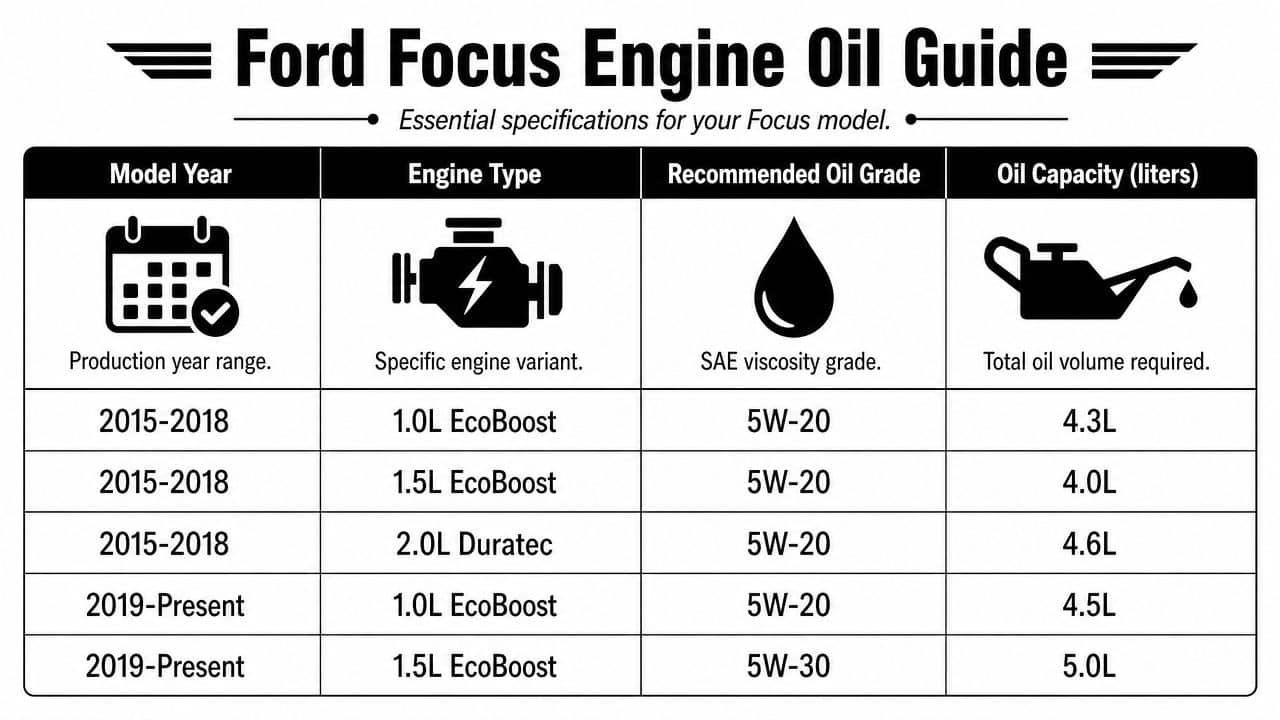
Quick reference by model family
Below is a practical reference layout. Use it to narrow the search, then verify the exact approval and capacity for your own car before ordering or filling.
Focus Generation | Engine | Ford Specification (WSS) | Viscosity Grade | Oil Capacity (Litres) |
Mk1 | Petrol and diesel variants | Check handbook or VIN lookup | Varies by engine | Check handbook |
Mk2 | Petrol and diesel variants | Check handbook or VIN lookup | Varies by engine | Check handbook |
Mk3 | 1.0 EcoBoost | Check handbook or VIN lookup | Common retail listings include 5W-20 | Check handbook |
Mk3 | 1.5 EcoBoost | Check handbook or VIN lookup | Common retail listings include 5W-20 | Check handbook |
Mk3 | 2.0 petrol variants | Check handbook or VIN lookup | Retail market often includes 5W-20 or 5W-30 depending on application | Check handbook |
Mk4 | 1.0 EcoBoost | Check handbook or VIN lookup | Varies by exact engine and year | Check handbook |
Mk4 | 1.5 EcoBoost | Check handbook or VIN lookup | Varies by exact engine and year | Check handbook |
Mk4 | 2.0 variants | Check handbook or VIN lookup | Example shown by Ford for a 2021 to 2024 2.0L is SAE 5W-30 | Check handbook |
How to use a chart without getting caught out
A good reference chart helps you ask the right question. It shouldn't tempt you into skipping the final check.
Use generation as a filter. It helps narrow the field, especially if you're working on an older Mk2 or a later EcoBoost car.
Treat engine type as essential. A Focus petrol and a Focus diesel from similar years may not want the same oil family.
Check capacity only from official vehicle-specific data. Don't pour by assumption.
Pair oil with the filter. If you're servicing the car properly, both should be selected from the same vehicle record.
Generic “best oil for Ford Focus” lists are where misbuys start. Model-specific checking is what stops them.
If you're servicing different Focuses in one household or in a small workshop, keeping a written note of each car's exact approval and refill amount saves time the next time round.
Choosing Between Synthetic and Semi-Synthetic Oil
Once you know the required specification, the next question is usually whether to choose fully synthetic or semi-synthetic. The short answer is simple. If the required approval points you to a fully synthetic oil, that's what the engine should get. If an older application allows a semi-synthetic that still meets the correct spec, that can be perfectly serviceable.
The mistake is deciding oil type by price alone.
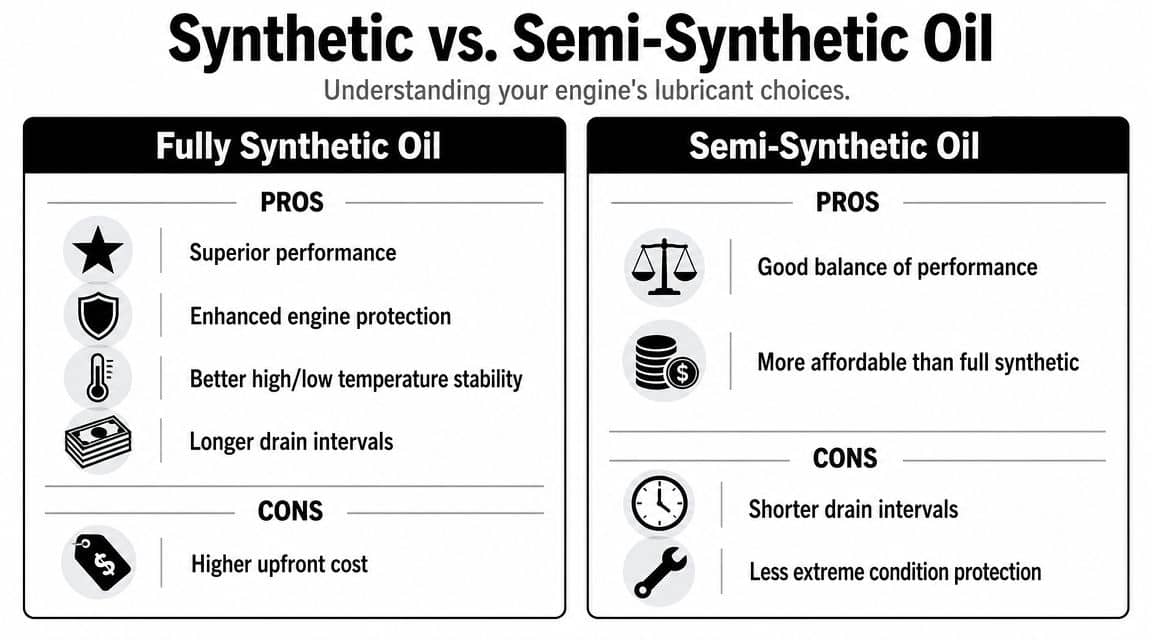
Fully synthetic in day-to-day Focus use
Fully synthetic oil is usually the right fit for later, more demanding Focus engines, especially turbocharged petrol models. It handles heat well, stays more stable over time and tends to suit engines that rely on tighter control of deposits and lubrication behaviour.
Pros and cons are fairly straightforward:
Better for modern engine design. Useful where the engine runs hotter or works the oil harder.
Stronger stability across conditions. Helpful for cold starts, motorway work and stop-start use.
Higher purchase price. You'll notice it at checkout.
Where semi-synthetic still makes sense
Semi-synthetic oil can still be a sensible choice for some older Focus engines, but only if the vehicle's required approval allows it. It often suits owners who want decent protection without paying for a higher-spec oil their engine doesn't require.
A few trade-offs matter here:
Oil Type | Where it suits | Main strength | Main limitation |
Fully synthetic | Later engines and harder use | Stability and protection | Costs more up front |
Semi-synthetic | Some older engines where approved | Lower cost with solid everyday performance | Usually less suited to higher-demand applications |
What I'd tell a DIY owner at the counter
Don't upgrade or downgrade blindly. A more expensive oil isn't automatically better if it doesn't match the required approval, and a cheaper semi-synthetic isn't a bargain if the engine was designed around a full synthetic standard.
If your Focus needs a specific approval, the correct oil type is the one that meets it. Not the one with the nicest label or the lowest price.
For older high-mileage cars, owners sometimes want to solve wear or oil use by switching grades at random. That rarely helps for long. Start by using the correct approved oil, then monitor consumption and condition properly.
How to Check and Top Up Your Focus Engine Oil
Checking the oil level takes a few minutes and tells you a lot about how the car is coping between services. It's one of the easiest habits to build, and it can save a great deal of trouble if the level starts dropping.

Checking the level properly
Use a level surface and give the engine time to settle before reading the dipstick. If the car has just been running, let the oil drain back down first so the reading is accurate.
Follow this order:
Park level and switch off. Don't check on a slope if you can avoid it.
Open the bonnet and find the dipstick. It usually has a bright handle.
Pull it out and wipe it clean with a lint-free cloth.
Reinsert it fully, then remove it again for the reading.
Check where the oil sits between the minimum and maximum marks.
If the level is near the lower mark, top up with the exact approved oil for your car.
Adding oil without overfilling
Patience is important. Add a small amount, refit the cap, wait for it to settle, then check again. Overfilling is just as unhelpful as running low.
A funnel makes this cleaner and far less frustrating, especially on engines where the filler neck sits awkwardly. If you need one, a simple oil funnel for topping up engine fluids keeps the job tidy.
Add a little at a time. Small top-ups are easier to control than trying to correct an overfill.
Use the same spec where possible. Don't treat top-up oil as a place to improvise.
Refit the cap securely. A loose cap creates its own mess.
Recheck after a short wait. Fresh oil needs a moment to settle in the sump.
A clean dipstick reading is more useful than a rushed guess. Wipe, dip again, then read it.
If you'd rather see the process, this video gives a useful visual guide before you start: How to check the fluid levels on a Ford Focus 2011 to 2014
What not to do
Don't top up with an unknown bottle that's been rolling around the garage for years. Don't judge the level from the first pull without wiping the dipstick. And don't ignore a recurring low level if you're topping up often. That's when it's worth checking for leaks, consumption or a service issue rather than just adding more oil forever.
Matching the Right Oil Filter to Your Service
Fresh oil and an old filter don't make a proper oil service. The filter's job is to catch the contamination the oil is carrying away from the engine. If the filter is tired, restricted or poor quality, you're asking clean oil to circulate through a weak point from the start.
That's why a filter change should be considered part of the same job, not an optional extra.
Why the filter matters so much
An oil filter has a simple role, but it does important work. It traps fine debris and contamination before that material can keep circulating through bearings, galleries and moving parts. Reusing an old filter means leaving old contamination in the system and asking the new oil to deal with it.
A poor-quality filter can also create avoidable problems. Bad fit, weak sealing and inconsistent filtration are all things you want to avoid on a routine service.
Choosing the correct filter
The right filter is vehicle-specific in exactly the same way the oil is. Focus generations, engines and housing styles vary, so the filter should be matched to the exact registration or VIN, not guessed from appearance.
A proper lookup makes this much easier than trying to cross-match by eye. If you're sourcing service parts online, use a vehicle-specific Ford Focus oil filter search rather than picking one that “looks about right”.
Here's the approach that works in a home garage or trade bay:
Match the filter to the exact car. Registration or VIN is better than model name alone.
Replace it every oil service. Don't try to stretch a filter into another interval.
Check sealing surfaces carefully
. Especially if you're removing a spin-on filter and the old seal may stick.
Prime and tighten correctly
where applicable. Overtightening causes as many problems as under tightening.
A clean oil service is oil plus filter. Leaving the old filter in place undermines the whole job.
Brand choice versus fit and spec
Owners sometimes focus on brand first. In practice, fit and quality matter more than badge loyalty. Established filter manufacturers generally give predictable fit, reliable sealing and proper construction. That's what you want from a service part. Not drama, not guesswork.
If the filter is correct for the vehicle and comes from a reputable manufacturer, you're on the right track.
Ordering Your Ford Focus Oil and Parts from GSF
Buying the right service parts online is straightforward when you start with the vehicle details instead of the product list. That avoids the usual trap of seeing several oils that look suitable and trying to work backwards from the label.
The cleanest process is to let the vehicle lookup narrow the options first, then compare the listed approvals and pack sizes.
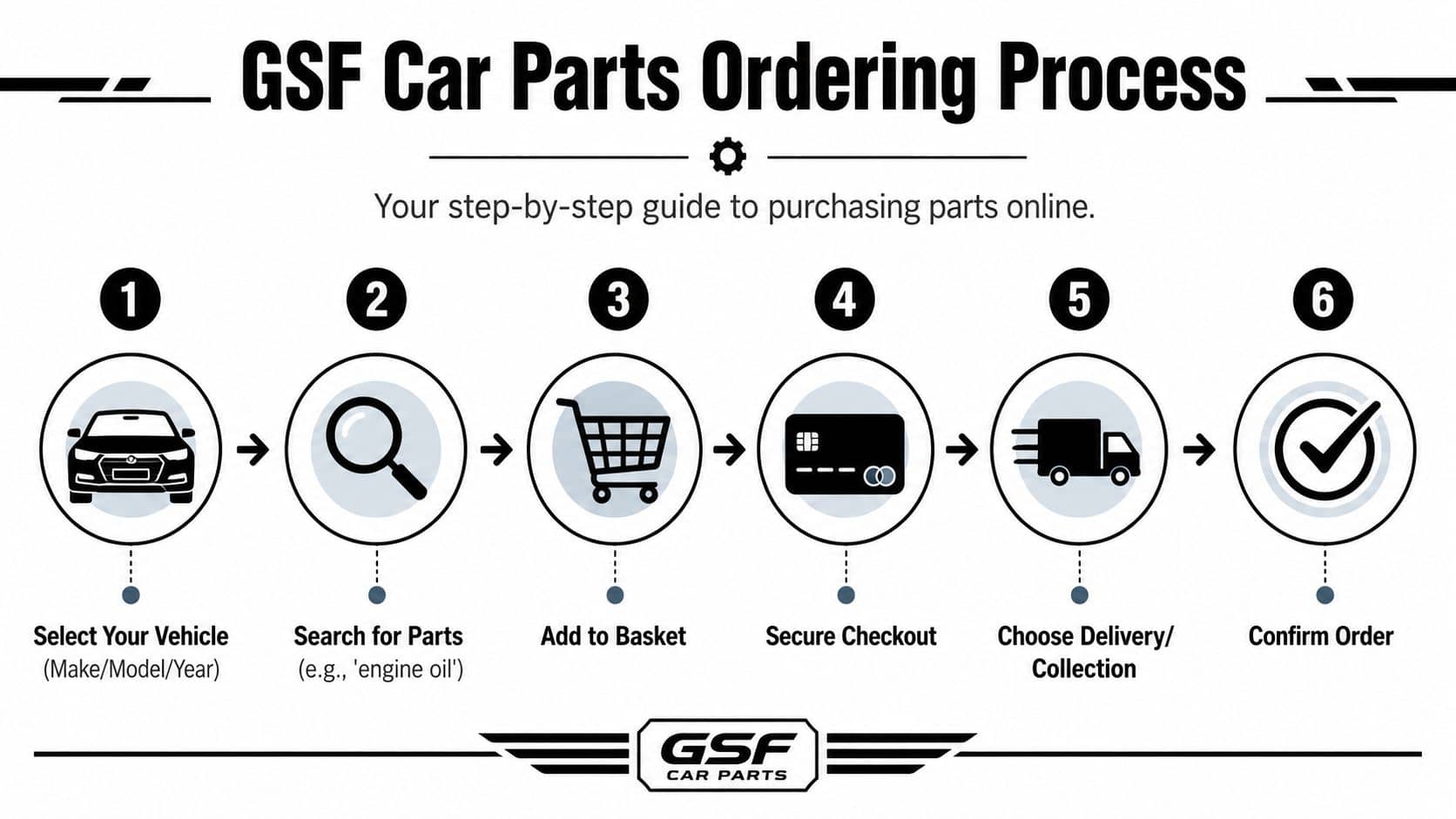
A simple ordering routine that avoids mistakes
If you're shopping for engine oil for Ford Focus, use this sequence:
Enter the registration or vehicle details so the catalogue filters to the exact car.
Search for engine oil and filter together rather than as separate jobs.
Open the product details and compare the approval information with your handbook.
Choose the right pack size so you can fill and top up without guessing.
Add any service extras such as sump plug washers or a funnel if needed.
Select delivery or collection based on how soon the job needs doing.
The workflow matters more than the retailer. A good registration lookup saves time and cuts down on misbuys because you're starting from fitment.
What to double-check before checkout
Even after the site filters parts for your car, it's worth doing one final sense check.
Check | Why it matters |
Approval listed on the oil | Confirms suitability beyond viscosity |
Filter type and dimensions | Avoids wrong fitment |
Pack quantity | Helps prevent underbuying |
Engine notes in the listing | Useful where one model year has more than one engine option |
For UK owners doing a weekend service, stock visibility and collection options can make the difference between finishing the job and leaving the car on stands. The important thing is to order from a listing that's tied back to the exact vehicle, not from a generic “fits Focus” page without proper detail.
Ford Focus Oil Change FAQs
How often should I change the oil in my Ford Focus
Follow the service schedule in the owner's manual for your exact engine and model year. That's the only interval that matters. Driving style can also affect how hard the oil works, so a car used for repeated short trips may need closer attention than one doing regular longer runs.
If you've just bought a used Focus and the service history is unclear, an oil and filter change is usually sensible as a baseline.
Can I mix different brands of oil
Brand is less important than matching the required specification and viscosity. In an ideal world, you top up with the same product already in the engine. If that isn't possible, the safest approach is to use oil that matches the exact required approval for the vehicle.
Mixing random leftover oils because they look similar on the bottle isn't good practice.
What are the signs I may have used the wrong oil
You might notice rougher running, unusual engine noise, a change in oil consumption, or warning messages that appear after a service. Sometimes there are no immediate symptoms at all, which is why checking before filling matters more than trying to diagnose after the fact.
If you suspect the wrong oil has gone in, don't keep driving for weeks hoping it'll be fine. Verify the requirement from the handbook or VIN-based data and correct it.
Does the oil choice change on a high-mileage Focus
High mileage doesn't give the car a new specification. Start with the oil the engine is meant to use. Owners sometimes want to switch to a heavier or completely different oil as a cure for age-related wear, but that should be a considered decision based on condition, not a default move.
If an older Focus is using oil or leaking, diagnose the cause first. The right approved oil is the baseline, not the last resort.
Do I really need to change the filter every time
Yes. If you leave the old filter on, you leave old contamination in the system and reduce the value of the service you've just done. Oil and filter belong together.
Is 5W-30 always right for a Ford Focus
No. It's a common retail grade for some Focus applications, but it isn't universal. Some Focus models appear with 5W-20 in retail listings, and Ford's guidance is to confirm the correct oil by manual or VIN-based lookup for the exact vehicle. That's why broad one-line answers don't hold up well on this model.
If you're ready to buy the correct oil, filter and service bits for your exact car, GSF Car Parts lets you start with your registration so you can match parts to the vehicle before you order. That's the simplest way to avoid guesswork and get the job done properly.





