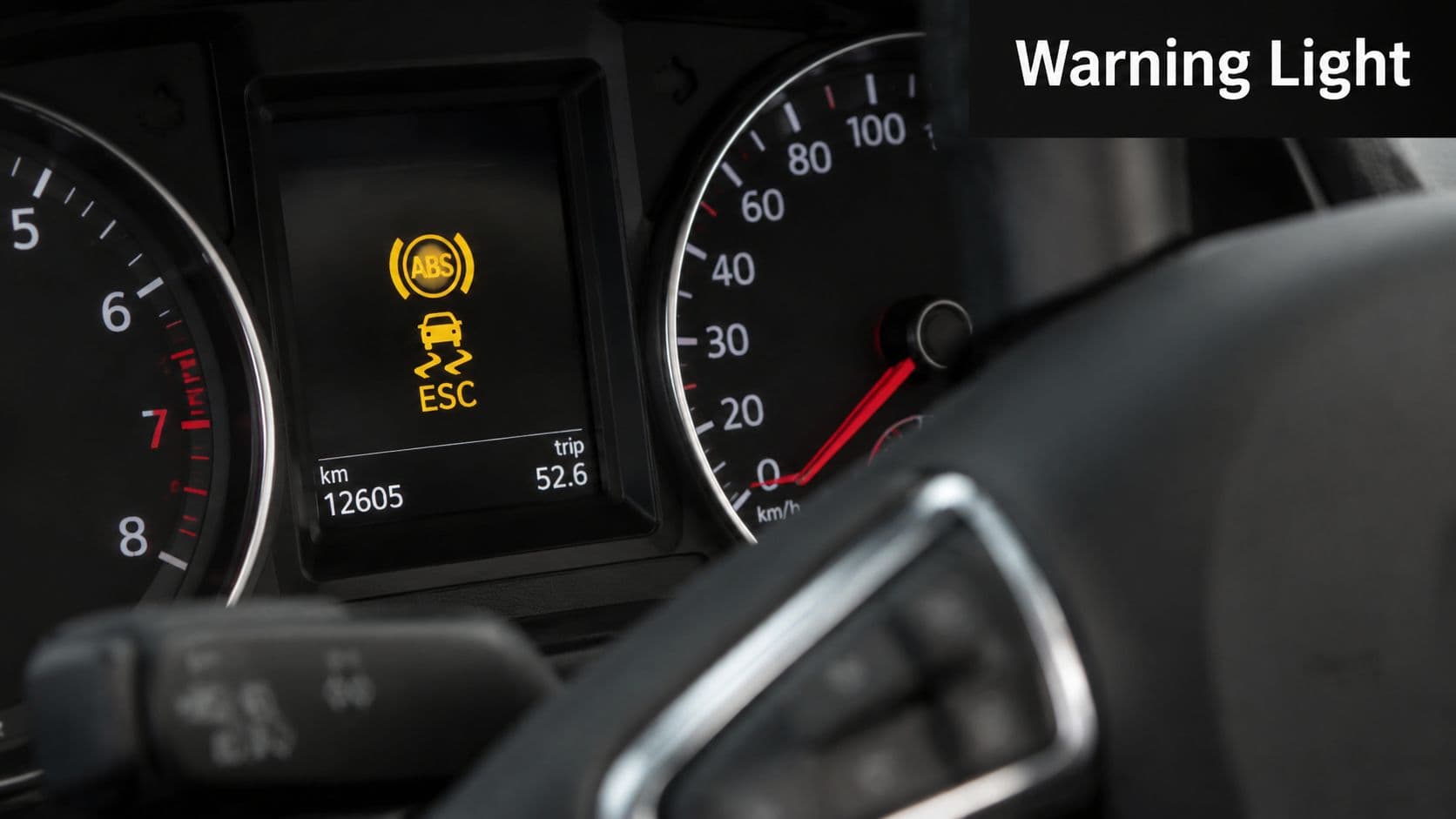
You've had the tracking sorted, the steering wheel looks straight, and then the ABS or traction control light stays on the moment you pull away. That's the point where a lot of drivers assume something expensive has failed.
Often, it hasn't. The car just needs a steering angle sensor reset.
This catches out DIY owners and plenty of garages because the mechanical work is finished, but the car's electronics still think the wheel position is wrong. On modern UK cars, that matters far more than it used to. Stability control, traction control, and many driver assistance functions all rely on the steering angle sensor knowing exactly where straight ahead is.
Understanding the Steering Angle Sensor
A steering angle sensor, often shortened to SAS, sits in the background doing a very important job. It tells the car's control modules where the steering wheel is positioned and how quickly it's being turned. That information feeds systems such as ABS, ESC, and on newer vehicles, ADAS functions as well.
When the sensor's zero point is wrong, the car can still drive, but the electronics start making decisions based on bad information. That's why a car can feel mechanically fine yet still throw up warning lights after alignment work, steering repairs, or column work.
Why it matters on UK roads
On a wet roundabout or during an emergency lane change, the stability system compares steering input with wheel speed, yaw, and lateral movement. If the steering angle reading is off, the car's software can't judge the situation properly.
In the UK, the prevalence of Electronic Stability Control and ADAS has reached parity with North American standards, where it's estimated that 45% of all vehicles require a steering angle sensor recalibration after common maintenance, and over 90% of active SAS fault codes indicate calibration rather than hardware replacement. That's why this has become such a common workshop job rather than a rare electrical fault. If you're checking whether the part itself may be involved, a steering angle sensor range for common applications gives you a useful reference point.
Practical rule: If warning lights appeared straight after otherwise routine work, suspect calibration before you assume the sensor has failed.
What drivers usually notice
The usual signs are familiar:
ABS or ESC warning lights stay on: especially after wheel alignment or suspension work.
Traction control behaves oddly: the system may intervene at the wrong moment or stay disabled.
Steering feels normal but the dashboard disagrees: that mismatch is classic SAS territory.
A lot of people never hear of the sensor until there's a warning light. In reality, it's one of the key links between what you do at the wheel and what the car's safety systems think is happening.
When a Steering Angle Sensor Reset is Needed
This isn't a random maintenance item. A steering angle sensor reset is required after specific jobs that alter the steering system's relationship to the car's straight-ahead position.
The most common trigger is wheel alignment. You straighten the geometry mechanically, but the control unit may still be working from the old stored reference. That's why the final step matters.
Jobs that make a reset mandatory
According to Snap-on's steering angle sensor reset guidance, a steering angle sensor must be recalibrated after any adjustment to toe-in, replacement of the sensor itself, replacement of the ESP ECU, or any work on the steering column. Failure to do so can leave the ABS warning light illuminated.
Use that as the baseline checklist:
After wheel alignment or toe adjustment: especially if track rod ends or steering geometry have been altered.
After replacing the steering angle sensor: a new unit still needs its zero position taught in.
After ESP ECU replacement: the module needs correct steering reference data.
After steering column work: anything that changes the column position or support can affect calibration.
Other real-world situations to keep in mind
Some cars also lose their learned position after electrical interruption or other repair work. It doesn't happen on every model, but it happens often enough that it's worth planning for.
A reset is also sensible after:
Suspension work followed by alignment
Front-end repair work where geometry may have shifted
Battery-related electrical disturbances on certain vehicles
Steering rack or column component replacement
If you've had alignment done and the steering wheel is straight but the warning light remains, the reset is usually the missing last step.
The mistake is treating the reset as optional. It isn't. If the job affects steering reference, the calibration belongs on the end of the repair order, not as an afterthought.
Preparation and Essential Tools
A steering angle sensor reset goes far more smoothly when the car is prepared properly before you plug anything in. Most failed resets aren't dramatic. The wheel isn't centred, tyre pressures are uneven, the battery voltage is weak, or the tool being used can read codes but can't perform calibration.
Start with the basics. Park on level ground. Make sure the front wheels are pointing straight. Set the tyre pressures correctly. Then check the steering wheel itself, not just the road wheels. If the wheel is half a spline out or visibly off-centre after other work, calibration won't fix the underlying problem.
Pre-check before you attempt anything
Run through this in order:
Level surface: the car needs to sit naturally, not twisted on a kerb or slope.
Correct tyre pressures: uneven pressures can confuse your diagnosis if the car pulls afterwards.
Steering wheel centred: this is the most important physical check before calibration.
Battery in good health: low voltage can interrupt module communication.
No unfinished mechanical issues: worn joints, bent parts, or poor alignment need sorting first.
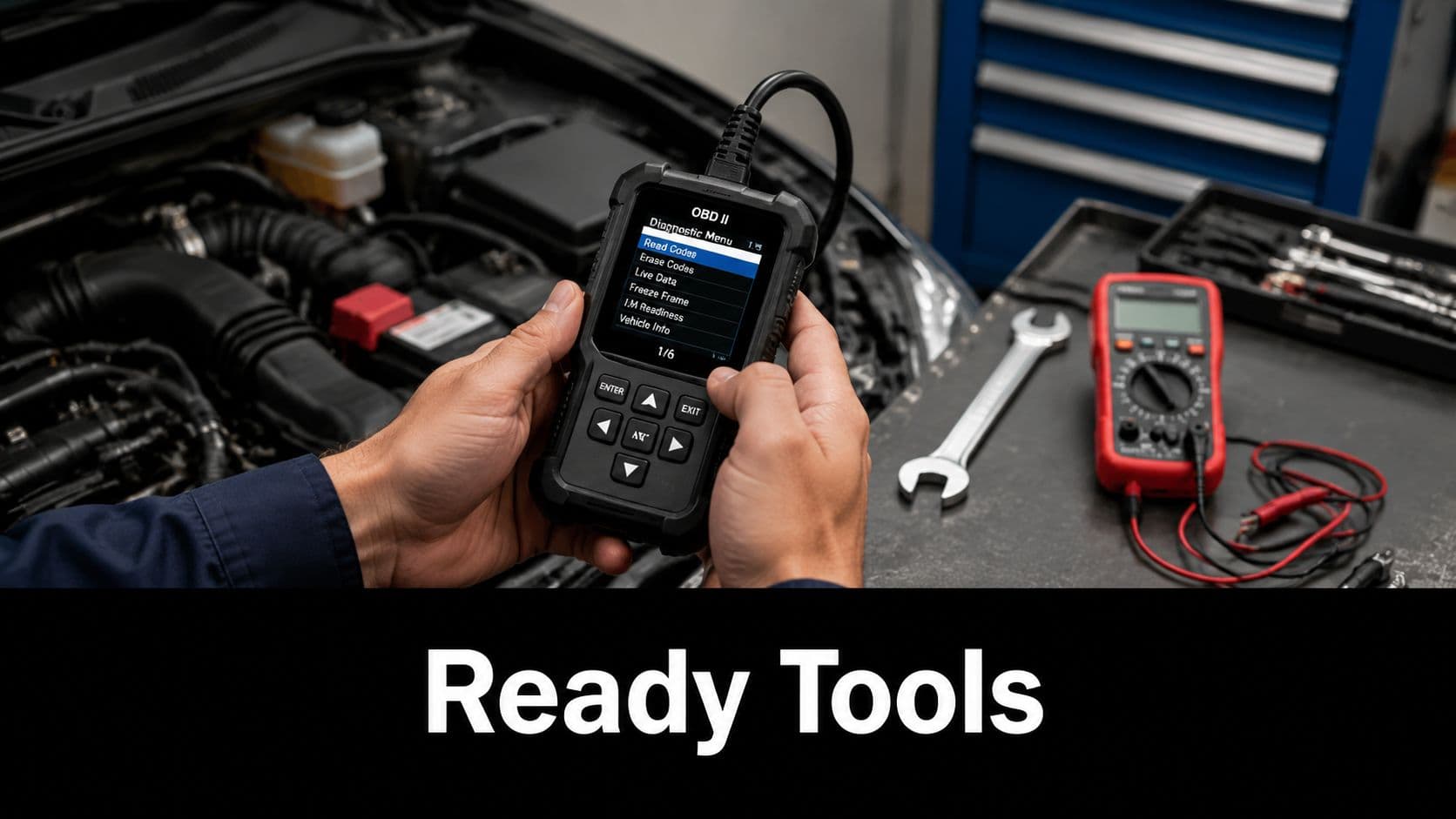
For many DIY owners, the scanner is the sticking point. A basic code reader may tell you there's a steering angle fault, but it often won't offer the function needed to initialise or calibrate the sensor.
Here's the kind of tool category worth looking at:
If you're building a home toolkit, look for vehicle diagnostics equipment suited to service resets and fault finding rather than the cheapest universal code reader you can find.
What the right tool needs to do
A useful diagnostic tool for this job should offer at least some of the following:
Tool function | Why it matters |
SAS calibration or reset | Lets you perform the actual zero-point set-up |
ABS or ESC module access | Many vehicles store the function in these modules |
Live data viewing | Helps confirm the sensor reads correctly when centred |
Fault code clearing | Needed after repair and calibration |
DIY versus trade tools
Dealer-level systems are best, but they're not the only option. Plenty of independent garages use strong aftermarket diagnostics, and some DIY owners get good results with mid-range tools that support service functions properly.
The key trade-off is simple. Cheap readers are fine for seeing a fault. They're often poor at finishing the repair. If your scanner can't access the relevant module or run the calibration routine, you'll waste time repeating manual tricks that may never work on your model.
How to Reset Your Steering Angle Sensor
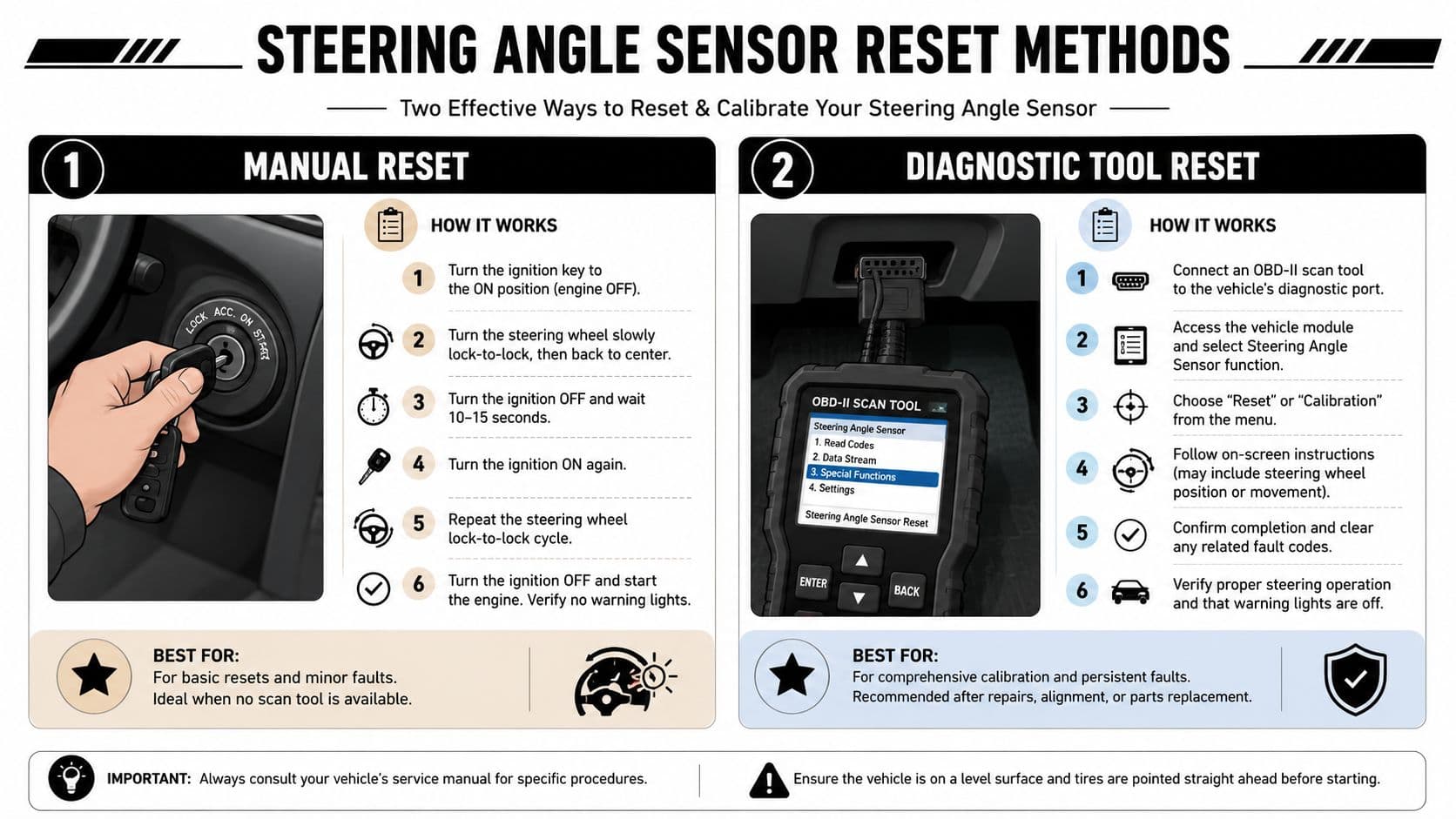
There isn't one universal method. Some vehicles need a scanner-led routine. Some accept a lock-to-lock sequence. Others will self-learn after a short drive once the initial conditions are right. Knowing which method suits the car saves a lot of frustration.
The most dependable route is a proper diagnostic reset. Manual methods are worth trying when tool access is limited, but they're vehicle-dependent and shouldn't be treated as guaranteed.
Method one with a diagnostic tool
This is the workshop standard because it tells the module exactly what you're doing.
A typical process on many UK-market vehicles goes like this:
Centre the steering wheel with the ignition in ACC.
Turn the wheel to full lock in one direction, then to full lock in the other, counting revolutions where relevant.
Return the wheel to centre carefully.
Connect the diagnostic tool to the OBD port.
Enter the ABS, ESC, steering, or chassis menu depending on the vehicle.
Select Steering Angle Sensor Calibration or similar wording.
Follow the on-screen prompts until the tool confirms completion.
Clear any stored related codes if required.
On some cars, the menu path sits under ABS. On others, it appears under steering assist or special functions. Don't assume the wording will be identical across Volkswagen, Ford, Vauxhall, Mercedes, or Peugeot systems.
The reset routine only works properly if the wheel is physically straight before you start. Software can't correct bad mechanical alignment.
Method two with lock-to-lock steering input
This is the method often learned about first because it doesn't require specialist equipment. It can work, but not on every vehicle.
Try it like this:
Start with the front wheels straight.
Switch ignition on, or start the engine if your model requires it.
Turn the steering wheel fully left.
Turn fully right.
Return carefully to centre.
Cycle ignition if required by the vehicle.
Drive a short distance and see whether the system completes its relearn.
This method is best viewed as a basic reset attempt, not a full substitute for scanner calibration. It's useful when a car only needs to relearn steering limits, but less useful when the module wants an explicit zero-point calibration.
The trade-off is clear. It costs nothing, but it's inconsistent.
Method three with a short drive cycle
Some vehicles need movement before they'll finish the process. If the car has accepted the initial set-up, a slow drive with gentle left and right steering input may allow the control unit to finalise calibration.
Place this after the initial reset attempt, not before. If the wheel is off-centre or the module still holds a hard fault, driving won't magically cure it.
A walkthrough can help if you want to see the process in practice: How to Reset the Steering Angle Sensor on ANY Mercedes - No Tools!
What works best for most people
Over 40% of DIY owners in the UK don't own a professional-grade diagnostic tool, which is why manual and low-cost methods matter. Even so, if you want the best chance of a first-time fix, proper tools and quality parts make a difference. UK mechanics using OEM spares such as Delphi or Mann achieve a 97% reset success rate, compared with 78% using non-OE alternatives.
That's why the sensible approach is:
Method | Best use | Limitation |
Diagnostic tool reset | Full calibration after repair or alignment | Needs compatible equipment |
Lock-to-lock method | Basic reset attempt on some models | Won't work universally |
Drive cycle relearn | Finishing step on certain vehicles | Depends on the car already accepting calibration |
If the car gives you direct access to SAS calibration through a capable tool, use it. It's the shortest route to a reliable result.
Troubleshooting Common Reset Problems
The annoying part about steering angle sensor faults is that the light can go out and the job can still be unfinished. That's where many people get caught. They assume no flashing warning means success, then the fault returns or the car logs fresh errors after a short drive.
A UK audit found that 44% of mechanics incorrectly assume a successful reset when the ABS light stops flashing, and proper verification means checking the sensor's offset value with a compatible tool to confirm it is at zero. That matters because 21% of steering-related breakdowns in some UK commercial vehicles are linked to this wider issue of incorrect steering-related set-up and confirmation.
Don't trust the warning light alone
The better check is live data. With the wheels straight and the steering wheel centred, read the steering angle value through a compatible scan tool. You want to see the sensor sitting at 0.0° when centred, then changing smoothly as you turn the wheel left and right.
If the reading is offset while the wheel is straight, the reset hasn't been completed properly, or the mechanical alignment is still off.
A dashboard light is only a clue. Live data is the confirmation.
Common reasons the reset fails
A failed calibration usually comes back to one of these:
Wheel not centred: the most common cause.
Mechanical alignment still wrong: software can't compensate for bad geometry.
Stored faults in ABS or ESC module: these may need clearing before or after calibration.
Wrong module selected in the scanner: some cars hide SAS functions in less obvious menus.
Faulty or poor-quality replacement part: especially with non-OE sensors or related components.
If you've worked on front suspension or steering parts, also check whether another issue is feeding the warning system. A problem with a wheel speed input can muddy the picture, and that's where checking related components such as an ABS and traction control sensor range can help narrow things down.
Common SAS-related fault codes
Fault Code | Common Meaning | Next Step |
Steering angle sensor not initialised | Calibration hasn't been completed | Re-centre wheel and rerun reset |
Steering angle sensor implausible signal | Sensor reading doesn't match expected input | Check live data, alignment, and sensor fitment |
ABS or ESC module calibration rejected | Module didn't accept zero point | Clear faults, confirm wheel centre, retry with proper routine |
Communication fault with steering or chassis module | Scanner or module access problem | Check battery voltage and module selection |
The wording varies by make and scan tool, so focus on the meaning rather than chasing an exact phrase.
When to Seek Professional Help
If you've centred everything properly, tried the correct reset routine, and checked live data, but the fault keeps returning, stop there. At that point you're likely dealing with more than a missed calibration.
Persistent faults after a proper reset often point to a failed sensor, damaged wiring, a clock spring issue, module communication trouble, or an unresolved steering geometry problem. If the car has had collision damage, structural front-end repair, or airbag deployment, it makes even more sense to hand it over to someone with the right diagnostic access and experience.
This is where smart DIY matters. Doing the easy part yourself is worthwhile. Knowing when the fault has moved beyond a simple steering angle sensor reset is just as important.
A trusted garage can tell you whether the sensor itself has failed or whether another steering, ABS, or stability-control issue is blocking calibration. If replacement parts are needed, supplying good-quality OE-matching components helps avoid doing the same job twice.
If you need quality replacement parts, trusted brands, diagnostics, or service items to keep the repair moving, GSF Car Parts is a solid place to start. You can find OE-quality options from brands drivers and workshops already know, order online, and use Click & Collect when the car needs sorting quickly.