


Anti-roll bar bushes are unassuming yet critical components within your car's suspension system. They are small, durable rings, typically made from rubber or polyurethane, that insulate the connection between the anti-roll bar and the vehicle's chassis. Their function is straightforward but vital: they allow the bar to twist and articulate smoothly while absorbing vibrations, which is essential for maintaining stability and control, especially during cornering.
The Function of Anti-Roll Bar Bushes in a Car
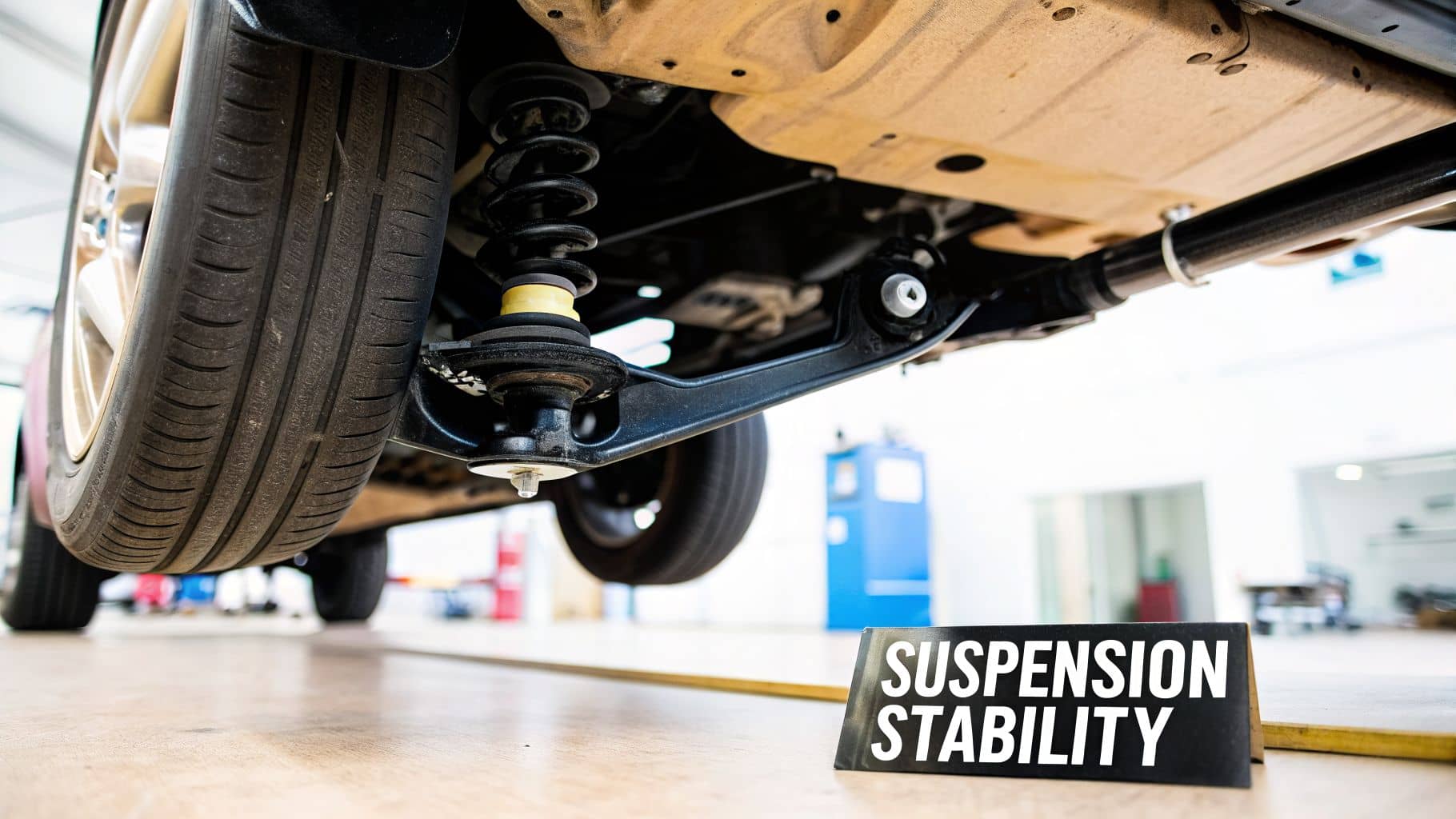
To fully appreciate the importance of anti-roll bar bushes, it's helpful to understand the forces at play when a car turns. As you navigate a corner, centrifugal force shifts the vehicle's weight to the outside, causing the body to lean or "roll". The anti-roll bar (also known as a sway bar or stabiliser bar) is engineered to counteract this. It acts as a torsion spring, connecting the suspension assemblies on both sides of the axle to resist this rolling motion and keep the tyres in optimal contact with the road surface.
However, bolting this solid metal bar directly to the car's frame would be a mistake. Such a rigid connection would transmit every vibration and imperfection from the road directly into the vehicle's cabin, resulting in an unacceptably harsh and noisy ride. This is precisely where the bushes demonstrate their value.
The Role of Cushioning and Control
Anti-roll bar bushes serve as the essential interface between the bar and the chassis. By gripping the anti-roll bar securely while being mounted to the frame, they perform two key functions simultaneously:
Absorbing Vibrations:They function as a damper, isolating noise, vibration, and harshness (NVH) from the road surface before it can reach the occupants, ensuring a smoother and quieter driving experience.
Allowing Smooth Movement:0They provide a flexible pivot point. This allows the anti-roll bar to twist and respond correctly to suspension travel, preventing metal-on-metal contact and ensuring the system operates as designed.
Without healthy bushes, the anti-roll bar would knock against its mounts, and its ability to manage body roll would be severely compromised. They are the small components that enable the entire stabilisation system to function correctly.
A car's handling is a symphony of moving parts working in harmony. The anti-roll bar bushes are the quiet conductors, ensuring every component plays its part smoothly without creating unwanted noise or friction.
A Common Wear Item on UK Roads
Given that they are constantly under load and exposed to the elements—rain, grit, and road salt—it is inevitable that anti-roll bar bushes will wear out over time. The prevalence of potholes and uneven surfaces on many UK roads accelerates this degradation.
Worn bushes are a common reason for MOT test failures. According to Driver and Vehicle Standards Agency (DVSA) data, worn anti-roll bar bushes contributed to 15-20% of suspension-related MOT failures in 2024. This statistic highlights their significance in vehicle roadworthiness.
Maintaining these components is a fundamental aspect of vehicle maintenance that directly impacts handling, comfort, and safety.
Five Telltale Signs of Failing Anti-Roll Bar Bushes
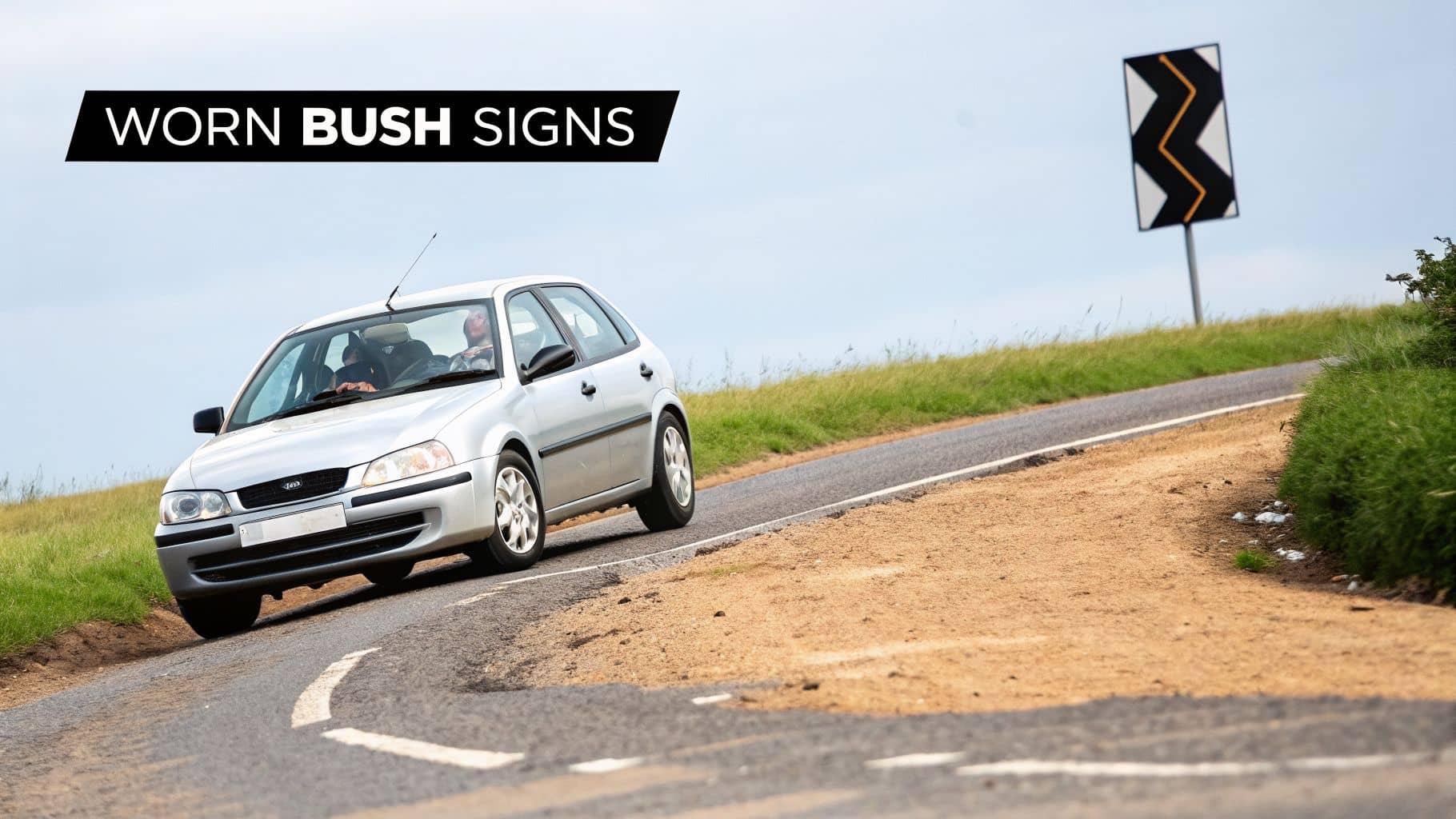
Fortunately, anti-roll bar bushes rarely fail suddenly. Their degradation is typically gradual, providing a series of auditory and sensory warnings. Recognising these early symptoms can prevent more significant and costly suspension issues from developing.
A vehicle communicates its condition through various sounds and handling characteristics. By understanding what to listen and feel for, you can diagnose issues like worn bushes before they escalate. Here are the five most common indicators that your anti-roll bar bushes require replacement.
1. Clunking or Knocking Noises Over Bumps
This is the most definitive and frequently reported symptom. A heavy, dull clunking or knocking sound will be audible from the front or rear of the vehicle, most noticeably when driving over speed bumps, potholes, or uneven road surfaces.
This noise is the sound of the metal anti-roll bar making contact with its mount or other chassis components. A healthy bush holds the bar securely, but a worn, compressed, or deteriorated one allows for excessive movement, creating the clunking sound.
2. Vague or Loose Steering Feel
A worn anti-roll bar bush can manifest as a less precise or 'woolly' steering response. You may notice a slight delay between your steering input and the vehicle's reaction, creating a sense of disconnection from the road.
This occurs because a properly functioning anti-roll bar is integral to managing the vehicle's weight transfer during cornering. When the bushes are worn, the bar cannot operate with the required precision. This loss of torsional control is often perceived through the steering, resulting in a vague and less confident feel.
A good suspension system gives you instant feedback. If your steering starts to feel delayed or disconnected, that's a clear signal that something—like a worn bush—is letting things move in a way they shouldn't be.
3. Increased Body Roll When Cornering
The primary function of an anti-roll bar is to minimise body roll during turns. If you observe that your vehicle is leaning or swaying more than usual when cornering, it is a strong indication that the system is not performing correctly.
Worn bushes allow the anti-roll bar to shift within its mounts instead of twisting as it's designed to. This reduces its effectiveness at counteracting the lateral forces that cause body roll. The result is a 'wallowy' and less stable feel, which can significantly reduce driver confidence and vehicle stability.
4. A Persistent Rattle from Underneath
Distinct from the loud clunk over a large bump, this symptom is a more subtle, constant rattle, often heard at lower speeds on textured road surfaces. It is less of an impact noise and more of a continuous, low-level vibration.
This is essentially a lower-amplitude version of the clunking noise. The worn anti-roll bar bushes permit the heavy steel bar to chatter and vibrate within its mounts during normal operation. This sound signifies that the component is no longer properly insulated.
5. Visible Damage to the Bush
The most conclusive evidence is a visual inspection. If you can safely access the underside of the vehicle, you can often identify a failed bush without specialist knowledge.
Look for the following signs of degradation:
Cracks and Perishing: The rubber appears dry, brittle, and has visible splits or fissures.
Bulging or Deformation: The bush is misshapen, compressed, or appears to be extruding from its mount.
Excessive Gaps: A clear space is visible between the bush and the anti-roll bar, indicating wear.
The presence of any of these signs provides definitive confirmation that the anti-roll bar bushes are beyond their service life and need to be replaced.
Choosing Your Material: Rubber vs Polyurethane Bushes
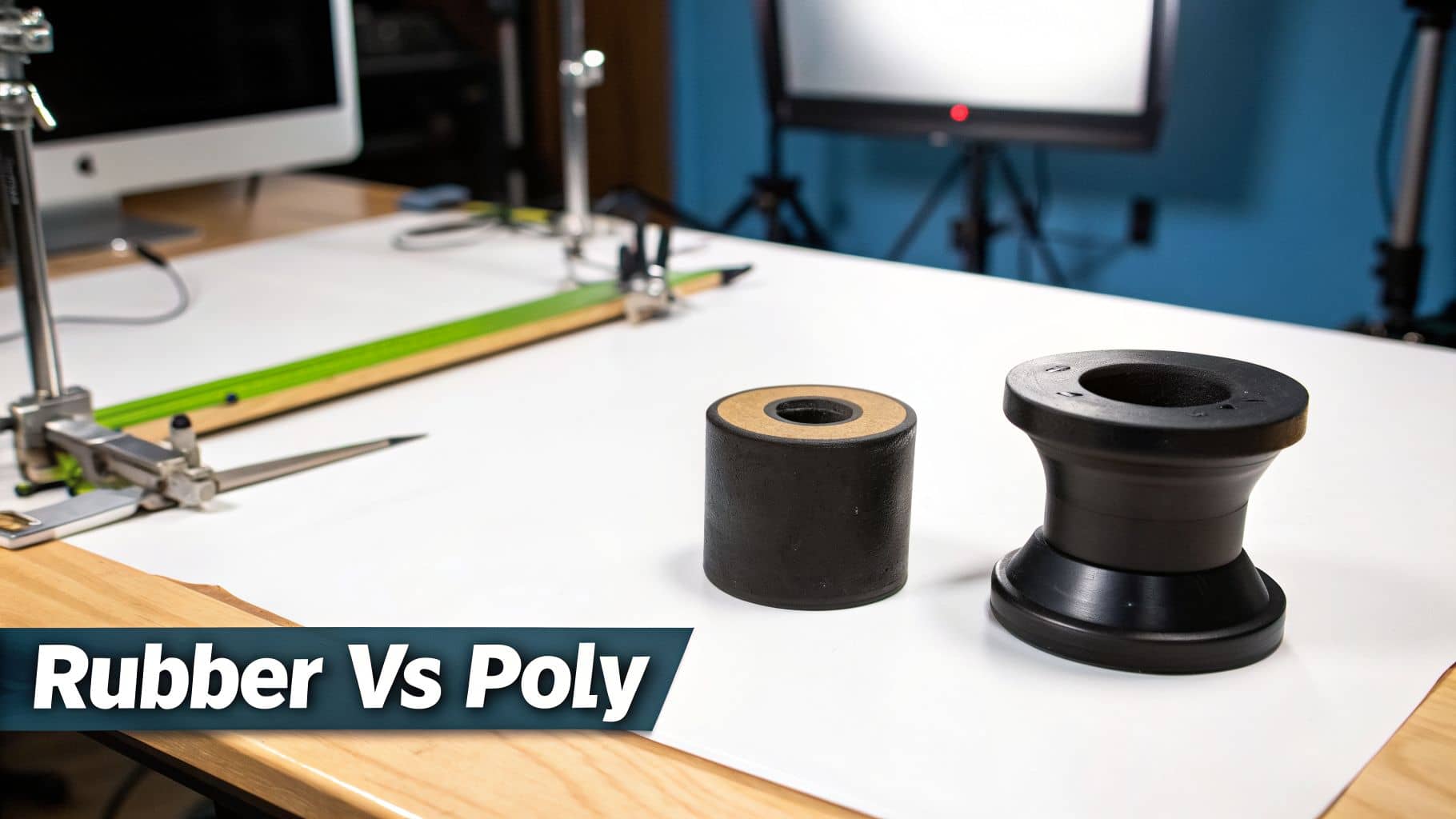
When replacing worn anti-roll bar bushes, you are presented with a choice that can significantly alter your vehicle's driving dynamics. You can opt to restore the original factory ride quality or upgrade for enhanced performance.
The two primary materials available are standard rubber and performance-oriented polyurethane. Each material has distinct properties, so understanding the trade-offs in handling, durability, and comfort is crucial for making an informed decision.
Performance and Handling
Most vehicles are equipped with standard rubber bushes from the factory. These are engineered to prioritise comfort. Their soft, compliant nature is excellent at absorbing minor vibrations and road imperfections, contributing to a smooth and quiet ride. The trade-off is that this softness allows for some deflection under high cornering loads.
Polyurethane ('poly') bushes are a different proposition. Formulated for performance, they are significantly firmer and less compliant than rubber. This rigidity virtually eliminates unwanted movement at the anti-roll bar mounting points, allowing the bar to function more efficiently. This translates to a noticeable improvement in handling.
Sharper Steering Response: The vehicle reacts more immediately to steering inputs.
Reduced Body Roll: The car remains flatter and more composed during cornering.
Enhanced Feedback: More information about the road surface is transmitted to the driver through the steering.
Durability and Lifespan
This is an area where polyurethane holds a distinct advantage. Rubber is an organic material susceptible to degradation from environmental factors.
Exposure to oil, road salt, heat, and UV light causes rubber to crack, harden, and lose its damping properties. Polyurethane, as a synthetic polymer, is engineered to withstand these conditions. It is highly resistant to abrasion, chemicals, and oils, resulting in a substantially longer service life.
Think of it this way: upgrading to polyurethane is often a 'fit and forget' job. You might replace rubber bushes a few times during your car's lifetime, but a quality set of poly bushes will likely outlast the car itself.
The Comfort Trade-Off
The firmness that gives polyurethane its performance benefits is also its main compromise: ride comfort. Because poly bushes do not absorb vibrations as effectively as softer rubber, an increase in road noise and harshness may be felt within the cabin.
For a daily-driven vehicle on typical UK roads, this can result in a noticeably firmer ride. If preserving the original quiet, smooth ride quality is the priority, a high-quality, OE-specification rubber bush is the most suitable choice. However, for performance vehicles or drivers who prioritise handling dynamics over ultimate comfort, this increased feedback is often a desirable trait.
The UK aftermarket reflects these choices. The market for anti-roll bar bushes is growing, with polyurethane options from top brands proven to cut body roll by up to 35% and last well over 50,000 miles. For comparison, standard rubber bushes typically give up around 30,000 miles, a figure often cut short by our pothole problem—the Department for Transport noted potholes were behind a massive 78% of suspension damage claims in 2023. You can dig into more on stabiliser bar market trends here.
Rubber vs Polyurethane Bushes Feature Comparison
To clarify the decision-making process, this table provides a side-by-side comparison of the key characteristics of each material.
Feature | Standard Rubber Bushes | Polyurethane (Poly) Bushes |
Primary Focus | Comfort and quietness | Performance and handling |
Ride Quality | Soft and smooth, absorbs vibrations well | Firmer, can transmit more road noise and vibration |
Handling | Good for daily driving, allows for some flex | Excellent, reduces body roll and sharpens steering response |
Lifespan | ~30,000 miles , susceptible to perishing from oil and heat | 50,000+ miles , highly resistant to chemicals, oil, and abrasion |
Cost | Lower initial purchase price | Higher initial purchase price |
Best For | Daily drivers, restoring original ride quality, comfort-focused motorists | Enthusiasts, track days, performance upgrades, drivers seeking a 'fit and forget' part |
Ultimately, the choice between rubber and polyurethane depends on your personal priorities for your vehicle's performance and comfort.
Weighing Up the Value
While polyurethane bushes have a higher initial purchase price than their rubber counterparts, their long-term value should be considered.
The higher upfront cost can be offset by their exceptional durability. Since they are unlikely to require replacement again, you save on future parts and labour costs. This makes them a cost-effective investment over the lifespan of the vehicle.
Finding the Perfect Anti Roll Bar Bushes for Your Vehicle
Selecting the correct replacement anti roll bar bushes is the most critical step in the entire process. Ordering an incorrectly sized part leads to wasted time, money, and significant frustration.
Fortunately, ensuring you get the right component is a matter of following a logical verification process. These simple checks will allow you to order the correct part with confidence, ensuring a successful repair.
Guarantee Fitment with Your Vehicle Registration
The most efficient and reliable method for identifying the correct parts is to use a vehicle registration number (VRN) lookup tool. Every vehicle has a specific parts catalogue associated with its unique build specifications, and your VRN provides access to this data.
By entering your registration into an online parts finder, like the one at GSF Car Parts, the system automatically filters its extensive database to display only the anti-roll bar bushes that are guaranteed to be compatible with your vehicle's make, model, and year. This virtually eliminates the risk of human error.
Confirm the Anti Roll Bar Diameter
While a VRN lookup is highly accurate, it is prudent to perform a physical check of one key dimension, particularly on models with different trim levels or optional suspension packages. The most critical measurement for an anti roll bar bush is its internal diameter, which must precisely match the external diameter of the anti-roll bar.
Manufacturers sometimes use different diameter bars on the same model—for example, a 'sport' version may have a thicker, stiffer bar than a standard version.
A quick measure-up with a set of digital calipers is ideal, but even an adjustable spanner and a ruler will do the trick. Measure the bar’s diameter, then cross-reference that number with the part description online. It’s the ultimate confirmation for a perfect fit.
OEM Quality vs Trusted Aftermarket Brands
Once the size is confirmed, you must choose a brand. It is not always necessary to purchase Original Equipment (OE) parts from a main dealer. High-quality aftermarket brands often provide equivalent performance and durability at a more competitive price point.
Brands like Delphi and DriveTec are widely trusted within the automotive repair industry for manufacturing components that meet or exceed OE specifications. They represent an excellent balance of reliability and value, making them a popular choice for both professionals and DIY enthusiasts. You can explore a huge range of these trusted anti roll bar bushes and other stabiliser bar components at GSF Car Parts to find the best fit for your budget.
Understanding Solid vs Split Bushes
Finally, when browsing for parts, you will likely encounter two common designs: solid and split.
Solid Bushes:
These are a single, continuous ring of rubber or polyurethane. Installation requires them to be slid over the end of the anti-roll bar, which may necessitate disconnecting other suspension components, such as the drop links.
Split Bushes:
This design incorporates a slit down one side. This allows the bush to be opened and fitted directly over the bar at its mounting point, eliminating the need to slide it along the bar's length.
For DIY replacement, split bushes are often the preferred choice. They can significantly simplify the installation process, reducing the time and effort required under the vehicle. If a split version is available for your application, it is highly recommended.
An Overview of the Bush Replacement Process
The DOs and DON’Ts When Installing Polyurethane Suspension Bushings
Replacing worn anti-roll bar bushes is a rewarding task that can noticeably improve a vehicle's handling and ride quality. However, it is important to understand the scope of the job before beginning.
This overview outlines the general procedure, helping you to determine if it is a task you are comfortable undertaking yourself or one better left to a professional mechanic.
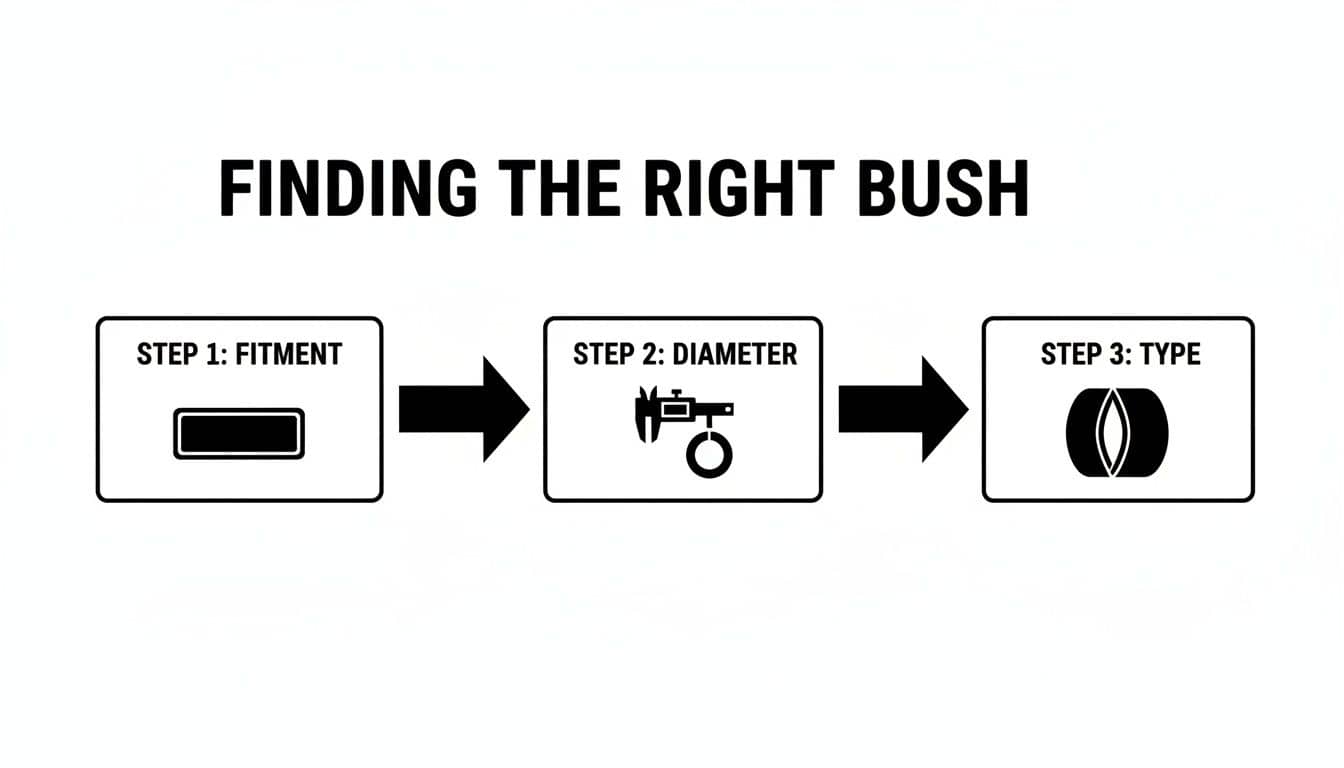
As shown, the foundation of a successful replacement is correct part selection. Confirming fitment, measuring the bar diameter, and choosing the appropriate material are essential prerequisites to any physical work on the vehicle.
Gathering Your Essential Tools
Attempting a repair without the correct tools is inefficient and can be unsafe. Assembling all necessary equipment beforehand ensures the process is as smooth as possible.
While a professional workshop is not required, several key tools are essential for performing the job safely and correctly.
Here is a checklist of the typical tools needed:
Jacks and Axle Stands:
This is a critical safety requirement. Never work under a vehicle supported only by a jack. Need a set? You can explore a range of high-quality axle stands to keep you safe
.
Socket Set and Ratchet: A comprehensive metric set is required to remove the mounting bracket bolts.
Torque Wrench: Essential for tightening fasteners to the manufacturer's specified torque settings. This is a crucial step for safety and proper function.
Pry Bar or Breaker Bar: gProvides the necessary leverage to loosen stubborn bolts that have been subjected to corrosion and road grime.
Wire Brush: Used to clean rust and debris from the anti-roll bar and brackets before installing the new components.
Silicone Grease: This is required when fitting polyurethane bushes to prevent squeaking. It is often supplied with the new bushes.
The Typical Replacement Sequence
Although the exact procedure can vary between vehicle models, the fundamental steps for replacing anti-roll bar bushes are broadly consistent.
Here is a general breakdown of the process.
The Main Steps Involved:
Secure the Vehicle: Park on a solid, level surface, apply the parking brake, and chock the wheels that will remain on the ground. Use a suitable jack to raise the vehicle and then lower it onto rated axle stands.
Locate the Mounts:
From underneath the vehicle, identify the anti-roll bar. Follow it from the suspension linkage towards the centre of the vehicle to find the two 'D'-shaped brackets that secure it to the subframe. The bushes are housed within these brackets.
Remove the Old Bushes:
Using a socket set, remove the bolts securing the mounting brackets. A breaker bar may be needed. Once the bracket is removed, the old bush can be taken off the bar. Split bushes pull off easily, while solid bushes may need to be slid off the end.
Clean and Prepare:
This is a vital step. Use a wire brush to thoroughly clean the section of the anti-roll bar where the new bush will sit, as well as the inside of the mounting bracket. Any remaining debris can cause premature wear.
Fit the New Bushes:
If installing polyurethane bushes, apply a thin layer of silicone grease to the inner surface. Fit the new bush onto the cleaned section of the bar, position the bracket over it, and start the bolts by hand. Do not fully tighten them yet.
Lower and Torque:
Repeat the process on the other side. With both new bushes and brackets loosely in place, carefully lower the vehicle off the axle stands so its full weight is resting on the wheels.
A critical pro tip: Always do the final tightening of suspension parts when the car is on the ground, with its weight on the wheels. If you torque everything up while the suspension is hanging down, you'll twist and 'pre-load' the bushes, which can cause them to fail very quickly.
With the vehicle at its normal ride height, use a torque wrench to tighten the bracket bolts to the manufacturer's specified value. This final step ensures the anti roll bar bushes are correctly seated and will function as designed for their full service life.
Why Trust GSF Car Parts for Your Suspension
Knowing you need new anti-roll bar bushes is half the battle. Finding the right ones without any faff? That’s where we come in.
Forget scrolling through endless lists, hoping for a match. Just pop your reg number into our tool, and we'll instantly filter our massive stock to show you only the parts guaranteed to fit your motor. It’s the fastest way to get from problem to solution.
Get the Right Parts Fast
When a car part needs replacing, you don’t want to be waiting around. That's why we built our service for speed. With our free Click & Collect option, you can order the bushes you need online and grab them from one of our 200+ stores across the country, often in as little as 30 minutes.
It’s the best of both worlds: the convenience of online shopping with the speed of a local parts counter. You're never far from getting your car back on the road.
Quality You Can Rely On
Your car’s suspension isn't something to gamble on. It’s a critical safety system, which is why we only stock trusted, OE-quality brands that the pros rely on every day, like Delphi and DriveTec.
At GSF, you never have to pick between quality and price. We give you dealer-level parts without the eye-watering dealer-level price tag.
Every single part we sell comes with a solid warranty and our no-nonsense 60-day returns policy, so you can buy with total confidence.
Whether you're a seasoned DIY mechanic doing a full suspension refresh or it's your first time swapping out a worn bush, we’ve got your back. Check out our full range of quality suspension parts in our comprehensive catalogue to find the perfect fit for your car and budget.
Frequently Asked Questions About Anti Roll Bar Bushes
Still got a few questions? No problem. Here are some quick answers to the things we get asked most about anti-roll bar bushes.
How Long Do Anti Roll Bar Bushes Last?
The lifespan of an anti-roll bar bush is influenced by material type, driving style, and road conditions.
As a general guideline, standard rubber bushes have a service life of between 30,000 and 60,000 miles. This can be significantly reduced by frequent driving on poorly maintained or potholed roads. In contrast, upgraded polyurethane bushes are far more durable and can often last for over 100,000 miles, frequently for the entire life of the vehicle.
Can I Drive with Worn Anti Roll Bar Bushes?
While it is physically possible to drive a vehicle with worn anti-roll bar bushes, it is strongly advised against. Worn bushes significantly compromise the vehicle's handling characteristics, particularly during cornering, leading to a feeling of instability and reduced control.
Delaying replacement can cause accelerated wear on other suspension components, such as drop links, and can negatively affect wheel alignment, resulting in premature tyre wear. For safety and to prevent more costly repairs, they should be replaced as soon as symptoms are detected.
Are They Difficult to Replace?
For a competent home mechanic equipped with the necessary tools, replacing anti-roll bar bushes is a manageable task. The difficulty level depends on the vehicle's design and the type of bush being fitted. Split bushes, for example, are considerably easier to install than solid bushes.
The primary challenges are typically ensuring the vehicle is raised and supported safely on axle stands and dealing with corroded or seized bolts. If you lack confidence or the required tools, such as a quality socket set and a torque wrench, this is a relatively inexpensive repair to have performed by a professional garage.
Ready to restore your car's handling? Find the perfect, guaranteed-fit anti-roll bar bushes for your vehicle at GSF Car Parts. Use our number plate tool to shop our range of trusted brands today. Get started at https://www.gsfcarparts.com.





