


You notice it on a road you drive all the time. The car still goes where you point it, but the steering doesn't feel clean anymore. There's a slight wobble through the wheel, a bit of looseness around centre, or a faint knock when you turn into a parking space.
That sort of change often sends people looking at tyres, alignment, or suspension first. Fair enough. But one small steering joint can sit right at the heart of those symptoms, and that part is the track rod end.
If you've searched what is a track rod end, the short answer is simple. It's the outer steering joint that links the track rod to the steering knuckle and helps turn steering wheel movement into actual wheel movement. The useful answer is a bit broader than that. You need to know what it does, how it wears, what bad ones feel like, how to check one safely, and whether it's a sensible DIY job or a garage job for your situation.
That Vague Feeling in Your Steering Wheel
A lot of steering faults don't arrive with a dramatic bang. They creep in. One week the car feels slightly less tidy on a straight road. Then you start correcting the wheel a bit more than usual. Then a front tyre starts wearing in a way you didn't expect.
That's often why track rod end problems get missed at first. The part is small, hidden low down behind the wheel area, and most drivers never see it until someone points it out on a ramp. But it has a big job. If it develops play, the steering input you make at the wheel no longer reaches the road as neatly as it should.
What drivers usually notice first
Loose steering feel when the car should feel settled
A knock or clunk from the front end during low-speed turns
A car that doesn't track cleanly and seems to need small corrections
Tyre wear that looks uneven without an obvious reason
A worn track rod end rarely feels like an isolated fault. It often shows up as a mix of steering vagueness, alignment trouble, and tyre wear.
The good news is that this isn't one of those mysterious parts that only a specialist can understand. Once you know where it sits and what it does, the symptoms make much more sense.
Your Car's Steering System and the Track Rod End
Steering only feels simple from the driver's seat. Under the car, several parts have to pass your input along cleanly while the front suspension is still moving over bumps and cambers.
A track rod end sits right at that hand-off point.
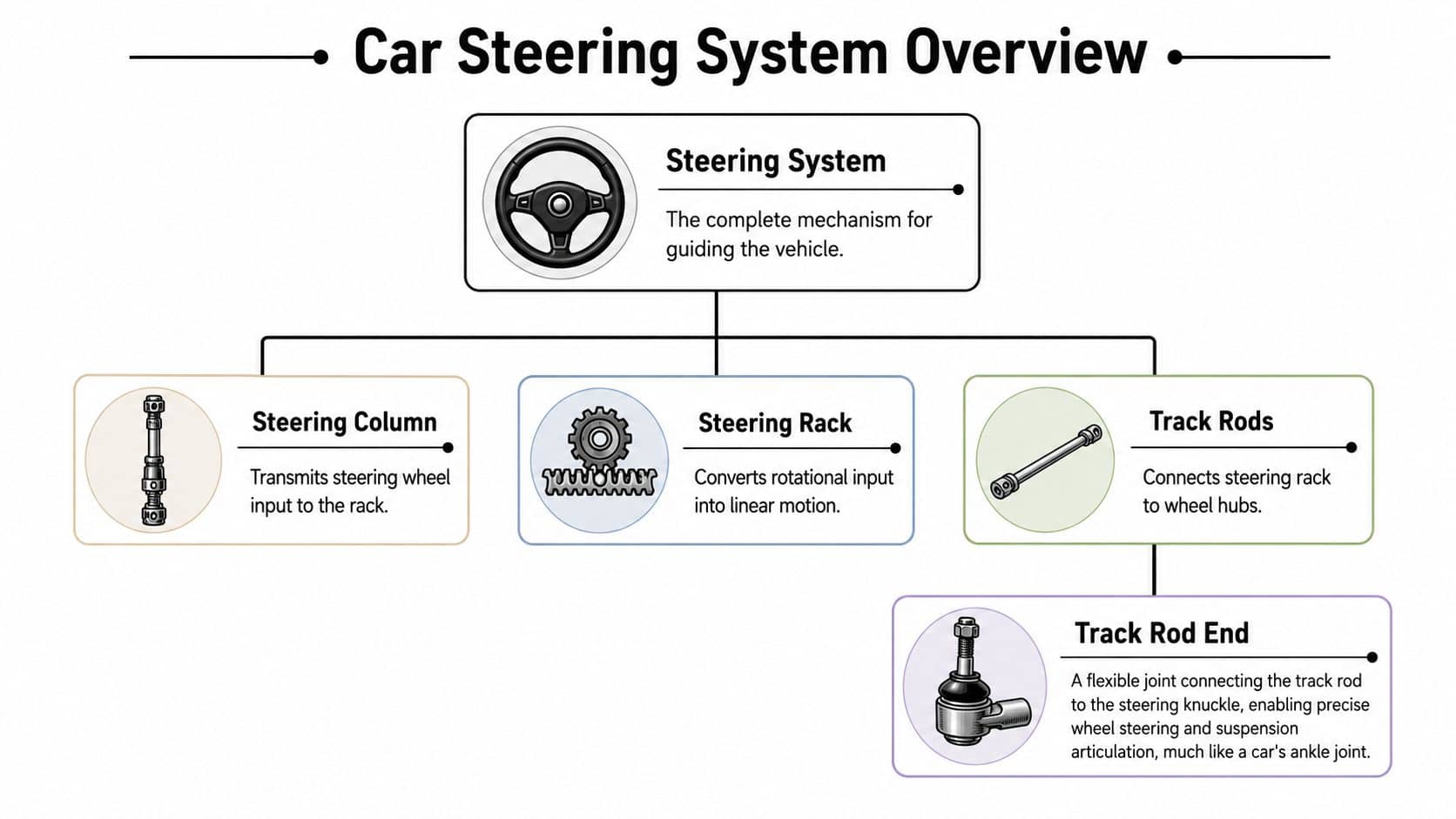
You turn the steering wheel, the movement goes down the steering column into the steering rack, the rack moves the track rods, and the track rod end forms the outer joint that links the rod to the steering knuckle. If you want to see how it fits into the wider assembly, it helps to view the steering rack and related parts as one working system rather than a pile of separate components.
What the track rod end actually does
The job sounds small, but it is doing two things at once. It has to transmit the steering force from the rack to the wheel assembly, and it also has to pivot freely as the suspension moves up and down. That is why the outer end uses a ball joint rather than a rigid fixed connection.
A simple comparison is an ankle joint. It carries movement in the direction you want, but it also allows controlled articulation instead of locking everything solid. In the same way, the track rod end lets the front wheel turn without binding as the suspension works through its travel.
In workshop terms, this is the outer steering joint. If there is wear in that joint, the wheel can start moving slightly before or after the steering input reaches it. For a UK driver, that often shows up as a car that feels less settled on rough roads, follows road imperfections more than it used to, or starts eating tyres because the toe setting will not stay where it should.
Why this part wears out
Track rod ends live in a harsh spot. They sit low, catch water and grit, and deal with constant small movements every time you steer, brake, park, or hit a pothole. Over time, the ball joint and its protective boot can wear. Once dirt gets in or grease breaks down, play develops.
Some older or heavy-duty setups can be greased. Many modern ones are sealed and replaced when wear is found. From an ownership point of view, that matters because there is no tidy mileage-based rule for changing them. One car can go years without trouble. Another can need one early because it has spent its life on rough urban roads or clipping kerbs.
For DIY checks, the useful mindset is simple. Treat the track rod end as a normal wear item, and take steering looseness seriously because even a small amount of joint play can affect alignment, tyre life, and MOT outcomes.
Common Signs of a Worn Track Rod End
The driving symptoms are usually what push people to investigate in the first place. You don't need to be under the car to spot the early clues. The steering and front tyres often tell the story before the part gets physically checked.

What it feels like on the road
A worn track rod end often shows up as vagueness through the steering wheel. The car may react a fraction later than you expect, or it may feel unsettled instead of crisp when you make small corrections on a straight road.
You might also feel shaking or vibration through the wheel. That doesn't automatically mean the track rod end is the only fault, but when the joint has developed play, it can contribute to that nervous feel.
Then there's the low-speed noise. A clunk or knock from the front corner when turning into a driveway or parking bay is a classic sign that a steering or suspension joint needs attention.
What you can see without tools
The most visible clue is often in the front tyres. If the alignment has started to drift because of wear in the steering joint, the tyre can scrub rather than roll cleanly. That often leaves wear concentrated more on one edge.
Watch for these common signs:
Steering looseness that makes the car feel less direct than it used to
Knocking noises during turning or manoeuvring
Wheel wobble sensation at certain speeds
Uneven front tyre wear that doesn't match normal use
A worn joint can also affect directional stability. When play becomes more obvious, the wheel assembly may move more than it should when force is applied by hand, and the car won't turn as efficiently or predictably.
This walkthrough shows the sort of symptoms and movement technicians look for when a steering joint starts to fail: How to Tell if Your Tie Rod is Bad
Don't assume a symptom has one cause. Tyres, wheel balance, suspension bushes, and alignment can overlap with track rod end symptoms. The pattern matters more than any single clue.
How to Safely Inspect a Track Rod End
If you're reasonably handy and you want a basic yes-or-no check, the most useful home test is the 9 and 3 o'clock wheel-shake test. The aim is simple. You're checking for play in the steering linkage.
Start with safety first
You need level ground, the handbrake on, and the rear wheels chocked before you lift anything. Jack the front of the car using the proper lifting point, then support it securely on axle stands suited to vehicle lifting. Never rely on the jack alone.
If you're not fully confident lifting the vehicle safely, stop there and book it into a garage. A steering check is never worth taking risks under an unstable car.
The 9 and 3 o'clock test
Once the wheel is off the ground:
Grip the tyre firmly at the 9 and 3 o'clock positions.
Rock it left and right with controlled pressure.
Feel for knocking or clicking rather than smooth, solid resistance.
Watch the steering joint area if you can do so safely, or have someone observe while you move the wheel.
Compare sides if only one side seems suspect.
What counts as a bad sign
You're looking for free play, a knock, or visible movement in the joint that shouldn't be there. Mechanics often describe this as end play or looseness. If the rod shakes excessively or the joint moves too freely, that points to wear.
If the wheel rocks and the movement appears in the steering joint instead of translating cleanly through the linkage, the track rod end needs closer attention.
Binding is also a warning sign. A good joint should articulate smoothly. It shouldn't feel seized, graunchy, or inconsistent through its travel.
This check can tell you something is wrong. It doesn't replace a full steering inspection or alignment check after repair.
Track Rod End Replacement Cost and Effort
At this stage, most owners make the practical decision. The job itself sounds small, and physically it often is. The complication is that steering parts don't live in an ideal world. Threads seize, locknuts fight back, tapers stick, and once the new part is fitted the alignment still needs sorting.
According to BookMyGarage's track rod end cost guide, replacement typically costs £70 to £160 per side, while wheel tracking after suspension work typically costs £40 to £70. That pricing is one reason garages treat it as a routine wear item rather than something exotic.
Where the effort really goes
The part swap itself isn't always the hard bit. The bulk of the time often disappears into:
Seized locknuts on older cars
Stubborn taper joints that need the right separator
Counting turns accurately so the replacement goes on close to the old position
Getting tracking done afterwards, because close enough isn't the same as correct
Some trade guidance also puts the part itself in a broad UK replacement range, with labour on top, which matches the recognition that access and corrosion can matter as much as the component.
DIY vs garage replacement
If you've got decent tools, a safe place to work, and some experience with suspension joints, this can be a fair DIY repair. If you don't, it can turn into a frustrating afternoon quickly.
Factor | DIY Replacement | Garage Replacement |
Cash outlay | Lower labour cost, but you still need the part and tracking | Higher total bill, but labour and fitting are handled |
Tools needed | Jack, axle stands, hand tools, and usually a joint separator | No personal tools needed |
Time | Can be quick on a clean car, or slow if parts are seized | Usually more predictable |
Skill level | Best for someone comfortable with steering and suspension work | Better if you want a straightforward fix |
Risk | Incorrect fitting or skipped alignment can create more problems | Lower risk if the garage is competent |
Aftercare | You still need wheel tracking arranged | Often easier to pair with alignment work |
The mistake that catches DIYers most often isn't removing the old joint. It's thinking the job ends when the new one is bolted on.
If the taper won't release, the locknut is rounded, or the replacement doesn't match perfectly, handing it to a garage is usually the cheaper decision in the long run.
How to Find the Correct Track Rod End
Ordering the right track rod end matters more than many people expect. Two parts can look almost identical on the bench and still be wrong for the car because of thread size, taper fitment, or steering geometry. That's why guessing from photos or a rough model description often goes wrong.
The simplest route is to use a registration lookup tied to your exact vehicle details. If you're buying online, that cuts out most of the common mistakes before you get anywhere near the checkout.
What has to match
A correct track rod end isn't just about make and model. Fitment can depend on details such as:
Thread type and size on the inner and outer connections
Stud taper and height where it fits the steering knuckle
Male or female thread direction
Vehicle-specific steering setup
That's why trade suppliers work from registration or VIN-linked fitment data rather than visual matching alone.
A sensible buying approach
If you're replacing one, start with a proper vehicle lookup for a tie rod end or track rod end matched to your car rather than selecting by eye. That's the easiest way to avoid ordering a joint with the wrong taper, thread, or fitment.
It also helps to buy from a supplier that gives you clear fitment guidance, sensible warranty cover, and collection or delivery options that fit the repair. GSF Car Parts offers registration-based parts lookup, stocks steering components from recognised brands, and states a minimum 12-month warranty across its range, which is useful when you want less guesswork and a clear route to the correct part.
Buy the part by vehicle data, not by confidence. Steering components need to fit exactly.
If you're still asking what is a track rod end, the practical answer is this. It's a small steering joint with a very large effect on how your car feels, tracks, and wears its tyres. Get the diagnosis right, don't cut corners on safety, and always treat the post-repair alignment as part of the job.
If your steering feels vague or you're ready to replace a worn joint, GSF Car Parts makes it straightforward to find the correct track rod end for your vehicle using the registration lookup, then choose delivery or Click & Collect to keep the repair moving.





