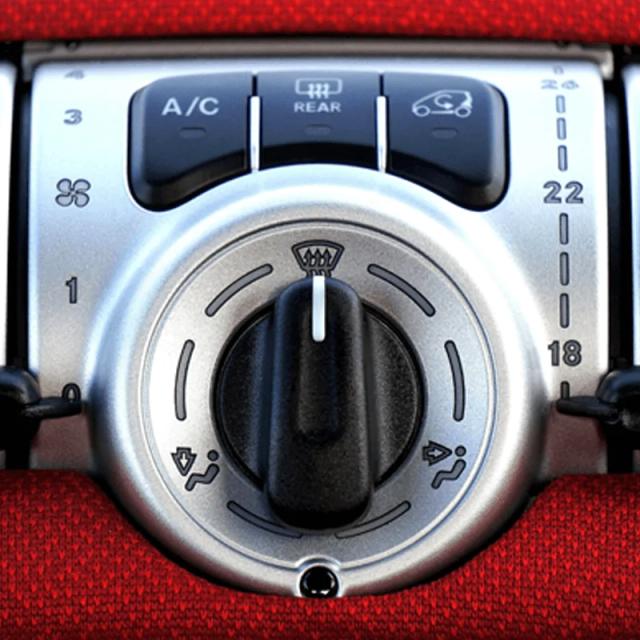
The first proper warm day always seems to expose a weak air con system.
You get in the car, turn the fan up, press the AC button, and wait for that familiar chill. Instead, you get lukewarm air, a strange click from the engine bay, or a smell that tells you something isn’t right. That’s usually the moment people start asking the same question. Is it just low gas, or is the air con compressor done?
A lot of the time, the compressor is the part that decides whether your system can cool properly at all. If it’s healthy, the rest of the system has a fighting chance. If it’s failing, the whole setup struggles, no matter how clean the cabin filter is or how high the blower speed goes.
That First Hot Day When The Air Con Gives Up
A common story goes like this. The car was fine last autumn, you barely used the air con through winter, and now the cabin feels like a greenhouse in traffic. The fan still blows. The controls still light up. But the air never gets cold.
That catches people out because the system can look alive even when the cooling side has stopped working. The blower motor and climate panel can still do their job while the air con compressor isn’t compressing refrigerant properly, isn’t engaging, or is mechanically damaged.
Why the compressor matters so much
Think of the compressor as the heart of the air con system. It keeps refrigerant moving around the loop under the right pressure so heat can be taken from inside the cabin and dumped outside the car.
When that heart weakens, a few things can happen:
Cooling fades slowly if the compressor is worn and no longer builds pressure well.
Cooling disappears suddenly if the clutch fails, the control valve sticks, or the internals seize.
The repair gets bigger if a damaged compressor sends debris through the system.
That last point is the one many DIY owners don’t expect. A failed compressor isn’t always a simple swap. Sometimes it turns into a system clean-out job as well.
Practical rule: If the air con has gone from “not as cold as it used to be” to “no cold air at all”, don’t keep running it and hoping it clears itself.
The decisions that actually matter
Most UK drivers don’t just want theory. They want to know three things. What’s failed, what part do I need, and can I trust the fix to last?
Those answers depend on a few practical details:
The compressor type fitted to your car
The refrigerant the system uses
Whether the fault is mechanical, electrical, or control-related
Whether the replacement part matches the original fitment properly
Get those right, and the repair is usually straightforward. Get them wrong, and you can spend money twice.
How Your Air Con Compressor Keeps You Cool
The easiest way to understand an air con compressor is to stop thinking of it as a “cold maker”. It doesn’t create cold air directly. What it really does is move heat.
It does that by pressurising refrigerant and pushing it around a closed loop. Once you see that loop clearly, the whole system starts to make sense.
The cooling cycle in plain English
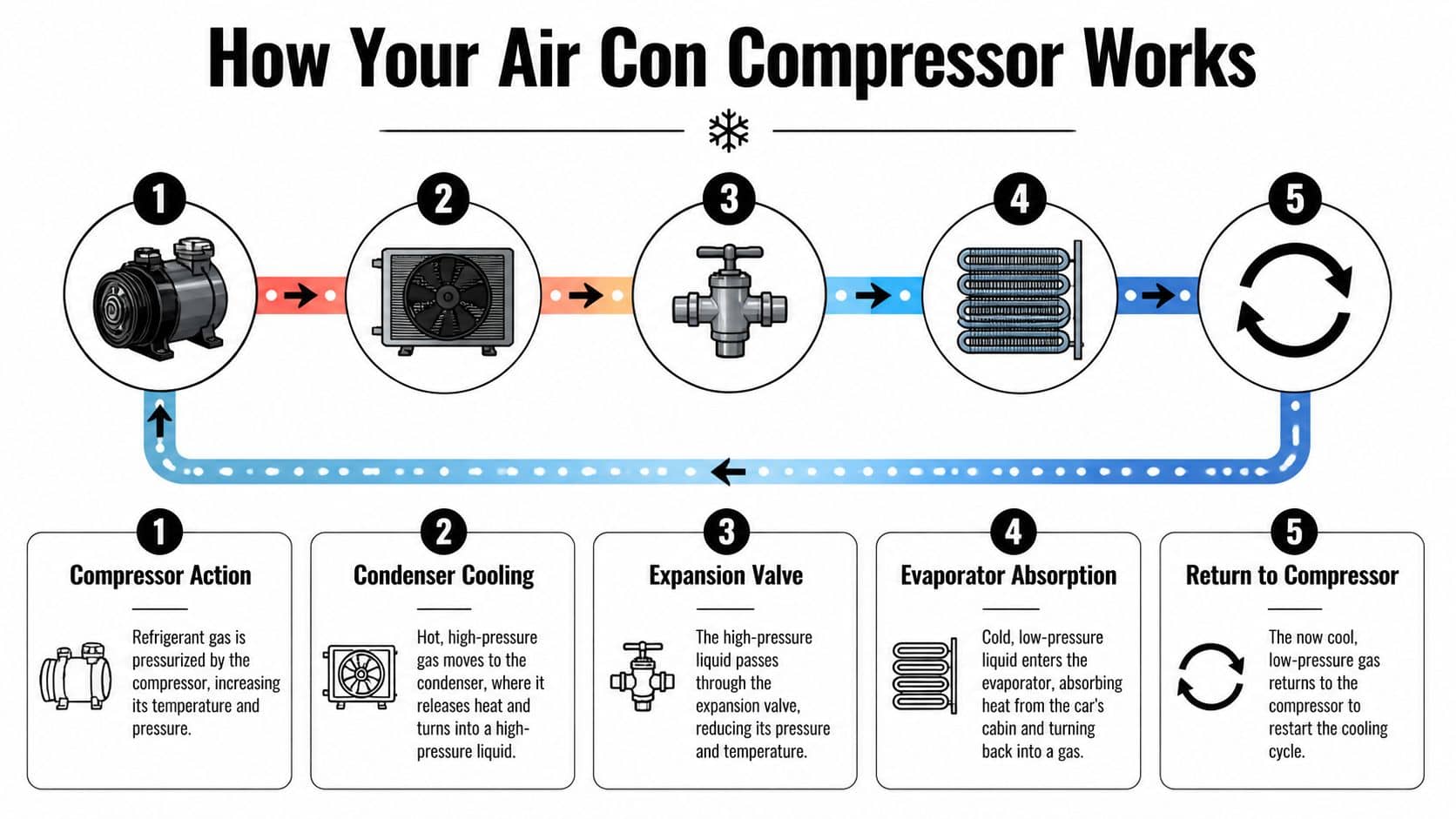
Here’s the simple version of what happens.
The compressor squeezes refrigerant gas
The gas enters the compressor at low pressure. The compressor squeezes it, which raises both its pressure and temperature.The condenser dumps the heat
That hot refrigerant moves to the condenser at the front of the car. Air passing through the condenser removes heat, and the refrigerant changes into a high-pressure liquid.The expansion valve drops the pressure
The liquid then passes through an expansion valve or similar metering device. Pressure drops sharply, and the refrigerant becomes much colder.The evaporator absorbs cabin heat
Inside the dashboard, the cold refrigerant passes through the evaporator. Cabin air blows across it, heat is absorbed, and the air coming through your vents feels cold.The refrigerant returns to the compressor
It heads back as a low-pressure gas, ready to start the cycle again.
If the compressor doesn’t do step one properly, none of the other steps can work as intended.
Fixed versus variable compressors
Older systems often used fixed displacement compressors. These tend to work in a more basic on-off way. They compress a set amount whenever they’re running, and the system often controls temperature by cycling the clutch.
Many newer UK vehicles use variable displacement compressors instead. DENSO notes that models such as the 6SE and 7SE can adjust refrigerant flow from 0% to 100% capacity, reducing energy consumption by up to 30% compared with older fixed displacement designs in partial-load use, which suits the UK’s variable climate (DENSO compressor leaflet).
That matters because a variable unit can match demand more closely. On a mild day, it can ease off instead of repeatedly cutting in and out. That usually means smoother operation and less wasted energy.
A fixed compressor behaves a bit like a tap that’s either fully on or fully off. A variable compressor behaves more like a mixer tap you can adjust precisely.
Why this affects replacement choices
People often assume any compressor that bolts on will do the job. It won’t.
You need the right design for the vehicle, the right control strategy, and the right refrigerant compatibility. A mismatch can leave you with poor cooling, fault codes, clutch problems, or a compressor that never works as intended from day one.
Symptoms of a Failing Air Con Compressor
Warm air from the vents is the headline symptom, but it’s not the only clue. Compressors usually give you a trail of hints before they fail completely. The trick is knowing which signs point at the compressor itself and which signs could still be caused by something else.

The symptoms most people notice first
Start with the obvious.
Warm or only slightly cool air
This can mean the compressor isn’t pumping effectively, isn’t being commanded on, or is suffering from an internal control fault.Clicking, grinding, rattling, or squealing
Noise when AC is switched on often points to clutch trouble, bearing wear, or internal compressor damage. Grinding is the one that should make you stop using it quickly.Intermittent cooling
If the system cools for a short spell and then gives up, that can point to a sticking control valve or a compressor that’s failing under load.Visible oily residue around the compressor
Refrigerant oil often leaves a dirty, damp-looking film where leaks occur. That doesn’t prove the compressor is mechanically dead, but it does tell you the area needs a proper inspection.
What can mislead you
A lot of DIY checks stop at pressure readings. That can be a mistake on modern systems.
Diagnosing variable compressors is more complicated because generic pressure readings often miss the real issue, and UK garages report an 18% misdiagnosis rate for this reason. One reason is that control valve failures can cause no-cold-air symptoms even when pressures look normal (variable compressor diagnostic video reference).
That’s why a simple “it’s got pressure, so the compressor must be fine” verdict can be wrong.
A smarter checklist before blaming the compressor
Before you order parts, check the basics:
Electrical feed and command
Is the compressor clutch receiving power on older clutch-driven systems? Is the control circuit intact?Pulley and clutch behaviour
Does the outer pulley spin normally? Does the clutch engage when AC is requested?Belt condition
A weak, cracked, or slipping auxiliary belt can create symptoms that look like compressor trouble.System cleanliness
If the evaporator smells musty or airflow is poor, that’s a separate maintenance issue. An air con cleaner won’t fix a failed compressor, but it can sort hygiene and odour issues that confuse the diagnosis.
A visual walk-round only gets you so far. This video is useful for seeing the sort of checks technicians make when they’re chasing compressor-related faults.
Symptoms Of A Bad AC Compressor
If the system has gone noisy and cooling has dropped off, treat that as a mechanical warning, not just a comfort issue.
Choosing Your Replacement Compressor Part
Once you’re confident the compressor is the problem, the next question is which replacement makes sense. At this point, many people either overspend or buy the wrong thing.
The right answer depends on how long you plan to keep the car, how quickly you need it back on the road, and whether you want to match original fit and behaviour as closely as possible.
The three main routes
There are three common options in the UK market. None is automatically right for every car.
Factor | OEM (Original Equipment) | High-Quality Aftermarket (e.g., from GSF) | Remanufactured |
Fit and specification | Closest match to the original vehicle build | Often designed as OE-equivalent | Depends heavily on rebuild quality |
Confidence in control strategy | Usually the safest route on complex modern systems | Good if the supplier lists exact compatibility | Can vary, especially on electronically controlled compressors |
Price position | Usually the highest | Usually more budget-friendly than OEM | Often attractive on upfront cost |
Availability | Can depend on dealer stock | Often easier to source quickly | Availability varies by application |
Warranty confidence | Usually clear and structured | Usually clear if bought from a reputable supplier | Worth checking carefully before purchase |
Best fit for | Owners keeping the car long-term or wanting closest factory match | Drivers wanting value without gambling on unknown brands | Older vehicles where budget is the main driver |
How to decide sensibly
An OEM compressor is the safe choice when the car is newer, the AC system is more complex, or you want the closest thing to factory behaviour. If the vehicle uses an electronically controlled variable compressor, OEM can remove a lot of uncertainty.
A high-quality aftermarket unit makes sense when the brand is known, the application match is clear, and you want a good balance of price and confidence. The key phrase is high-quality. This isn’t the place to buy by the cheapest listing alone.
A remanufactured compressor can work well on an older car, especially when originality matters less than keeping the vehicle useable at sensible cost. But reman quality can vary more, so the supplier matters a lot.
Refrigerant compatibility is not optional
Many buyers face a common challenge. The compressor must match the refrigerant system the car was designed for.
You’ll commonly come across R134a on many older vehicles and R1234yf on many newer ones. They are not just labels on a sticker. They affect oil choice, seals, service procedures, and component compatibility.
If you’re searching by registration, a proper air conditioning compressor finder is one practical way to narrow the field to parts that are listed for your specific vehicle.
Buy the part for the exact car, engine, and refrigerant system in front of you. Don’t buy the part that “looks the same”.
Questions worth asking before you click buy
Is this fixed or variable displacement?
Does it match my refrigerant type?
Is it supplied with oil, and if so, what type?
Will I need new O-rings or other related parts?
Is there any requirement to flush the system for warranty validity?
Those questions save more money than chasing the lowest price.
Replacement Costs and Is This a DIY Job?
This is the point where many owners start doing mental maths. If the compressor itself isn’t cheap, maybe fitting it at home will soften the blow.
Sometimes that thinking works with brakes, filters, or a starter motor. With air con, the picture is different.
The cost isn’t just the compressor
There’s the part itself, of course, but a proper compressor replacement often includes more than a box with a new unit inside. You may also need seals, the right oil, refrigerant recovery and recharge, and in some cases system flushing if the old compressor has broken up internally.
If the failure was messy, the final bill climbs because the job stops being “swap part, refill gas” and becomes “clean the whole system so the new part survives”.
Why DIY gets risky fast
Improper installation is a major cause of early failure. Automotive compressors are designed for vertical operation, and incorrect orientation during a DIY install can starve the unit of oil, causing failure within miles. That issue contributes to 20% to 30% of early compressor failures, with replacement costs averaging £400 to £800 for UK motorists.
That’s the practical reason many experienced mechanics are cautious about home-fitted compressors. The damage doesn’t always take months to show up. Sometimes it happens almost immediately.
What a home mechanic usually underestimates
Refrigerant handling
The system has to be recovered and recharged properly. This isn’t a “crack a pipe and let it out” job.Vacuum procedure
Moisture in the system is bad news. Air con systems need to be evacuated correctly before recharge.Oil balancing
Compressors don’t just need oil. They need the correct type and correct amount.Contamination control
If old debris stays in the system, the new compressor can fail for reasons that look mysterious but really aren’t.
If you’re checking service items before the job, the right air conditioning fluid range matters as much as the compressor itself.
Most capable DIYers can remove and refit the hardware. The specialist part is making sure the sealed system is clean, dry, correctly lubricated, and properly charged afterwards.
For most owners, a hybrid approach is the sensible one. Source the right part yourself if you want control over cost, then have a workshop handle the refrigeration side correctly.
Finding The Right Part and The Replacement Process
A good compressor replacement starts before any spanner turns. It starts with identification.
That means exact vehicle details, exact compressor type, and exact refrigerant system. “Looks about right” is how people end up with the wrong pulley, the wrong connector, or a unit that physically fits but never behaves properly once installed.
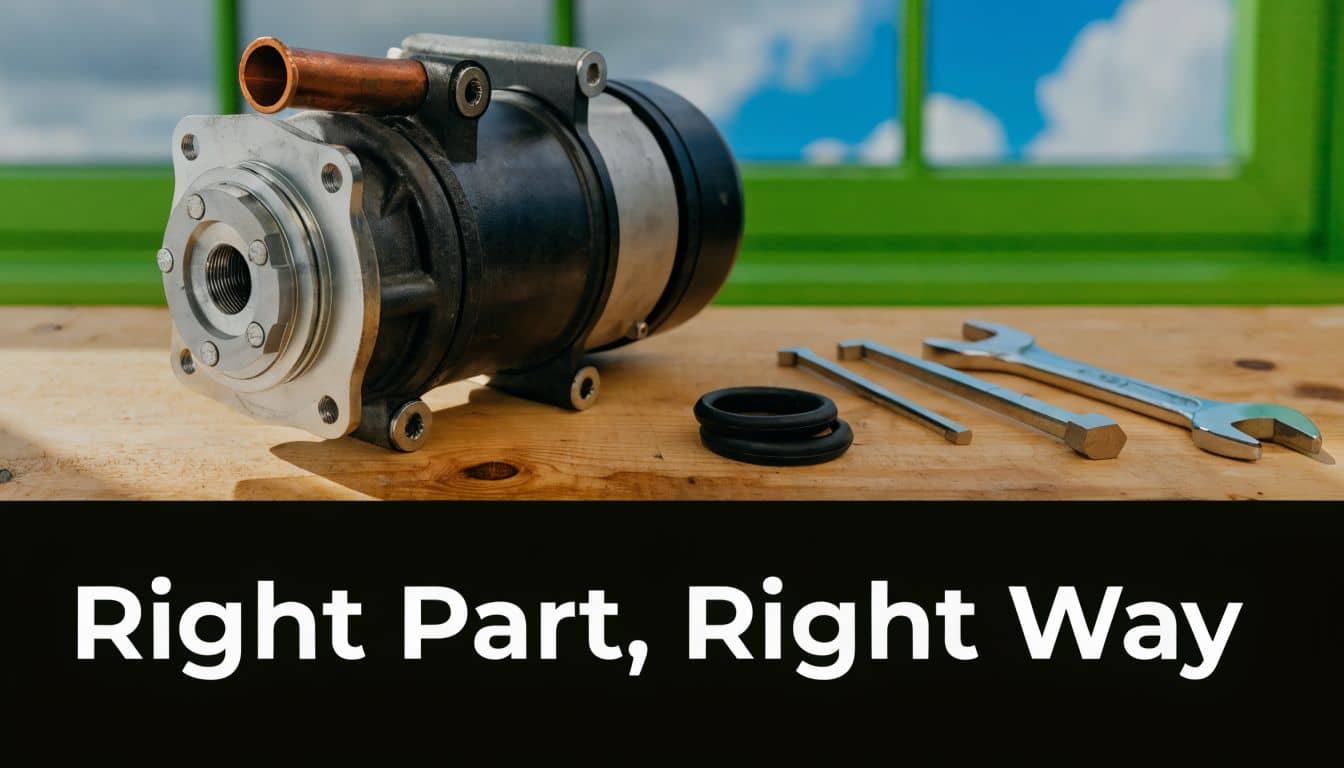
Getting the part match right
Registration lookup is usually the easiest starting point because it cuts through a lot of catalogue confusion. It helps narrow by vehicle application instead of forcing you to compare pulley counts, connector shapes, and compressor codes by eye.
Even then, it’s worth checking details on the old unit if visible, especially on vehicles with multiple compressor variants across the same model range.
What a correct replacement job usually includes
A proper workshop process usually looks something like this:
Recover the existing refrigerant
The old gas is removed with the right equipment rather than vented.Remove the failed compressor
That includes belt removal where needed and inspection of the old unit for signs of seizure or internal debris.Inspect the rest of the system
If the old compressor has shed material, the condenser, lines, and expansion components may need cleaning or replacement.Flush where required
This is one of the steps that separates a lasting repair from a repeat failure.Prepare the new compressor correctly
Oil type and amount matter here. This is not guesswork.
Why oil choice matters so much
Using the correct lubricant is essential. Sanden SP-A2 PAG oil, specified for many UK vehicles, contains additives that help prevent acidic corrosion from moisture ingress in the UK’s humid climate. Using the wrong oil can double internal friction and lead to thermal shutdown and rapid failure (Sanden compressor guide).
That’s one reason experienced technicians don’t treat “a bit of PAG oil” as close enough. Viscosity, compatibility, and charge amount all matter.
Final steps that protect the new unit
After fitting, the system should be evacuated under vacuum, checked for leaks, and then recharged with the correct refrigerant for the vehicle. Only after that can you judge cooling performance properly.
A solid handover should include these checks:
Stable system operation
No abnormal noise from the new compressor
Correct vent temperature behaviour
No signs of leakage at the new joints
Confidence that the right oil and refrigerant were used
If a garage can explain those steps clearly, that’s usually a good sign they understand the job rather than just swapping parts.
Get Your Air Con Fixed with GSF Car Parts
By the time an air con compressor fails, most drivers don’t just need a part number. They need clarity. Is the diagnosis sound, is the replacement compatible, and will the repair last?
That’s why the smartest route is usually simple. Identify the exact vehicle correctly, match the compressor to the right refrigerant system, and make sure the installer treats oil, flushing, and recharge as essential parts of the job, not extras.
If you’re sourcing the part yourself, it helps to buy from a supplier that lets you search accurately by registration and compare suitable options without guessing. For UK motorists and workshops, that’s where a supplier like GSF Car Parts fits into the process. It offers number plate lookup, stock for cars and light commercial vehicles, and collection options that can help when a repair needs moving quickly.
The bigger point is confidence. A compressor replacement goes better when the diagnosis is specific and the part choice is deliberate. That beats replacing pieces at random and hoping the cold air returns.
When you get it right, you don’t just make the cabin comfortable again. You avoid repeat labour, repeat gas charges, and the frustration of a system that still isn’t sorted after money has already been spent.
If you’re ready to find the correct air con compressor for your vehicle, GSF Car Parts lets you search by number plate so you can narrow down compatible options quickly and get one step closer to a properly cold car again.