


You're probably here because you've lifted the bonnet, checked the handbook, or stood in front of a shelf full of bottles thinking the same thing most drivers think.
Why are there so many engine oils, and how on earth am I supposed to know which one is right?
That confusion is completely normal. Engine oil labels are packed with numbers, letters, and approvals that can look like pure jargon. One bottle says 5W-30, another says 0W-20, another mentions ACEA, API, and a string of manufacturer codes in tiny print. It's enough to make anyone grab the cheapest bottle and hope for the best.
The good news is that choosing the best engine oil usually isn't about finding the fanciest brand. It's about matching the oil to the car in front of you. Once you know what the codes mean, the whole thing becomes much more logical.
Choosing the Right Oil Is Easier Than You Think
If you've ever felt like buying engine oil is a bit of a guessing game, you're not alone. The struggle isn't because oil is impossible to understand; it's because the labels mix several different bits of information together.
One part tells you how the oil flows. Another tells you what standards it meets. Another tells you whether a car maker has approved it for a specific engine. If you don't know which part matters most, every bottle starts to look the same.
Here's the simple truth. The best engine oil is the correct oil for your exact car.
That means you're not shopping for a winner in some imaginary contest between brands. You're looking for a bottle that matches what your engine was designed to use. If your handbook says a certain viscosity and approval is required, that's the target. Not “close enough”. Not “that should do”. The proper match.
The right oil is like the right size shoes. A premium pair in the wrong size still gives you trouble.
That matters even more with modern UK cars. A major shift in the market has pushed manufacturers towards lower-viscosity oils such as 0W-20, 5W-20, 5W-30 and 0W-30, largely because newer engines are built around efficiency and emissions targets. A UK-focused overview also notes that the Society of Motor Manufacturers and Traders reported 1.90 million new car registrations in the UK in 2016, with more than 80% of those registrations going to company or fleet buyers, which underlines how important manufacturer-approved oil specs are in high-mileage use (UK engine oil overview).
What usually confuses drivers
A few things catch people out again and again:
Viscosity grades like 5W-30. These describe how the oil behaves when cold and hot.
Specifications like ACEA or API. These tell you the performance standard the oil meets.
OEM approvals from car makers. These are specific requirements for your engine.
Oil type such as mineral, semi-synthetic, or fully synthetic.
Once you separate those into neat little boxes, the mystery disappears. You stop staring at labels and start reading them with confidence.
Why Your Engine Needs the Right Oil
Your engine oil does far more than just make things slippery. It's one of the hardest-working fluids in the whole car, and your engine depends on it every time you turn the key or press the start button.
Think of oil as the engine's working layer of protection. Metal parts are moving at speed, heat builds quickly, and tiny contaminants are constantly being created. Oil steps in and manages all of that.
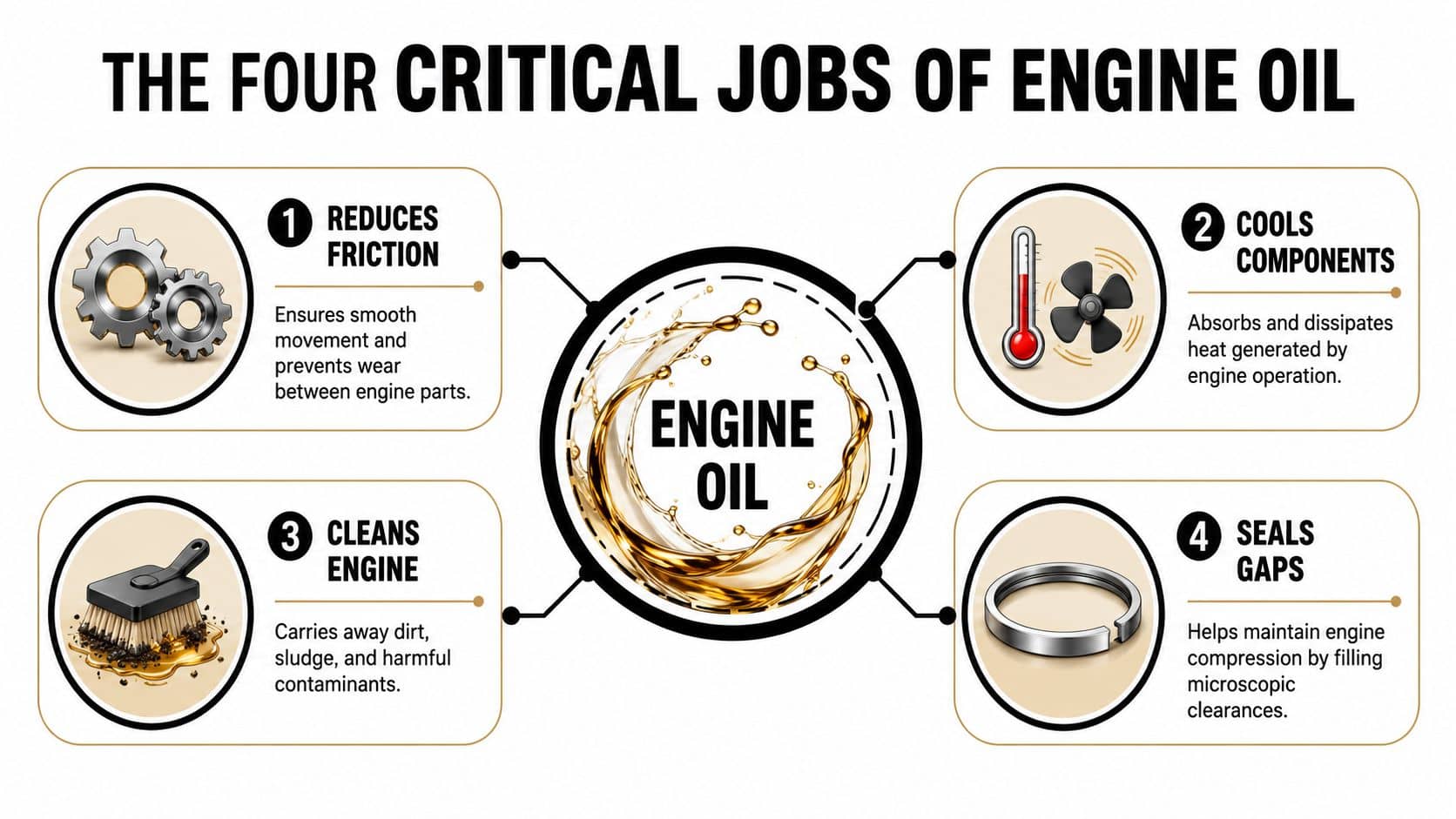
The four main jobs of engine oil
Oil has four big jobs inside the engine:
Reducing friction. It forms a protective film between moving parts like bearings, camshafts, and pistons so metal doesn't scrape directly on metal.
Cooling components. Oil helps carry heat away from parts that get extremely hot during normal running.
Cleaning the engine. It suspends soot, deposits, and debris so they can be trapped by the oil filter instead of sticking inside the engine.
Sealing small gaps. Oil helps the piston rings seal properly against the cylinder walls, which supports compression.
If any one of those jobs starts going badly, the engine notices. You may hear more noise, feel rougher running, or see warning lights. Leave it long enough and wear builds up where you can't see it.
What happens when the oil isn't right
Using the wrong oil doesn't always cause instant drama. That's what makes it tricky. Sometimes the damage is slow and quiet.
A thicker oil than specified may not flow quickly enough on a cold morning. A thinner oil than required may not protect properly under load. An oil with the wrong spec may fail to support emissions equipment or the engine's internal design.
Practical rule: Oil choice isn't just about lubrication. It's about lubrication, heat control, cleanliness, and protection all at once.
That's why getting the oil right matters so much. You're not being fussy. You're giving the engine the exact working conditions it was built around.
Synthetic vs Mineral and Viscosity Grades
Walk into any parts shop and you'll usually see three broad types of oil. Mineral, semi-synthetic, and fully synthetic. They all lubricate, but they don't all perform in the same way.
For many drivers, the decision process commences. Then the viscosity number on the front of the bottle adds another layer. Both matter, but they answer different questions.
Oil types compared
Here's a straightforward comparison.
Feature | Mineral Oil | Semi-Synthetic Oil | Fully Synthetic Oil |
Base composition | More traditional refined oil | Blend of mineral and synthetic base oils | More advanced synthetic base oils |
Performance stability | Lower | Better than mineral | Highest overall stability |
Cold-start behaviour | Less consistent in low temperatures | Improved over mineral | Strong cold-flow performance |
Suitability | Older or less demanding applications | Everyday mixed use | Modern engines, tougher conditions |
Typical buyer | Budget-focused driver of an older vehicle | Driver wanting balance | Driver following a modern spec or wanting higher performance |
Fully synthetic oil is often treated as the premium benchmark for good reason. In controlled testing, AAA found that synthetic oils outperformed conventional oils by 47% on average across the tests they conducted (AAA synthetic vs conventional oil research).
That helps explain why synthetic oils are commonly chosen for long service intervals, cold starts, turbocharged engines, and heavy stop-start driving. Those are all situations where oil gets worked hard.
What mineral, semi-synthetic, and synthetic really mean
If you want a simple mental picture, think of them like this:
Mineral oil is the older, simpler option. It can still be right for some vehicles, especially older designs that were built around it.
Semi-synthetic oil sits in the middle. It's a compromise between cost and performance.
Fully synthetic oil
is the more advanced option and is commonly specified for many modern engines.
That doesn't mean fully synthetic is automatically right for every car. The handbook still has the final word. But if a modern engine calls for synthetic oil, that's usually because the engine's tolerances, heat levels, and service demands need it.
Making sense of 5W-30 and similar grades
The number on the bottle typically first noticed is the SAE viscosity grade. You'll see things like 0W-20, 5W-30, or 5W-40.
This isn't a quality score. It's a description of how thick or thin the oil behaves at different temperatures.
A very simple analogy helps. Think of cold treacle versus warm water.
When oil is cold, it thickens.
When oil is hot, it thins.
The first number, before the W, relates to cold-temperature flow. The W stands for winter. A lower number generally means the oil can move more easily when the engine is cold.
The second number relates to how the oil behaves when the engine is up to operating temperature.
Why the grade matters in everyday driving
In the UK, cold starts matter. Even if our weather isn't extreme, a chilly, damp morning is enough to make oil flow characteristics important. The oil has to circulate quickly after start-up because that's when engines see a lot of wear.
A lower winter grade, such as 0W or 5W, can help the oil reach critical engine parts more quickly after you start the car. The hotter-running grade, like 20, 30, or 40, must still match what the engine was designed for once everything is fully warmed up.
If your handbook says 0W-20, moving to a thicker oil because it “sounds safer” can actually work against the engine design.
The key point is simple. Oil type tells you about the base formulation. Viscosity tells you how the oil flows. Neither one replaces the need to check the exact required specification.
Understanding Oil Specifications and Approvals
This is the part that sorts confident buying from expensive guesswork. Viscosity gets the attention because it's printed large on the front. Specifications and approvals are often in smaller text, but they're the key gatekeepers.
If the viscosity is the oil's shape, the specs are its passport.
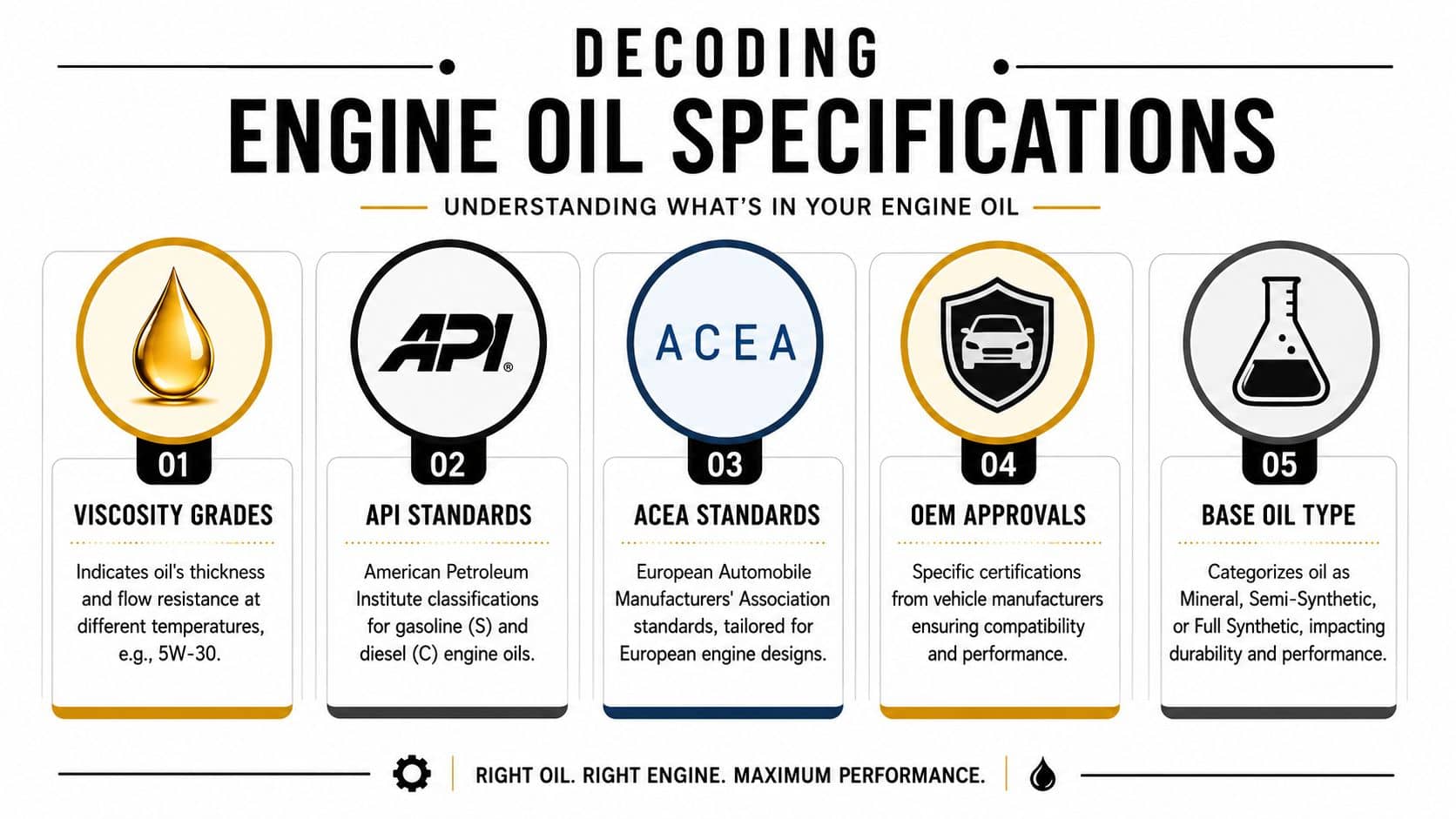
What ACEA, API, and OEM approvals mean
You'll usually come across three layers of information on a bottle.
ACEA standards
ACEA stands for the European Automobile Manufacturers' Association. These standards are especially relevant for many vehicles used in the UK and Europe.
They tell you what sort of performance the oil is designed to deliver, including compatibility with modern engine and emissions systems.
API standards
API comes from the American Petroleum Institute. These grades are common on oils used across many petrol and diesel applications, particularly for vehicles influenced by American or Asian standards.
They're useful, but for many modern UK cars, ACEA and manufacturer approvals often carry more practical weight.
OEM approvals
OEM means Original Equipment Manufacturer. In plain English, that's the car maker itself. These approvals are very specific.
A bottle may say it meets a general performance standard, but your car may require an exact manufacturer approval. That approval isn't marketing fluff. It's the car maker saying, “This oil has been tested for use in this type of engine.”
Why this matters so much on modern UK cars
For modern cars in the UK, meeting the exact OEM approval and ACEA sequence is critical. The move toward smaller, more efficient engines has pushed lower-viscosity oils like 0W-20 and 5W-30 into the mainstream, and diesel cars with DPFs need a low-SAPS oil, typically an ACEA C-grade, to avoid clogging emissions equipment (technical overview of UK oil requirements and low-SAPS needs).
That's where many people slip up. They buy an oil that seems close because the viscosity matches, but the approval doesn't.
Low-SAPS and DPF explained simply
These are two terms that worry people, but they're easier than they sound.
DPF means diesel particulate filter. It traps soot from diesel exhaust.
Low-SAPS refers to oil with lower levels of sulphated ash, phosphorus, and sulphur.
Why does that matter? Because some additives that help protect engines can leave behind ash in emissions equipment. If a diesel engine with a DPF needs low-SAPS oil and doesn't get it, the filter can suffer.
A simple way to think about it is this. Some oils are designed to protect both the engine and the emissions hardware together. Modern cars often need that balance.
Workshop view: The letters on the back of the bottle matter just as much as the big numbers on the front.
How to read the label without getting lost
When you pick up a bottle, scan it in this order:
Viscosity grade. Does it match the handbook?
ACEA or API spec. Does the required standard appear?
OEM approval. Is the exact manufacturer approval listed?
Oil type. Is it mineral, semi-synthetic, or fully synthetic, as required?
If any one of those is off, keep looking.
This is why there isn't one universal best engine oil for everyone. A brilliant oil for one engine can be the wrong oil for another. Modern lubrication is precise, not generic.
Engine Oil Myths and Maintenance Tips
A lot of oil trouble doesn't start with the bottle you buy. It starts with habits. Drivers skip checks, overfill, top up with whatever's lying around in the garage, or assume “long-life” means “never think about it again”.
That's how small issues turn into workshop bills.
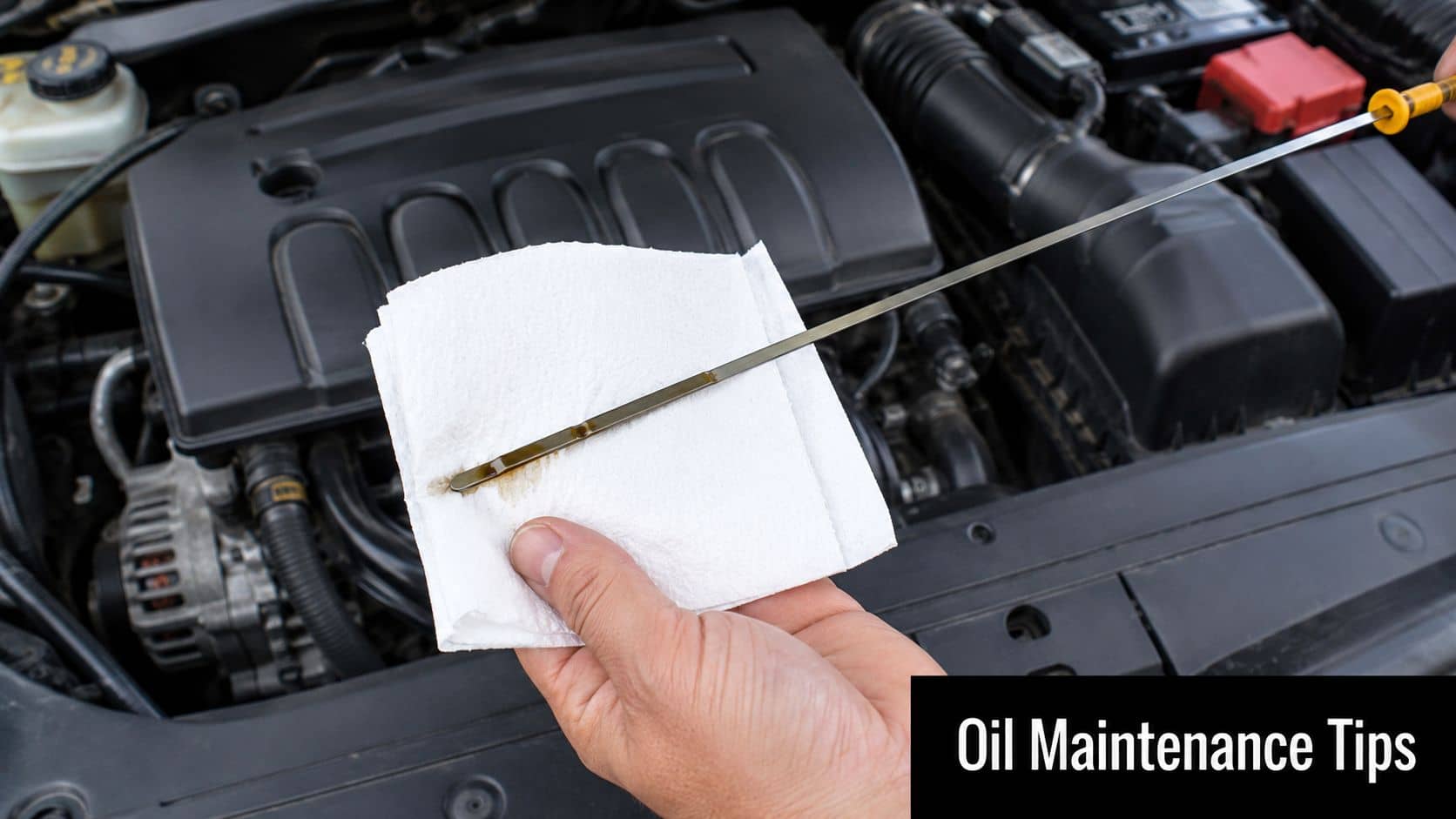
How to check your oil properly
Checking the oil level is simple, but doing it carelessly can give you a false reading.
A safe routine looks like this:
Park on level ground so the oil sits evenly in the sump.
Let the engine settle before checking. If it's just been running, give the oil time to drain back down.
Pull the dipstick and wipe it clean with a cloth or paper towel.
Reinsert it fully, then pull it out again to read the level.
Keep the level between the marks. Near the top is fine. Above it isn't.
If you're topping up, add a little at a time. Don't chuck half a bottle in and hope. Overfilling can be just as troublesome as running low.
For anyone doing their own servicing, proper disposal and draining equipment matter too. If you're setting up to handle old oil cleanly, oil drainers and service tools are the sort of kit worth having to avoid spills and mess.
Common myths that catch people out
Some oil myths just won't die. Here are a few that need clearing up.
“Thicker oil is always better.” Not on modern engines. Many newer engines are built around lower-viscosity oil for correct flow and protection.
“You can mix any oil in an emergency.” Mixing oils isn't ideal. If you must top up to protect the engine, use the closest matching spec you can and correct it properly afterwards.
“Long-life oil means I never need to check it.” Wrong. Even with long service intervals, engines can still consume oil between services.
“If the engine sounds fine, the oil must be fine.” Not always. Oil problems often worsen gradually before symptoms become obvious.
A quick visual guide helps
If you'd like to see the checking process in action, this short video gives a useful walk-through. Car Oil Myths You NEED TO Unlearn!
Small habits that save engines
A few simple routines make a big difference:
Check monthly if the car is used regularly.
Check before a long journey because motorway running can expose a low oil level quickly.
Watch the colour and feel. Dark oil isn't automatically bad, but gritty oil or obvious contamination deserves attention.
Change the filter with the oil because clean oil pushed through a tired filter isn't ideal.
Find the Perfect Engine Oil on GSF Car Parts
Once you know what the codes mean, the easiest way to cut down mistakes is to start with your registration number. That removes a lot of random browsing and narrows the list to oils that fit your vehicle application.
Start with the number plate lookup
On the engine oil section at GSF Car Parts, the simplest approach is to enter your registration first.
That step matters because many cars were sold with different engines under the same model name. A 2.0 diesel and a 1.5 petrol version of the same car may need different oil grades and different approvals. Searching by reg helps filter those out.
A practical way to use the listings
Once your vehicle is identified, work through the options in this order:
Open the product details, not just the product title.
Check the viscosity shown on the bottle or listing.
Look for ACEA or API specs in the technical information.
Check for exact manufacturer approvals if your handbook gives one.
Confirm the oil type if your car specifically calls for synthetic.
Don't stop at “that looks about right”. Read the smaller print. That's where the important match usually sits.
Use your handbook as the final tie-breaker
Parts lookup tools are useful, but the vehicle handbook is still your best referee. If the handbook says an exact approval is required, make sure the product listing shows that exact code.
Here's a sensible buying routine:
Handbook first for the required grade and approval.
Registration lookup next to narrow the parts list.
Product page last to verify the details match exactly.
If the handbook and the bottle agree, you can buy with confidence. If they don't, keep searching.
This approach takes the stress out of choosing engine oil. You're no longer guessing from branding or packaging colour. You're matching specifications properly.
Your Engine Oil Checklist for the Right Choice
When people ask for the best engine oil, what they usually want is peace of mind. They want to know they're putting the right thing in the engine and not making an expensive mistake.
That decision gets much easier when you strip it down to a short checklist.
Keep this checklist handy
Check the handbook for the exact viscosity, specification, and any manufacturer approval.
Use your registration on a parts site to narrow the options to your vehicle.
Match the viscosity exactly unless the handbook clearly allows alternatives.
Verify the ACEA or API standard shown on the bottle.
Confirm the OEM approval if your car requires one.
Be careful with diesel DPF models because low-SAPS oil may be essential.
Top up with care and don't overfill.
Change the oil filter at the same time when carrying out an oil service. If you're replacing service parts together, it also helps to check the correct oil filter options by vehicle.
The main thing to remember
There isn't one magic bottle that suits every engine. The best engine oil is the one that matches your car's exact needs.
Once you understand viscosity, specs, and approvals, the shelf stops looking confusing. It starts looking organised. You know what you're looking for, what to ignore, and what to double-check.
That's when buying oil becomes simple. Not because oil got less technical, but because you learned how to read the label properly.
If you're ready to match the right oil, filter, and service parts to your vehicle, GSF Car Parts lets you search by registration so you can check compatibility before you buy.





