


You’re usually reading this at one of two moments. Either the car has just turned over a bit slower than normal and you’re thinking, “That didn’t sound right,” or it’s already gone fully silent on the drive, with only a click from under the bonnet.
That’s the right time to learn how to test a car battery at home. Not after you’ve bought a new one on a guess. Not after you’ve been stranded twice in a week. A few simple checks can tell you whether the battery is weak, merely discharged, or being dragged down by something else in the car.
A lot of battery replacements happen too early because the first diagnosis is wrong. That’s even more common now that many UK cars run stop-start systems, keyless entry, trackers and control modules that stay awake longer than people realise. The battery gets blamed first because it’s easy to see. It isn’t always the actual fault.
Why Your Car Battery Deserves a Regular Check-Up
Cold mornings expose weak batteries fast. You turn the key, the dash lights flicker, the starter gives a half-hearted effort, and your plans change immediately.

That’s not a rare problem. In the UK, car battery failure is the leading cause of breakdowns, accounting for approximately 38% of all incidents reported by the AA in their 2023 annual data, with over 1.2 million callouts directly linked to battery issues amid the region's harsh winter conditions.
The battery usually gives a warning first
Most batteries don’t fail out of nowhere. They normally give you a few clues:
Slower cranking: The engine turns over, but it sounds laboured.
Electrical hesitation: Interior lights dip more than usual when starting.
Intermittent starts: One start is fine, the next feels weak.
Short-trip trouble: Cars used mainly for local errands often don’t recover full charge properly.
Those signs matter because the battery does more than start the engine. It stabilises the car’s electrical system and supports everything from lighting to onboard electronics during start-up. When it’s weak, the whole system feels it.
UK driving conditions are hard on batteries
A battery that copes in mild weather can struggle as soon as the temperature drops. Add damp air, short journeys and long periods parked up, and the usual lead-acid wear speeds up.
I’ve seen plenty of batteries blamed for “sudden” failure when the underlying cause was weeks of light use, repeated short runs, and no proper charge recovery. The driver notices it only when the weather turns.
Practical rule: If the car sounds different when starting, test the battery that day. Waiting rarely improves anything.
A quick home test saves guesswork
A home battery check doesn’t replace every workshop test, but it does give you a reliable starting point. In a few minutes, you can spot obvious terminal corrosion, check resting voltage, and see how the battery behaves under load.
That changes the conversation from “I think the battery’s dead” to “The battery is charged but collapses under cranking,” or “The battery is low, but the charging system also needs checking.” That’s a much better place to start.
Gathering Your Tools and Staying Safe
Before you touch the terminals, get the basics sorted. Battery testing is simple, but it isn’t a job for rushing.

What you actually need
You don’t need a workshop full of gear. For most home checks, this short list covers it:
Digital multimeter:This is the main tool. It lets you measure battery voltage accurately.
Gloves:Useful when handling dirty terminals or old battery clamps.
Safety glasses:Worth wearing whenever you’re working around a battery.
Wire brush or terminal brush:Handy for clearing corrosion off the posts and clamps.
Clean rag or paper towel:For wiping dirt and residue away.
Basic spanner or socket set:Needed if you’re removing covers or disconnecting terminals.
Torch:Some battery trays are buried low in the engine bay.
If you’re buying equipment specifically for this job, a proper voltage tester or multimeter is the sensible first purchase. GSF stocks voltage testers and detectors for this kind of diagnostic work.
Why safety matters more than people think
A car battery looks harmless compared with bigger mechanical jobs, so people get casual around it. That’s when sparks happen, clamps get shorted, and terminals get damaged.
Keep these habits every time:
Switch the engine off fully.
Remove the key and keep it out of the ignition.
Work in a ventilated area.
Keep metal tools away from bridging both terminals.
Don’t lean over the battery while loosening clamps.
If you do need to disconnect the battery, remove the negative terminal first. When reconnecting, fit the positive first and the negative last. That order reduces the chance of accidental shorting.
Corrosion, loose connections and poor contact can mimic a bad battery. Clean and secure connections before you trust any reading.
Know what you’re testing before you start
Not every battery under a bonnet wants the same approach.
A standard flooded lead-acid battery may allow visual checks around the casing and terminals, and on some older designs you may inspect the electrolyte condition more directly. An EFB battery looks similar from the outside but is built for heavier cycling in stop-start use. An AGM battery is sealed and more sensitive to incorrect charging and poor test assumptions.
That matters because people often treat all batteries as if they’re interchangeable. They’re not. You can still use a multimeter on all of them, but some old-school checks don’t apply to sealed designs.
A quick visual walkthrough helps if you want to see the process before doing it yourself:
TOPDON Battery Tester BT200 | Mechanic Mindset
Set yourself up for a clean reading
Testing straight after a drive can mislead you. A recently charged battery may show a temporarily inflated voltage. If you test in that state, you can mistake a tired battery for a healthy one.
For a better result:
Let the car sit: Leave it parked long enough for the battery to settle.
Turn off all electrical loads: Lights, heater blower, heated screens, chargers.
Inspect first, test second: Dirt and corrosion can affect your contact and your conclusion.
Use the battery posts where possible: That gives a truer battery reading than probing dirty cable clamps.
Skip the common mistakes
Most bad home tests come from routine errors:
Wrong meter setting: Make sure it’s on DC volts.
Poor probe contact: Touch clean metal, not painted or crusted surfaces.
Testing after charging: Surface charge can flatter the result.
Ignoring battery type: AGM and EFB batteries can fool simple pass-fail thinking.
If you’re careful with setup, the rest of the job becomes straightforward.
Your Complete Guide to Testing a Car Battery
Cold morning, key in, one slow turn of the engine, then nothing. Plenty of drivers blame the battery on the spot and order a replacement. Sometimes they’re right. Sometimes the battery is only flat because the car has a drain somewhere, or because a stop-start AGM or EFB battery is being judged like an older standard one.
A home test works best in stages. Start with what you can see, confirm the battery’s state of charge, then check how it behaves under load. That approach saves guesswork and helps you avoid replacing a battery that still has life in it.
Start with a visual inspection
Lift the bonnet and inspect the battery before touching the meter.
Look for a swollen case, cracks, leaks, loose clamps, damaged terminals, or signs the battery has been moving in its tray. Corrosion around the posts matters too. White or blue crust on the terminals can add resistance and create the same symptoms as a weak battery.
Clean terminals give cleaner results. Earlier guidance in this article already covered the standard terminal-cleaning method and why dirty connections can mislead your diagnosis.
Stop if the case is cracked or leaking. At that point, testing is no longer the job. Replacement is.
Check resting voltage
A resting voltage test gives you the starting point. It does not tell the whole story.
Set a digital multimeter to DC volts and measure directly across the battery posts, not the cable clamps if you can avoid it. If you need one, a digital voltage tester for battery checks makes this part straightforward at home.
Use the reading as a guide:
Voltage Reading | What it usually means | What to do next |
12.6V to 12.8V | Battery is well charged | Move on to a cranking or load-style check |
Around 12.4V | Partly discharged | Recharge first, then retest |
Well below 12.4V | Low charge, possible deterioration, or a drain issue | Charge fully, then investigate why it went low |
That middle step matters. A low reading does not automatically mean the battery has failed. A healthy battery can be pulled down by repeated short trips, long periods parked up, a boot light staying on, or an electrical module that does not go to sleep properly.
Watch what happens during cranking
This is the test many DIY checks miss, and it often tells you more than the standing voltage.
Keep the meter connected to the battery and crank the engine. You are looking for how far the voltage drops and how the engine sounds at the same time. If the voltage falls sharply and the starter turns slowly, the battery may be weak even if the resting voltage looked acceptable. If the reading stays fairly stable but the engine still struggles to crank, look harder at the starter circuit, cable connections, or the starter motor itself.
Battery type proves to be a crucial differentiator in actual use. Standard flooded batteries usually show their decline fairly clearly. AGM and EFB batteries can hold a respectable standing voltage, then fall away under starter load or become unreliable on short-run, stop-start use. That catches a lot of people out.
Use the headlight check as a quick clue
The headlight test is old-fashioned, but it still has some value if you treat it as a clue rather than proof.
Switch the headlights on with the engine off, then crank the engine. If the lights dip hard and the starter barely moves, battery performance is suspect. If the lights stay fairly steady and the engine still does not crank properly, the fault may not be the battery at all.
I’d never use this as the only test, especially on newer UK cars with AGM or EFB batteries, but it can support what the meter is already telling you.
Know which battery you are testing
A lot of wrong battery diagnoses start here.
Standard flooded batteries
These are common on older or simpler cars. They are usually the easiest to assess with basic home tests. If one has gone flat because the car has been standing, a proper recharge often gives you a clear answer.
EFB batteries
EFB stands for enhanced flooded battery. These are common on stop-start cars and cope better with repeated cycling than a standard battery. They still need correct charging and careful interpretation. A basic voltage check can make an EFB look healthier than it really is.
AGM batteries
AGM stands for absorbed glass mat. These are fitted to many higher-spec or stop-start vehicles and they do not like being repeatedly left undercharged. They can appear fine on a simple meter check, yet still struggle during cranking or fail to support stop-start properly. They also need the right charger settings. Using the wrong charger can shorten their life.
If your car was built for AGM or EFB, replace like-for-like unless the vehicle manufacturer says otherwise. Fitting a cheaper standard battery into a system designed for something stronger usually creates more problems than it solves.
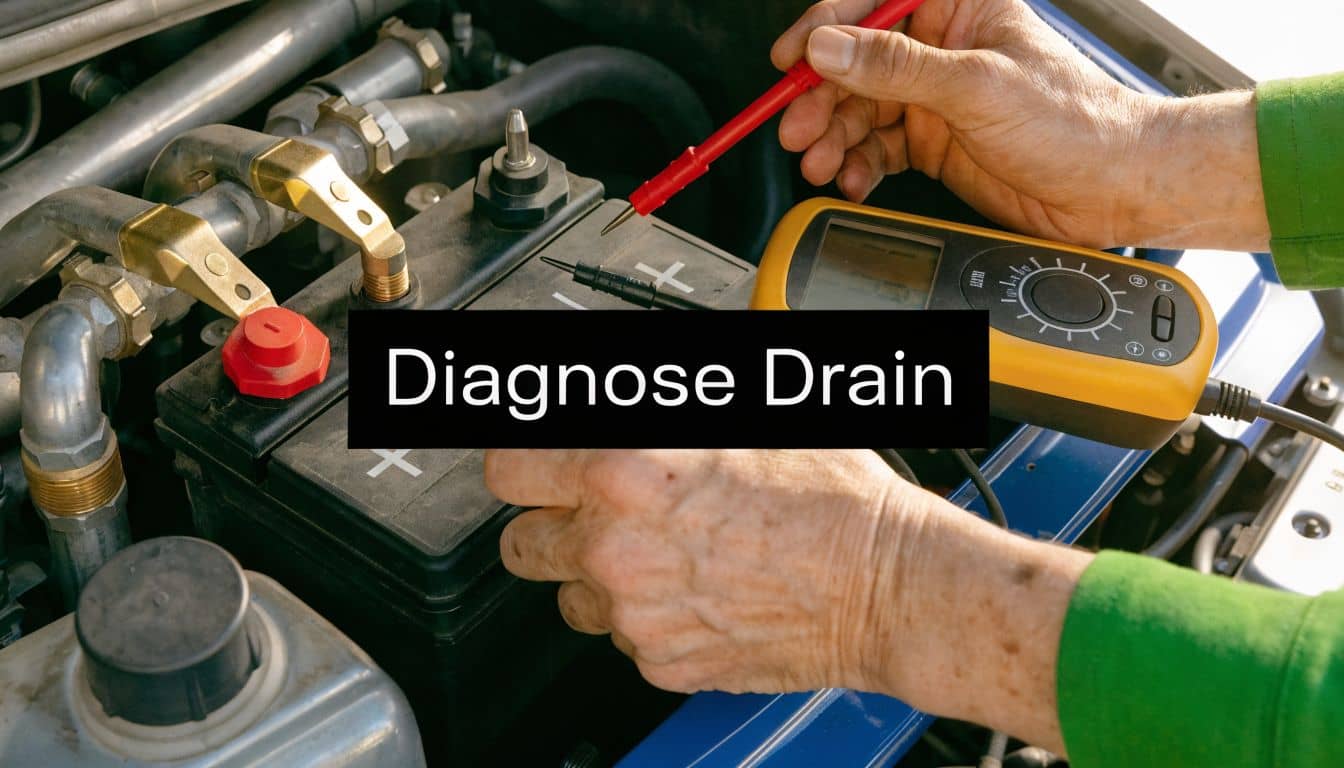
Separate battery failure from parasitic drain
This is one of the most common misdiagnoses in the workshop.
If the battery tests low, you charge it fully, and it starts the car normally for a day or two before going flat again, do not rush to buy another battery. That pattern often points to a parasitic drain. Alarm systems, dash cams, faulty control modules, boot lights, and aftermarket accessories are regular offenders.
A failing battery and a drain issue can look similar at first. The difference is repeatability. A worn-out battery still struggles after a full charge and a proper retest. A battery drained by the car often comes back to life after charging, then loses charge again while the vehicle sits.
That distinction matters even more with AGM and EFB batteries because they cost more to replace. Getting the diagnosis right can save a fair bit of money.
What a sensible home test includes
Use a sequence, not a single reading.
Inspect the case, clamps, and terminals
Measure resting voltage at the posts
Check voltage while cranking
Factor in the battery type
Question whether repeated discharge points to a drain rather than battery failure
That gives you a much better answer than resting voltage alone.
When home testing has reached its limit
Some batteries sit in the grey area. The car starts on one day, struggles the next, and the readings are only slightly off. That is common with ageing AGM and EFB units.
At that point, a conductance test or a proper battery and charging-system test is the better move. It confirms whether the battery can still deliver current, instead of only showing surface voltage.
Recharge or Replace Interpreting Your Test Results
A battery test only matters if it leads to the right decision. The job here is to work out whether the battery needs a proper recharge and retest, or whether it has reached the point where replacement is the sensible option.
Battery type matters more than many DIY guides admit. A standard flooded battery, an EFB, and an AGM can all show similar symptoms when they are low on charge, but they do not age in quite the same way and they do not cost the same to replace. That is why I always judge the result in context, not from one voltage number on its own.
When recharging makes sense
Recharge first if the battery has been run down by short trips, time off the road, cold weather, or a light left on, and the battery is otherwise in sound condition. That is often the right call with newer batteries, especially AGM and EFB units fitted to stop-start cars, because replacing the wrong battery type is an expensive mistake.
Age still matters. A battery that is only a couple of years old and has gone flat after poor use patterns often deserves a full charge and a second test. One that is already well into its service life and has begun to struggle in normal use is less likely to recover for long.
Use a proper battery charger before you retest. A quick drive is rarely enough to bring a significantly discharged battery back to a true full state of charge.
When replacement is the smarter call
Replacement is usually the better answer when the battery regains voltage after charging but still cannot deliver dependable starts.
Look for this pattern:
Resting voltage improves after charging, but cranking is still weak
The battery goes flat again soon after a full charge, with no clear drain issue confirmed
Cold starts are inconsistent, even after charging
The case is swollen, cracked, leaking, or the terminals are damaged
The battery fitted is not the correct specification for the vehicle, such as a standard battery in a car that should have AGM or EFB
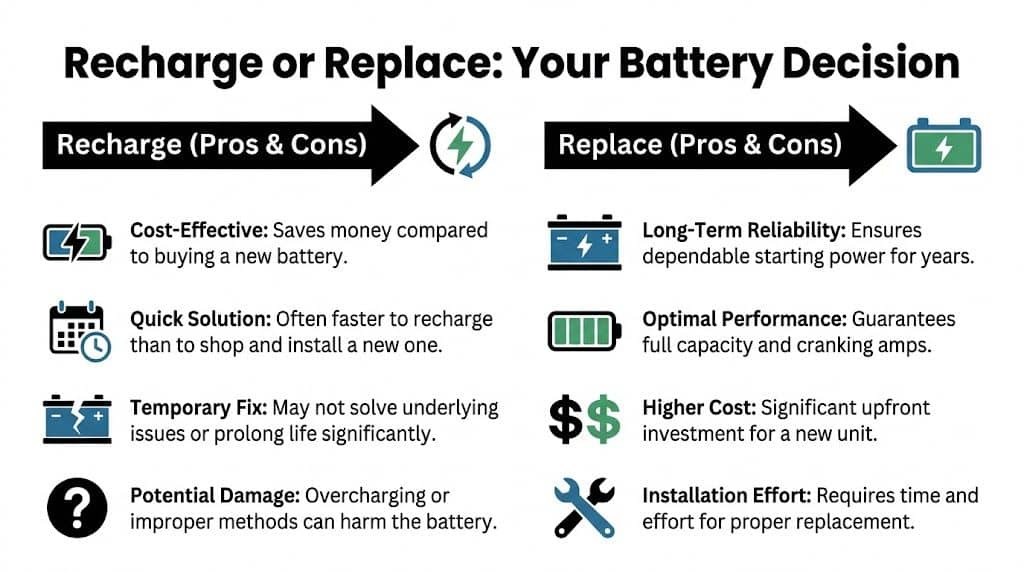
AGM and EFB batteries deserve a bit more caution before you condemn them. They often sit in that awkward middle ground where the voltage looks acceptable, but starting performance has clearly dropped off. In that case, a home charge and retest is worthwhile. If the same weakness comes back straight away, replacement is easier to justify.
Do not get fooled by a fresh charge
A newly charged battery can look healthier than it really is. Surface charge can lift the reading for a while, even if the battery has lost real capacity.
The better question is simple. Does it still crank strongly the next morning, or after a couple of days standing, without dropping back into the same symptoms?
That is the difference between a battery that was merely discharged and one that is wearing out internally.
Judge it on reliability
A battery does not have to be fully dead to be finished in practical terms. If the car is your daily driver, repeated doubt is enough reason to stop chasing one last recovery attempt.
For a weekend car, you might accept a recharge, monitor it, and see how it behaves. For a work car, school-run car, or anything that has to start first turn on a cold morning, reliability matters more than squeezing a bit more life out of a doubtful battery.
Good diagnosis saves money here. Recharging a healthy but flat AGM or EFB can save replacing an expensive unit too soon. Replacing a battery that no longer holds up under real use saves the usual cycle of charging, hoping, and getting caught out again.
Is It Really the Battery A Guide to Your Charging System
You charge the battery, the car starts, and it feels sorted. Two mornings later it is sluggish again. That pattern catches a lot of people out, because a weak start does not always mean the battery itself is finished.
A battery can be perfectly serviceable and still keep going flat if the car is not charging it properly or something is draining it while parked. That matters even more on UK stop-start cars, where AGM and EFB batteries cost more and get replaced unnecessarily when the actual fault sits elsewhere.
Check charging voltage with the engine running
Start with the simplest system check. Put the multimeter across the battery terminals, start the engine, and watch the reading settle. In most cars, you want to see roughly 13.8V to 14.4V once the charging system has stabilised.
Use that reading as a guide, not a final verdict:
Around 13.8V to 14.4V: Charging is likely normal at idle
Below that range: The battery may not be getting enough charge back
Well above that range: The battery may be getting overcharged, which shortens its life
AGM and EFB batteries are less forgiving here than an old standard flooded battery. A standard battery might put up with marginal charging for a while. AGM in particular tends to show the problem sooner through poor stop-start performance, slow cranking, or repeated low-voltage warnings.
If the voltage is clearly off, the charging side needs attention before you blame the battery. If you end up tracing the fault further, the relevant replacement category is alternator parts for your vehicle.
A battery fault and a drain fault behave differently
This is the distinction that saves money.
A worn battery usually struggles most on a cold start, after several years of use, or after failing to recover properly even when fully charged. A parasitic drain gives a different pattern. The car may start fine if driven every day, then struggle after sitting overnight or over a weekend. Charge it up and it comes back. Leave it parked again and the same problem returns.
That points to power being used while the car is switched off.
Common causes include:
Dash cams wired to permanent live
Aftermarket trackers or alarms
Boot, glovebox, or interior lights staying on
Control modules failing to go to sleep
Keyless entry systems with an abnormal standby draw
I see this misdiagnosis regularly. A new battery gets fitted, the car behaves for a short while, then the same flat-battery complaint comes back. The battery was never the main problem.
How far you can check at home
Home testing is realistic up to a point. You can spot the pattern, confirm charging voltage, and make a sensible call on whether the fault looks battery-related or drain-related.
Drain testing itself is trickier on modern cars because the reading changes every time the vehicle wakes up. Open a door, activate the central locking, or reconnect the battery incorrectly, and the current draw can jump around enough to confuse the result. That is why a lot of DIY checks end with the wrong conclusion.
A practical home routine looks like this:
Check the resting voltage after the car has stood
Observe how strongly it cranks from cold
Measure charging voltage with the engine running
Notice whether the trouble appears mainly after parking
Match the battery type properly, standard, EFB, or AGM, before replacing anything
That last point matters. If the car was built for AGM or EFB and someone fits a cheaper standard battery, the symptoms can look like a charging fault or premature battery failure. The battery is wrong for the job.
Treat the battery, alternator, and parked-current draw as one system. That is how you separate a failing battery from a car that is slowly flattening a good one.
Troubleshooting Common Battery Problems and Next Steps
“Just replace the battery” is easy advice. It’s also wrong often enough to waste money.
Modern cars have made battery diagnosis less forgiving. The battery itself may be fine, but the test method is poor, the charge state is misleading, or the battery type hasn’t been considered properly.
Stop-start cars need a different mindset
Sealed AGM and EFB batteries are dominant in UK stop-start vehicles, making up 72% of 2025 registrations, and 35% of UK drivers replace them prematurely due to mis-testing.
That matters because traditional habits don’t transfer neatly to these batteries. A hydrometer approach isn’t relevant for sealed AGM, and an old pass-fail mindset based only on one voltage number can lead you the wrong way with both AGM and EFB.
Common misdiagnoses to avoid
A few patterns come up again and again:
Battery blamed for overnight discharge: Often a drain issue.
New battery fitted to a car with weak charging: The replacement soon looks faulty too.
Standard battery fitted where AGM or EFB is required: The car may start at first, but long-term performance and charging behaviour suffer.
Resting voltage treated as final proof of health: Useful, but not enough by itself.
If your car has stop-start from the factory, match the replacement type properly. Don’t downgrade the battery just because it physically fits.
Signs the problem may be outside the battery
Look wider if you notice any of the following:
The battery goes flat after the car sits
The battery warning light appears while driving
Electrical oddities continue after charging
Starting improves with a jump but degrades again quickly
The car has added electrical accessories
Those clues point you towards charging or drain problems rather than a simple battery wear issue.
A sensible next-step checklist
If you’ve done the home checks, use the result to decide what happens next:
Clean and tighten the terminals if the problem was poor connection.
Recharge and retest if the battery was undercharged but not obviously failed.
Replace like-for-like battery type if the battery can’t hold up in service.
Check the charging system if the running voltage looks wrong.
Investigate parasitic drain if the car repeatedly goes flat while parked.
The aim isn’t to turn every driveway into a diagnostic bay. It’s to stop guessing.
If your battery checks point towards a replacement, a charger, or the need to match the correct AGM, EFB or standard unit, GSF Car Parts makes it straightforward to find the right part using your registration. If you’re mid-repair, Click & Collect can help you get moving again without waiting around, and if you’re unsure what fits your vehicle, the team can point you in the right direction.





