You're halfway through a repair, the old part is off, and the replacement in the box doesn't quite match what's on the car. Or the fault still hasn't gone after fitting the part you were sure would fix it. That's usually the moment customer service support stops being an abstract idea and becomes the difference between getting moving again today or losing the rest of the afternoon.
Car parts queries are rarely just “where's my order?”. They're often about fitment, compatibility, urgency, and whether the next step should be another part, a return, or a proper diagnosis. That's why the most useful support isn't just fast. It's organised, practical, and built around the way real repairs happen.
A lot of support now starts online because that's how the majority of individuals shop and check information. In 2025, 93% of UK households had internet access, which helps explain why people expect quick digital help, but technical retail still depends on reliable human assistance when the issue is urgent or complex, as noted in this UK service overview. In practice, that means the quickest route isn't always the shortest message. It's the route that gets the right details in front of the right person first time.
Your Essential Guide to GSF Customer Service Support
A common support journey starts like this. You order brake discs, pads, and a wear sensor for what you believe is the correct trim level. The discs look right at first glance, but the offset is wrong once you line them up. Now the car is on stands, the job is paused, and you need an answer that's specific enough to act on.
That's where good customer service support has to do more than apologise or point you to a generic help page. It needs to separate three things quickly. What vehicle you have, what part you received, and what outcome you need now. Sometimes that's confirming the correct part. Sometimes it's checking whether a registration-based result needs a manual cross-check. Sometimes it's helping you decide whether to return the item or keep troubleshooting the original fault.
What helps before you even make contact
The fastest conversations usually start with solid basics. Have these ready:
Vehicle identity: Registration, make, model, engine size, fuel type, and year.
Part trail: Product name, part number, and any markings on the box or label.
Order detail: Order number, branch if relevant, and whether it was delivery or collection.
Problem summary: Wrong size, wrong connector, warning light still on, damaged packaging, missing item, or delayed collection.
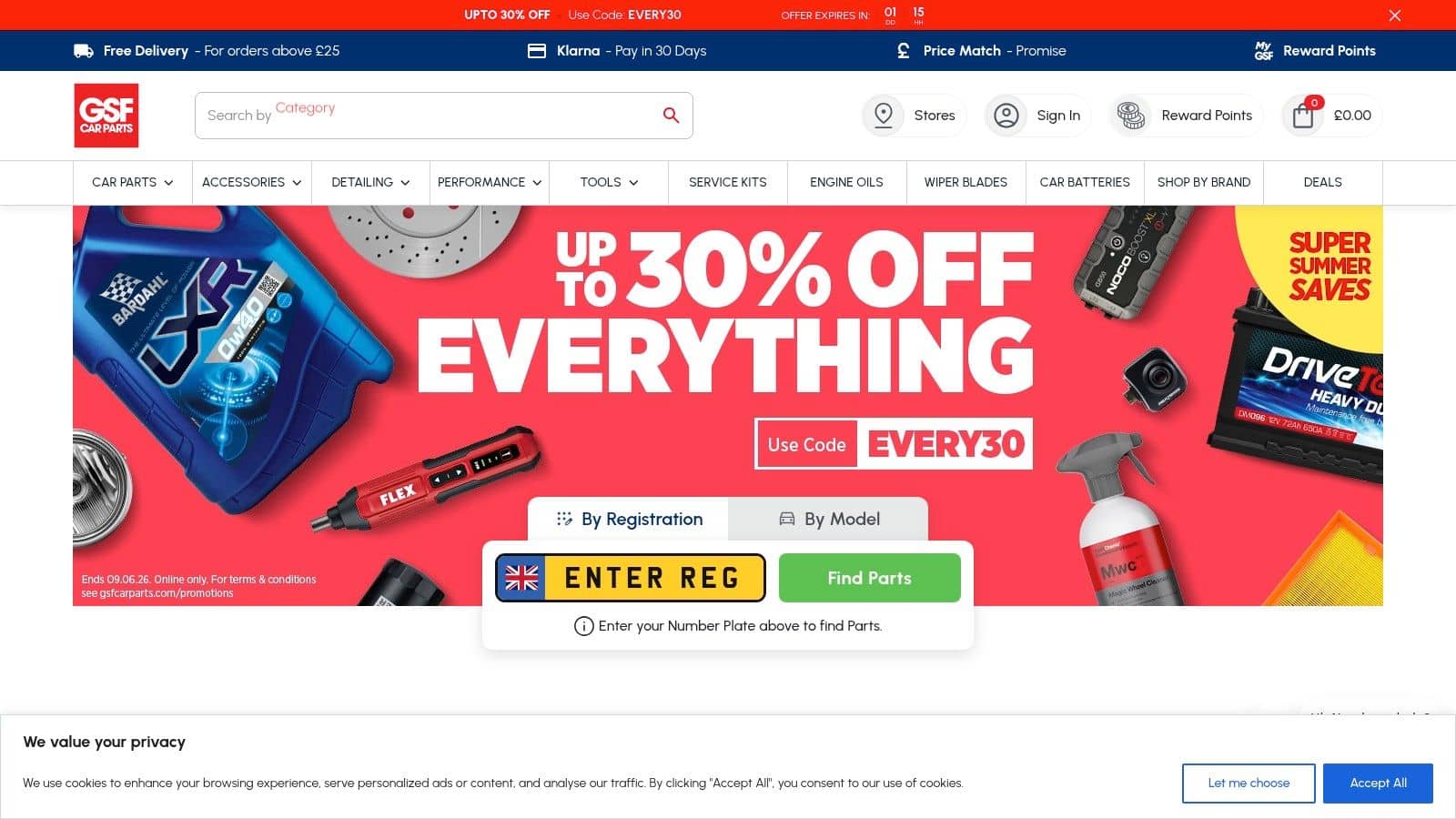
If you're browsing the GSF Car Parts website, it helps to keep the product page open while you speak to us or message us. That avoids the slow back-and-forth where everyone is trying to identify the same item from memory.
Practical rule: If the car is already dismantled, say that at the start. Urgency changes the most sensible support path.
The support mindset that works
For car parts, the right answer often comes from narrowing the issue, not widening it. “It doesn't fit” is understandable, but “the mounting holes align, the depth is wrong, and the electrical plug differs from the original” gets you to a useful answer much faster.
We treat support as part of keeping your vehicle usable, not just part of completing a transaction. That means helping you move from confusion to the next clear action, whether that's checking fitment data, arranging a return, or steering you towards a better part match.
What Great Car Part Support Really Means
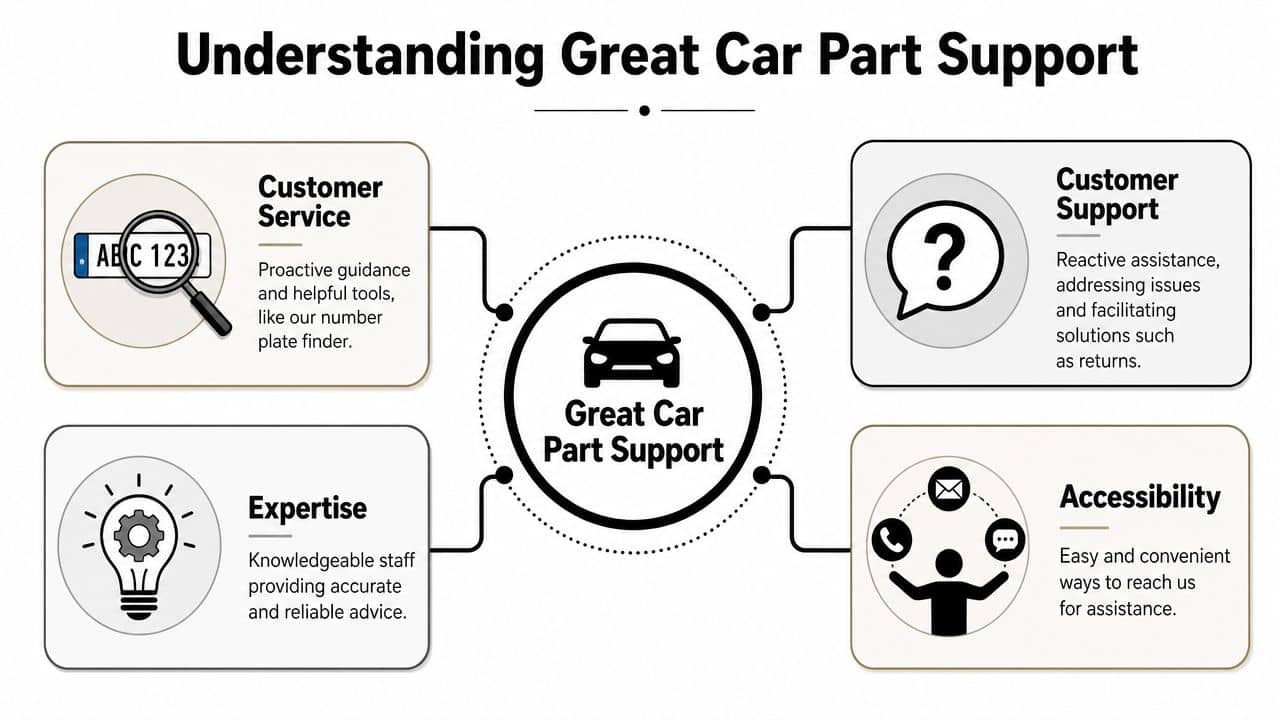
Good support in the motor trade has two sides, and customers often need both in the same job. Customer service is the guidance that helps you choose well in the first place. Customer support is the problem-solving that kicks in when something needs fixing after that choice.
Service helps you prevent the problem
Think of service as the advice you'd expect from a switched-on parts counter. It helps you narrow options before you spend money.
That includes things like:
Finding by vehicle: Using registration lookup or part filters to reduce obvious mismatches.
Comparing options: Choosing between standard replacement and a premium brand line.
Sanity-checking the basket: Noticing when the part selected doesn't suit a vehicle variant or intended repair.
If you're checking components before buying, the parts range at GSF gives you the starting point. The value comes from pairing that catalogue view with the vehicle details and symptoms you already know.
Support fixes the problem in front of you
Support is what matters when the part has arrived and the question becomes operational. Does it fit? Is it faulty? Was the fault diagnosed correctly? Can this be returned? Does this need escalation to someone with deeper technical knowledge?
UK customer behaviour matters here. While digital channels are growing, Ofcom experience data cited in this customer support trends summary shows phone remains the most common route for complex support, which makes sense in car parts. A misfire, ABS issue, or fitment mismatch usually isn't solved well by a one-line message.
The best support channel is the one that matches the complexity of the problem, not the one that feels quickest to open.
Four signs the support is actually good
Pillar | What it looks like in practice |
Clarity | You know what information is needed and why |
Expertise | The person helping can distinguish fitment from diagnosis |
Accessibility | You can switch channel if the first one isn't enough |
Ownership | The issue keeps moving until there's a clear next step |
What doesn't work is treating every query as identical. A stock check, a warranty question, and a wrong-part-on-ramp problem need different handling. Great support recognises that immediately.
How to Contact GSF for Fast Car Part Advice
If you need help quickly, choose the contact method based on the type of issue, not just convenience. That one decision often saves the most time.
Use live chat for short, factual queries
Live chat suits questions that can be answered cleanly in text. If you need to confirm stock, check a basic order update, or ask whether a product listing covers a specific vehicle detail, chat is often the neatest route.
It works best when you can paste or type exact identifiers:
Order references: Order number and postcode
Vehicle references: Registration and engine details
Part references: SKU, brand, and product title
Keep the message tight. “Need to confirm whether this oil filter fits a 2017 1.6 TDI” is much easier to route than a long fault story that really needs a phone conversation.
Pick up the phone for fitment and diagnosis issues
Phone support is usually the right move when the repair has stalled. That includes mismatched parts, recurring warning lights, urgent Click & Collect issues, or cases where the website result needs human interpretation.
A spoken conversation helps because support on car parts is often conditional. The answer depends on whether the vehicle has a particular engine code, brake setup, connector type, or production change. Those details come out faster in conversation than in fragmented chat messages.
Email suits non-urgent issues with evidence
Email is useful when the issue needs photos or a fuller written record. Damaged packaging, an item that arrived incorrect, or a warranty-related concern can be easier to handle when images and order details sit together in one thread.
Use email when you need to send:
Photos of the old and new part
Images of labels, connectors, or dimensions
A written timeline of what happened
In-store support is practical for physical comparison
If you're local to a branch and the issue is visual, face-to-face can save a lot of guessing. A counter colleague can often tell very quickly whether you've got a sensor with the wrong plug, a filter with the wrong height, or a disc with the wrong dimensions.
Industry research discussed in this contact-centre analysis notes that many customers switch channels when a digital journey fails. In car parts, that's normal. If chat isn't moving the issue forward, switching to phone or in-branch support isn't a failure. It's the sensible next step.
If your car is immobilised or booked into a same-day repair slot, don't stay stuck in the wrong channel. Escalate early.
Navigating Click & Collect and Returns with Confidence
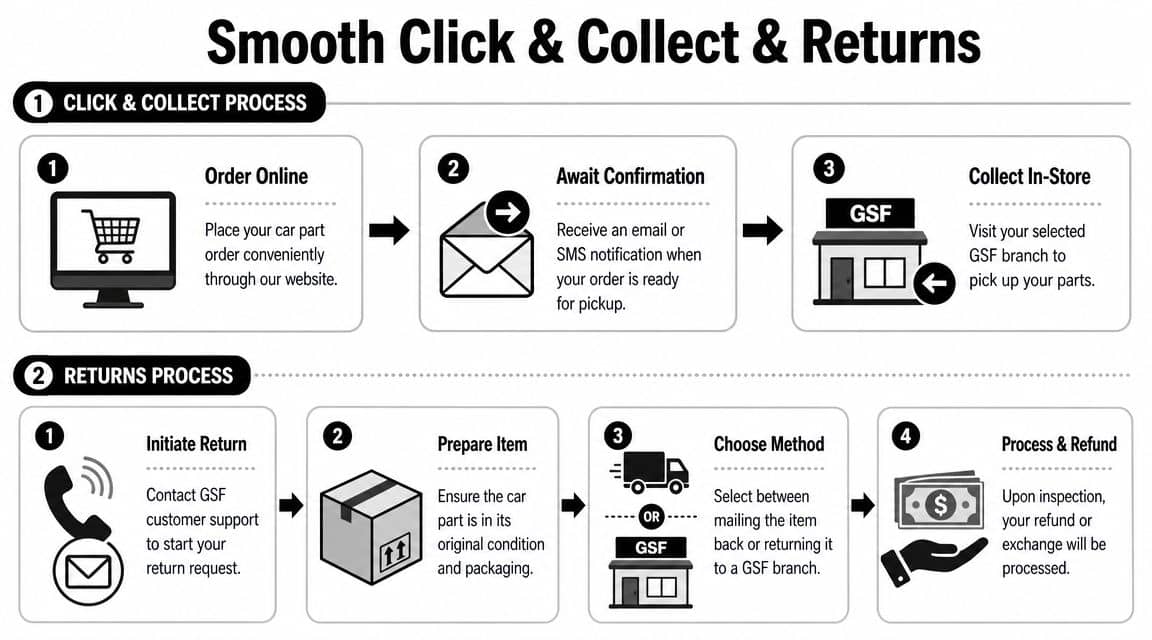
Click & Collect works well when you need parts quickly and want to avoid waiting at home for delivery. Returns work smoothly when the item and the evidence are prepared properly. Most friction comes from missing references, unclear condition, or uncertainty about what happens next.
Click and Collect without the usual hold-up
For urgent repairs, collection only feels fast if the handover is clean. The simplest way to keep it that way is to treat collection as the final confirmation stage, not just the pickup stage.
Use this sequence:
Place the order carefully
Double-check the vehicle match, quantity, and branch before payment. Small basket errors become bigger delays when the car is already dismantled.Wait for readiness confirmation
Don't assume the order is ready the moment payment clears. Collection works best when you've received the prompt that tells you it can be picked up.Bring the right references
Have your order confirmation and collection details available. If someone else is collecting, make sure they can identify the order clearly.Check obvious fitment points before leaving if the job is urgent
For time-sensitive repairs, compare box labels, part numbers, and visible features before you drive away. It won't replace a full fitting check, but it can catch the most obvious mismatch early.
Returns that move faster
Returns tend to be straightforward when the item is still in suitable condition and the reason is clear. The more precise you are, the easier it is for the team to process the next step.
A useful return checklist:
Keep the packaging: Labels and original boxes help identify exactly what was supplied.
Separate fitment from fault: “Did not fit vehicle” and “item appears defective” are different paths.
Gather the paperwork: Order number, receipt, and any photos that explain the issue.
Avoid further marking the item: Don't keep trial-fitting in a way that damages the part if you think it may need to go back.
Warranty questions need detail, not guesswork
Warranty-related support usually becomes slow when the description is too broad. “Failed after fitting” isn't enough on its own. A better report explains the symptom, the fitting date, the vehicle details, and whether the original fault changed at all after installation.
A return is faster when we can identify the item, the order, and the exact reason in the first message.
If you're unsure whether your issue is a return, exchange, or warranty question, start by describing what happened physically. Wrong connector, wrong diameter, warning light remained on, leak persisted, or item arrived damaged. That language gives the support team something concrete to work with.
Pro Tips for a Quicker Support Experience
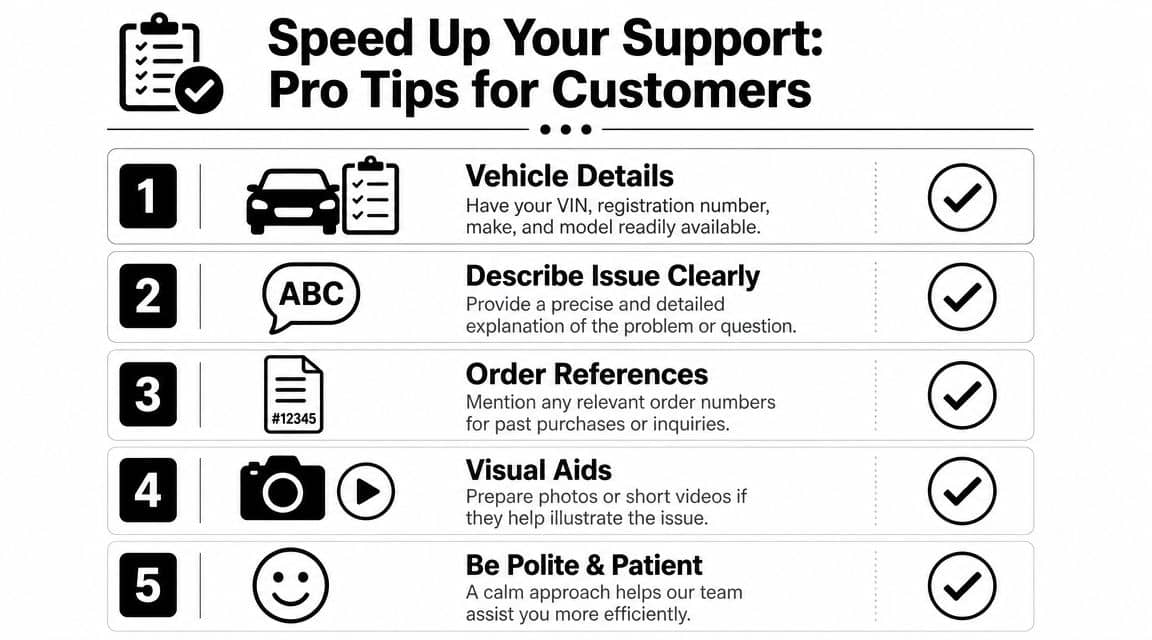
Five minutes of preparation can save hours of waiting, especially when the car is off the road. Most slow support cases aren't caused by unwillingness to help. They slow down because the first message lacks the details needed to route the query properly.
The pre-contact checklist that actually matters
Before you contact support, gather the information that narrows the issue immediately:
Vehicle details first: Registration, VIN if available, make, model, engine size, fuel type, and year.
Part details next: Product name, part number, brand, and any numbers printed on the part or box.
Order trail: Order number, order date, branch or delivery method, and whether the item has been fitted.
Fault description: Explain what happened in plain language. Wrong size, connector mismatch, dashboard light stayed on, noise unchanged, item damaged, or collection issue.
Photos if relevant: A clear image of the old part beside the new one often answers questions faster than a long paragraph.
Why this speeds things up
Modern teams often use a tiered support model. Basic issues can be handled quickly, while technical cases go to people with deeper product or diagnostic knowledge. According to this explanation of tiered support operations, providing details such as your registration or order number upfront helps route the query directly to the right specialist tier, which leads to faster diagnosis and resolution.
That matters a lot in automotive support. A missing order update can be handled one way. A fitment mismatch on a vehicle variant needs a different person, with different checks.
A better way to describe the problem
Compare these two messages:
Weak message | Useful message |
“This part is wrong” | “The supplied rear pad set matches the shape, but the wear sensor position differs from the original on a 2018 vehicle” |
“Need help urgently” | “Vehicle is on axle stands and I need to confirm whether this disc size suits the registration before refitting” |
“Order issue” | “Order received, but one bulb pack is missing from the parcel and the rest is present” |
Trade and fleet customers can go even further. If the vehicle is booked into a workshop slot, say so. If downtime is affecting a van or customer handover, include that context. It helps support prioritise the practical next step instead of starting with generic questions.
Escalation Paths and Common Questions Answered
Not every issue gets solved in the first contact. That's normal with technical parts, mixed vehicle histories, and urgent repairs. What matters is having a clear escalation path instead of repeating the same explanation to different people.
How escalation should work
A sensible escalation flow usually looks like this:
Initial triage
The first contact identifies whether the issue is order-related, fitment-related, returns-related, or a possible warranty matter.Technical review if needed
Queries involving compatibility, vehicle variants, or unclear diagnosis move to someone who can assess the part match more closely.Returns or account handling
If the issue is no longer technical and now needs processing, it moves into the correct admin path with the references already attached.Manager review for unusual cases
If the problem doesn't fit the standard route, escalation should focus on what will resolve it, not on defending the process.
If the first answer doesn't solve the actual problem, ask for the case to be reviewed with the vehicle details, part number, and photos attached together.
Common questions from customers
Can you help if I'm not sure the fault was diagnosed correctly
Yes, but support works best when it stays within what can be confirmed from parts information and symptoms. If you can explain the fault code, noise, warning light, or failed function, the team can often help narrow whether the selected part still makes sense or whether another component should be checked before you spend more.
What if the part I need isn't listed online
That doesn't always mean it isn't available. Sometimes the listing may be limited by vehicle data, product mapping, or a variant that needs manual checking. If that happens, use the part details from the old unit if you have them, then cross-check against related maintenance items such as service kits and routine replacement components where appropriate.
What if standard support channels are difficult for me to use
Accessible support matters, especially when phone trees, timed forms, or rigid verification create barriers. The UK's Equality Act 2010 requires businesses to make reasonable adjustments for disabled customers, and practical examples include callbacks or alternative verification methods, as explained in this overview of accessible customer service.
That means you should ask for the format that helps you communicate effectively. If speaking on the phone is difficult, say so. If you need more explicit written guidance, an alternative contact method, or extra time to verify an order safely, that's a valid support need.
What usually causes the longest delays
The biggest delays come from partial information, unclear photos, and choosing a channel that doesn't fit the problem. A stock question sent by email may just be slower than necessary. A complicated fitment issue sent through a short chat window may be too compressed to solve properly.
The fastest support experience usually starts before contact. Know the vehicle, know the part, know the symptom, and say what outcome you need.
If you need help choosing, checking, or sorting a car part issue, start with GSF Car Parts and have your registration, order details, and part information ready so the rig