Car Parts Click and Collect: Your GSF Guide to Fast Fixes
A car rarely chooses a convenient moment to need a part. It's usually a flat battery before work, a brake warning light the day before an MOT, or a split wiper blade just as the weather turns filthy.
That's why car parts click and collect makes so much sense. When you already know the job needs doing, waiting around for a van delivery can be the slowest part of the repair.
The Modern Solution for Car Repair The Rise of Click and Collect
A lot of motorists still think of parts buying in old terms. You either walk into a factor and hope they've got what you need, or you order online and accept the wait. Click and collect sits neatly in the middle. You search online, confirm the part, pay for it, and collect it from a local branch when it's ready.
In car parts, that matters more than it does in a lot of other categories. A replacement bulb, battery, oil filter, set of brake pads, or coolant top-up isn't always a leisurely purchase. Often, the car is already off the road, or it soon will be.
Why it fits the way people now buy parts
In the UK, click-and-collect has become a normal retail habit rather than a niche extra. Statista's overview of click-and-collect trends notes that post-pandemic omnichannel shopping helped make pickup-from-store a mainstream option, and that shift suits automotive buying particularly well because urgent or bulky items are often more useful collected quickly than shipped to a doorstep.
That lines up with how most real repairs happen. You diagnose the fault, check compatibility, then want the part in your hands as soon as possible. You're not buying a jumper for next week. You're trying to get a vehicle usable again.
Practical rule: If the car is already making your life harder, the part-buying process shouldn't make it harder again.
For many drivers, the smart move is to order through a proper parts site, use the vehicle lookup tools, and collect locally. If you want to see how that works in practice, the GSF Car Parts website is one example of that setup in the UK aftermarket.
What works and what doesn't
What works is simple. Use click and collect when the job is time-sensitive, when you need fitment confidence before turning a spanner, or when the part is awkward to ship.
What doesn't work is treating every part like a generic online purchase. Car parts aren't one-size-fits-all. A battery can have multiple capacity and terminal layouts. Brake pads can vary by engine, trim, or brake system. Even something as ordinary as a cabin filter can differ within the same model range.
That's why click and collect isn't just about convenience. It's a smarter way to combine online accuracy with local availability.
Key Benefits Speed Cost and Getting It Right First Time
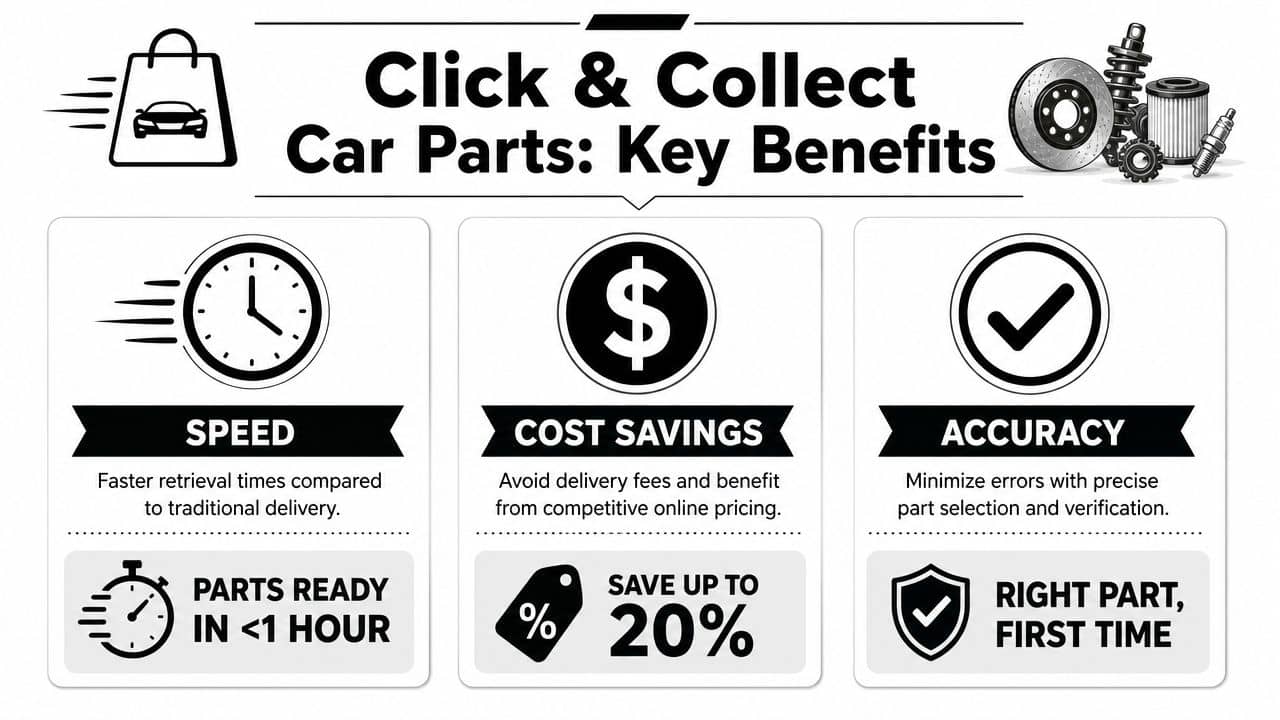
If you strip the decision back to what matters, three things usually win. You want the part fast, you want it at a sensible price, and you want to avoid the misery of fitting the wrong thing.
Those priorities aren't guesswork. YouGov-cited independent research on auto-parts shopping found that price matters to 74%, availability matters to 54%, and location convenience matters to 47% of buyers. It also noted that 32% already buy auto parts online. Even though that survey is US-based, the buying logic is easy to recognise in the UK aftermarket.
Speed when the car can't wait
The biggest appeal is obvious. If you need the car tonight or first thing tomorrow, click and collect cuts out the home-delivery delay.
That's especially useful for jobs like:
Battery replacement: The car won't start, so waiting is pointless.
Brake service parts: Pads and discs are often a same-day priority once wear is confirmed.
Bulbs and wipers: Small items, but often needed immediately for safety or legality.
Service consumables: Oil, filters, screen wash, and coolant are rarely exciting, but they stop routine maintenance from dragging on.
Cost without paying for dead time
There's the direct saving of not needing delivery for that order. But there's also the less obvious saving. You don't lose half a day waiting in for a parcel, and a garage doesn't leave a ramp tied up while a courier slot comes and goes.
A cheap part that arrives too late can still be the expensive option. For trade users especially, time off the road costs money even when no invoice says so.
The smartest parts purchase is often the one that lets the repair finish today.
Right part first time
People can either save themselves a headache or create one. The old gamble of “that looks about right” doesn't belong anywhere near modern vehicles.
A good click and collect process lets you confirm fitment before collection. That matters with ignition parts, filters, braking components, sensors, and batteries, where small spec differences can turn into wasted time at the driveway or in the workshop.
A short way to judge it is this:
Priority | Bad approach | Better approach |
Speed | Order the first matching-looking part | Match by registration or exact vehicle details |
Cost | Buy twice after a fitment mistake | Buy once and collect the correct item |
Accuracy | Guess by photo or old box | Verify against vehicle-specific data |
Your Step-by-Step Guide to Ordering from GSF
The key step happens before anything goes into the basket. You start with the vehicle, not the part. That sounds obvious, but it's where most wrong orders begin.
Start with the registration lookup
Automotive catalogue data is messy behind the scenes. Guidance on auto-parts ecommerce data and fitment standards points out that fitment information is structurally complex, often using ACES and PIES-style standards, and that poor data mapping is a major cause of wrong-part risk and avoidable returns.
That's why a number plate finder is more than a convenience. It's your first filter against buying something that nearly fits.
If you're ordering through the GSF parts catalogue, enter the registration first and let the site narrow the options before you browse. That's the right order round. Registration first, then product category, then brand and spec.
Pick the part with the job in mind
Once the vehicle is identified, choose the component based on the specific repair needed. Don't just search “brake pads” and stop there. Think about the repair properly.
For example:
Routine service job Look for oil filters, air filters, cabin filters, engine oil, drain plugs, and any service consumables you'll want on hand at the same time.
Braking work Check whether you're replacing pads only or doing pads and discs together. If the wear pattern or disc lip says the discs are done, buy for the full job rather than pausing halfway through.
Battery fault Confirm terminal layout, size, and specification. Start-stop cars in particular can catch people out if they order on assumption rather than fitment.
A parts finder saves the most time before you click buy, not after the wrong box lands on the bench.
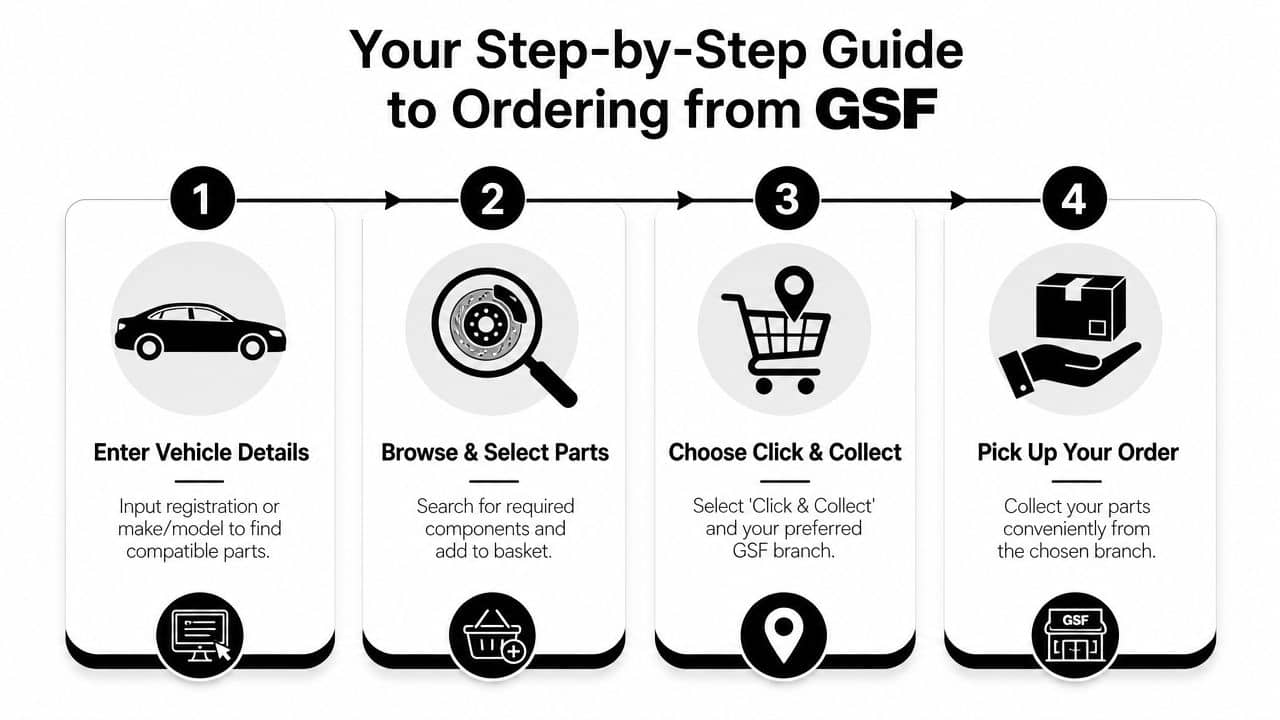
Here's the basic order flow customers will typically follow:
Enter vehicle details: Registration is quickest. Manual vehicle selection works too.
Browse the matched category: Brakes, filters, batteries, bulbs, oils, tools, or consumables.
Check product notes: Look for engine-specific or trim-specific fitment details.
Add to basket and select collection: Choose Click & Collect at checkout and pick the branch that suits you.
A quick walkthrough can help if you prefer to see the process before trying it yourself: GSF Car Parts Car Honest Review - Watch Before Using
Before you confirm the order
Take ten extra seconds and ask yourself three workshop-style questions:
Have I diagnosed the fault, or am I guessing?
Am I buying all the small extras needed to finish the job?
If the old part has multiple variants, have I matched the exact vehicle?
That tiny pause saves far more time than rushing through checkout and sorting out a mismatch later.
Seamless In-Store Pickup What to Bring and Expect
The pickup side should be the easy part. If the online order was done properly, collection is mostly about being organised and knowing what the branch will need to hand the parts over quickly.
The reason it works at all is back-end stock control. Grid Dynamics' discussion of auto-parts search and inventory architecture explains that reducing last-mile friction depends on continuous inventory synchronisation across stores and online channels, so customers can be directed to a branch that has stock available for fast pickup.
What to bring
Keep it simple. Bring the essentials that help the counter staff find and release the order without delay.
Order confirmation: On your phone is usually fine.
Identification: Useful if the branch needs to confirm who's collecting.
Vehicle details: Registration and model info are handy if you want a last check at collection.
Your old part if needed: Helpful for visual comparison on certain items, though fitment data should lead the decision.
What the process usually feels like
Most collections are straightforward. You arrive, give the order details, the staff retrieve the parts, and you're away.
If you've ordered something technical, it's worth taking a moment at the counter to sense-check what's in the box. Not because the system can't work, but because a quick human check is often useful on parts with visible spec differences, such as bulbs, batteries, and some filters.
If the repair is urgent, don't leave the branch wondering whether the part looks right. Open the conversation there and then.
A first-time user sometimes expects it to feel more complicated than it is. It usually isn't. The order has already done the heavy lifting. Collection is just the handover.
Beyond the Purchase Navigating Returns and Warranties
Even with a careful order, people still ask the sensible follow-up questions. What if the job changes? What if the garage finds another fault first? What if the part turns out not to be needed after all?
Those are fair concerns, especially with car parts, because repairs don't always unfold neatly.
Returns without drama
The practical approach is to keep the order details, keep the item in resaleable condition if you haven't used it, and act promptly if the part is no longer needed. For click and collect orders, check the retailer's returns process before buying so you know whether the item goes back to branch or through a separate route.
For GSF purchases, the publisher information provided for this brief states a 60-day returns policy. That gives buyers a clear window if a part was ordered in error or a repair plan changes.
Warranties and peace of mind
Warranty matters because a car part isn't just a product on a shelf. It's something you're trusting in service, often in heat, vibration, water, dirt, and repeated load cycles.
The publisher information also states that parts are backed by a minimum 12-month warranty. For a buyer, that's less about paperwork and more about confidence. If you're fitting a battery, brake component, filter, or electrical item, you want to know there's support behind it if the product proves faulty.
A few sensible habits make warranty issues easier to handle:
Keep the invoice: Don't rely on memory.
Retain packaging where practical: It helps identify the exact item.
Record fitting details: Especially useful for trade jobs.
Don't force-fit parts: Damage from incorrect installation muddies a straightforward claim.
The sensible mindset
Returns and warranties are safety nets, not a buying strategy. The best result is still getting the right part first time, fitting it properly, and never needing either process.
Still, knowing the backup is there makes click and collect feel less risky, particularly for motorists handling their own repairs for the first time.
Pro Strategies for Urgent Repairs and Trade Accounts
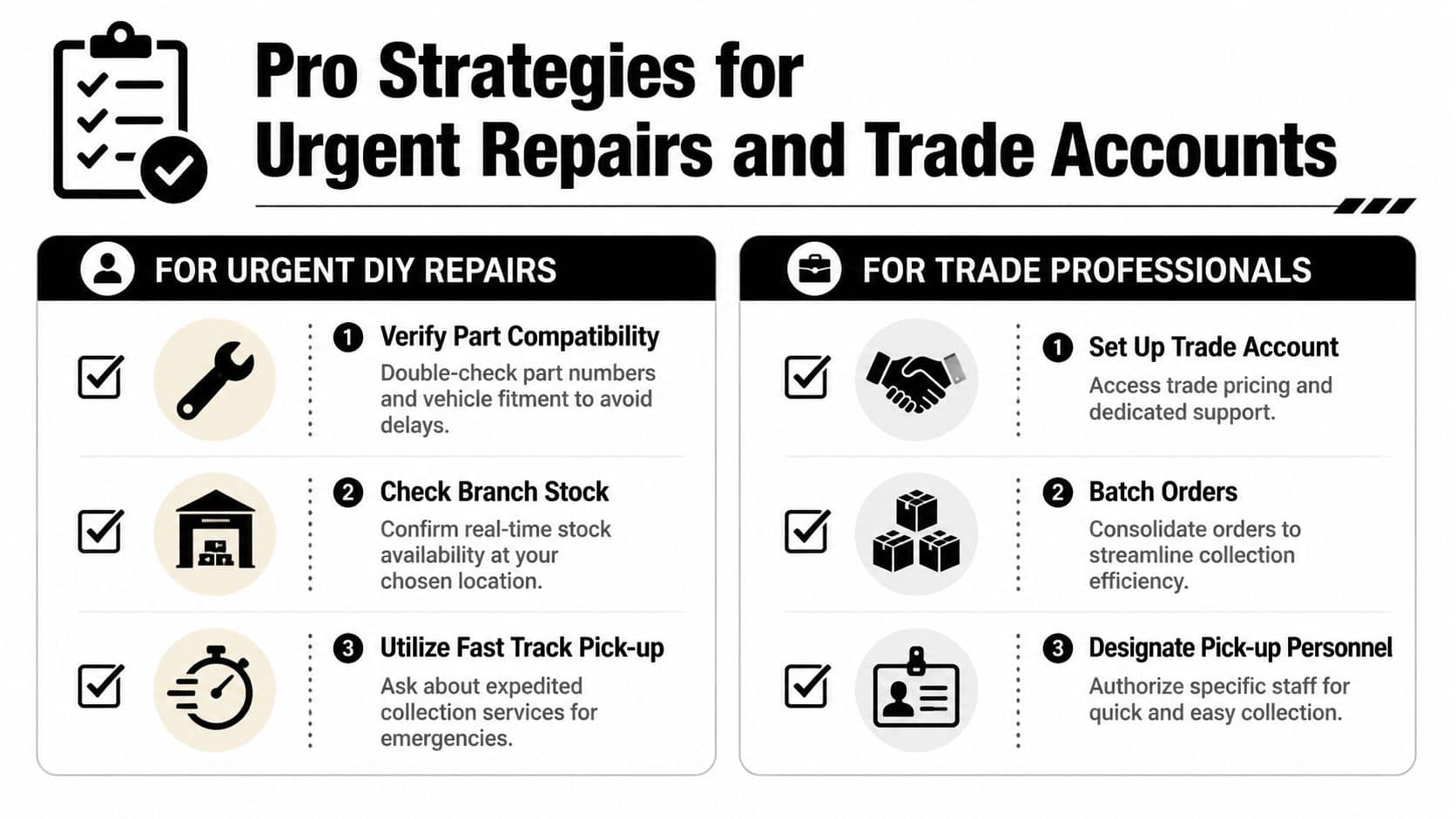
A weekend DIY repair and a busy workshop job don't look the same, but they share one rule. Delays usually come from poor preparation, not from the spanner work itself.
For the DIY driver with a car stuck on the drive
Say the battery dies on Saturday morning, or you pull a wheel off and find the front pads are lower than expected. Click and collect proves its value in such situations. You've got a fault, a vehicle, and a limited window to fix it.
The smart DIY approach is to be ruthless about sequence:
Confirm compatibility first: Don't browse by rough description.
Order every likely consumable: Brake cleaner, fitting clips, screen wash, oil, or bulbs often save a second trip.
Collect before starting strip-down where possible: It's better to have the replacement in hand than discover a mismatch with the car half apart.
A home mechanic should also think about tool readiness. If the job needs a piston rewind tool, filter wrench, trim tool, or torque wrench, sort that before collection day. A part on the bench is useless if the job stalls for lack of kit. For workshop equipment and service tools, the vehicle service tools range is relevant when the repair needs more than just the replacement component.
For the trade user trying to keep work moving
Now take the garage scenario. The car is on the ramp, the customer wants it back, and the technician has already confirmed the failed part. In that case, click and collect isn't a convenience feature. It's workflow control.
Trade users tend to get the best results when they build a routine around collection:
Situation | Strong habit | Weak habit |
Confirmed fault on ramp | Order immediately after diagnosis | Wait until strip-down is complete |
Multi-part repair | Consolidate everything in one collection | Drip-feed orders throughout the day |
Staff handover | Assign who's collecting | Leave pickup unclear and waste time |
Workshops lose time in the gaps between decisions. Good collection habits close those gaps.
For both DIY and trade, the principle is the same. Use click and collect when the repair has a clock running on it, and make sure the order reflects the whole job rather than just the headline part.
If you need car parts quickly and want the option to order online and collect locally, GSF Car Parts offers a practical route for common repairs, servicing jobs, and workshop essentials. Use the vehicle details first, buy for the whole job, and collect with the repair plan already clear in your head.